




A Conversation with Shalini Kantayya (LOVE APPTUALLY)
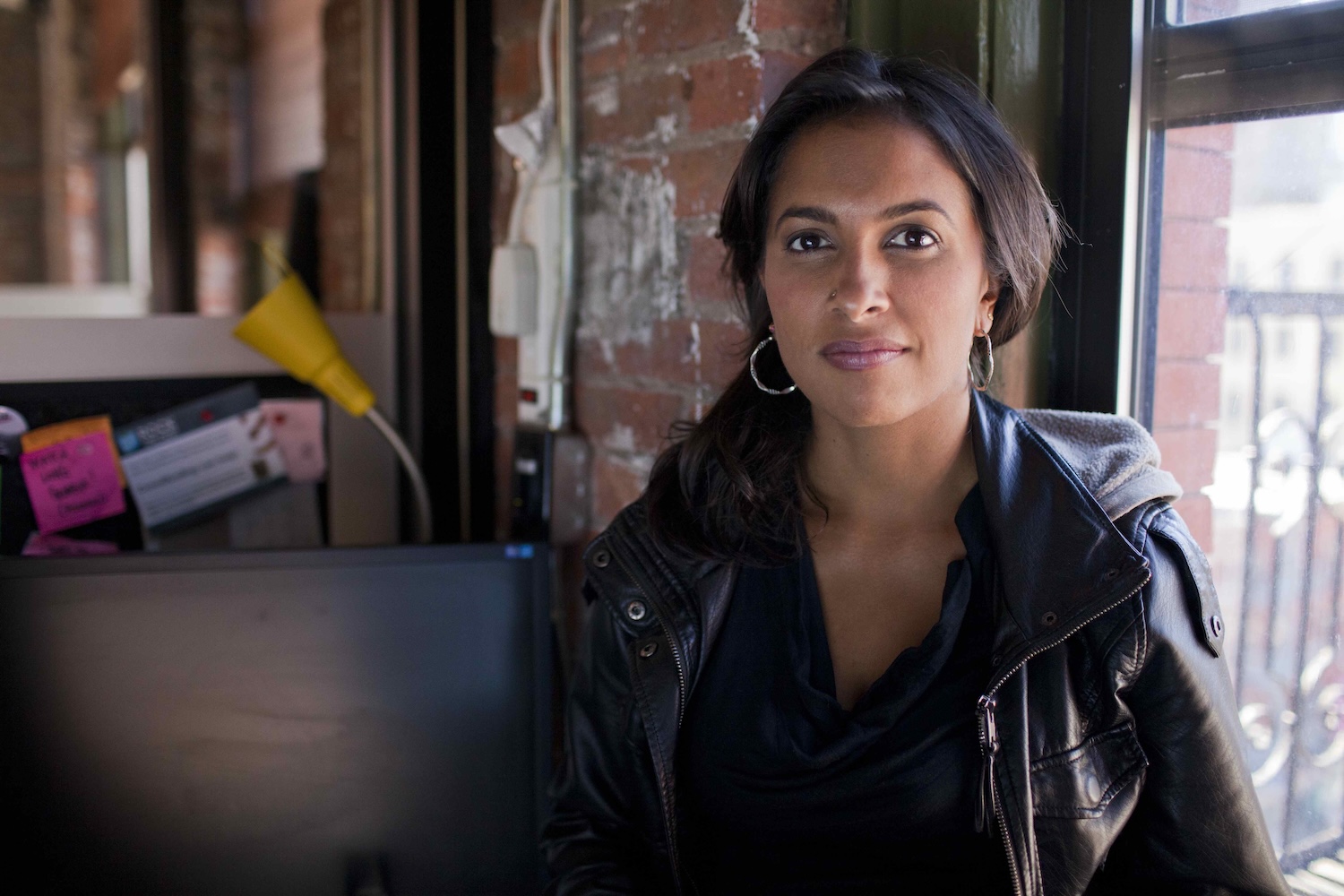
In her latest documentary, Love Apptually, director Shalini Kantayya takes an informed look at how we date in the modern world. Through a series of character profiles, including of French journalist Judith Duportail—who has written extensively on the subject, based on her personal experience and research—Kantayya offers different perspectives on the algorithms that rule our romantic lives these days. I reviewed the film out of the 2026 DC/DOX Festival and then had a chance to speak with Kantayya by Zoom shortly thereafter. Here is that conversation, edited for length and clarity.
Hammer to Nail: As you know, I’ve seen and reviewed your previous two technology-based films, Coded Bias and TikTok, Boom, so I have no doubt about your passion for tech, and we talked about that when I interviewed you for TikTok, Boom. Without getting too personal, I wanted to ask if your own experience with dating apps might be what drew you to this particular topic. In the interest of full disclosure, I met my wife on Tinder.
Shalini Kantayya: Actually, it wasn’t my personal experience. I had never used TikTok when I made a film about TikTok and I had never used Tinder when I made this film. I had some exposure to dating apps, but it was really minimal. It was really through the subject matter and being someone who had seen the landscape of cultural life in New York City change and as someone who likes to talk to strangers that I wanted to make the movie. And I don’t actually think that you need to have ever used a dating app to have been impacted by the way that they’ve changed culture.
HtN: Certainly it’s everywhere in the culture and you don’t have to have used the app to know what it means to swipe right or swipe left; that’s sort of ubiquitous. But given that you wanted to make this topic, how did you go about tracking down people to be in it? As far as French journalist Judith Duportail goes, I understand she’s been writing about this for a while, but how about the rest, people like Jerry Allen Carnegie or Heda Kurtz? What was your process like of finding such people to be in your movie?
SK: Well, I was really looking for a cross section of society, as always. I’m also always looking for voices of the marginalized, because I feel that they can often tell us the most about the impact of these technologies. So it was really important for me to have someone queer in the film and that was done through a casting call and I met Jerry and just fell in love with him. And I think it was also because I’m generally looking for people who have stakes and Jerry is really a hopeless romantic; he was on five apps. And I had a feeling if you’re on five apps and you’re that invested and that engaged, something was bound to happen during the making of the film.
A still from LOVE APPTUALLY
And then with Heda and Alex, I had interviewed the founder of that app and he let me know that oftentimes people will meet, long distance, on that app. And so he came to know of this couple that was about to meet and I reached out to them and they said, “We’re meeting in a week.” And I said, “Can you give me 8 days? Instead of 7 days, can you do 8 days? Because I need to pull together this crew.” And they said, “Yes.” And so we were able to get their meeting.
HtN: So they delayed their meeting for the movie. Wow.
SK: They did.
HtN: Now, how did this person who’d founded the app know that they were about to meet? It seems Big Brotherish when you say it like that.
SK: I think in this case that Nevermet is much more of a community than I would say anything owned by Match Group. And so there’s also a chat room inside of Nevermet where people connect and they are all on a Discord server, which is how I connected with them.
HtN: Gotcha. And then how did you pitch this film to Judith Duportail?
SK: I learned about Judith’s work during the making of Coded Bias and actually, I had not planned for her to be the main character in the film. I had thought that she would be an expert or a thought leader, but then, exactly for the reasons that you pointed out—because she had this very personal experience with Tinder and even was a Tinder enthusiast when the technology first came to France—my plans changed. I feel like she had this really big arc. And also, what she knows about Tinder is just really rare. In all of my films, I’ve gone to Europe because the journalists and watchdog groups that I am following are using European law to uncover the backend of these technologies. That information is not available to me as an American journalist.
HtN: And your film makes the point that privacy laws in Europe are much stronger, which is why she’s able to get the data that she gets. And speaking of which, I watched your film and you do explain it, but I’m still a little unsure on what an “Elo score” is and how it is determined. We learn in your film that, at least for a while, Tinder was using that kind of a score to rate users. I looked it up and I know it’s related to gaming, but I am not from that world. So how exactly does an Elo score work, as you understand it?
SK: Well, as I understand it, it’s based roughly on how chess players are classified. So, if you win against a strong player, your score goes up. And if you lose against a player who’s perceived as not as good, your score goes down. And what happened is that Judith came to know about a Fast Company article where very early on Tinder was talking about a desirability score and, off the cuff, [Tinder founder] Sean Rad tells this Fast Company reporter about this score. And so it’s roughly based off this classification system, which is a desirability score.
And really crudely, really roughly as I understand it, if you match with someone who is considered desirable, your score goes up and if you match with someone who’s considered less desirable, your score goes down. Since then, it’s important to say that Tinder has said, “We don’t use this score anymore, we’ve graduated.” Even Bumble is saying they’re not even going to use the swipe anymore and that they’re going to use some AI system.

A still from LOVE APPTUALLY
But I think what is important here, and what is valuable, is just understanding how hard it is to know what is happening behind the shiny interface of the screen. When we are going there seeking human connection, these systems are operating on a value system that may or may not reflect our own value system. And I think that what’s really important about the film is that these technological systems may be operating on a ranking system that might actually be the opposite of your own values when it comes to finding a partner or even just companionship.
HtN: And this links to the topics discussed in your film Coded Bias, too. You just said that Bumble wants to hand it over to an AI algorithm. That does not fill me with comfort, this idea that AI would be making choices. And again, going back to Coded Bias, what does that even mean? I think it’s Judith who says that the people who score highly in the favorability score are generically handsome white people with a certain sort of income, and obviously there’s a whole world outside of that particular kind of person.
SK: We don’t know what these values are, and what can feel so demoralizing to the more than 360 million people—more than that since I started making the film—that are using these apps is that we don’t know how these apps are operating. And I’ve had Black women say, “I was not getting any matches in the United States and then I went to Denmark and all of a sudden it seemed to operate differently and I was getting matches.” And so what can be really demoralizing is we don’t know what’s happening behind the shiny interface and we can take it really personally because it has to do with our desire for connection, for intimacy, to be seen, to feel close to someone, all of the vulnerable stuff that makes us most human.
HtN: That’s a perfect segue into my next question because Duportail makes a direct connection between how online dating works and the male loneliness epidemic and the growth of online misogyny and the toxic manosphere phenomenon. If you could just recap how she sees Tinder and comparable sites, most of them owned by the Match Group, disadvantaging men in particular.
SK: Well, I think there are several startling revelations in the film, and I had been hearing through just word on the street talking to people around making this film, that heterosexual men have been really feeling disenfranchised by these apps and don’t get matches. And yet again, like we said, because it’s screen by screen, no one can know what’s really happening. And one of the things that I think is so groundbreaking about Judith Duportall’s research is that she actually does this social-science experiment and figures out that heterosexual women get an average success rate of 55% and heterosexual men just 2%. And so this can add to the feeling of frustration.
And what she studied was that there was sort of a thing that happens online when you research “I get no matches on Tinder” where you’re in some rabbit hole of misogyny where they say it’s because of women that you’re getting rejected. And through Judith’s research, what she has found is that oftentimes they expect the men to pay: these companies still expect the men to pay. So if you don’t pay, maybe your profile’s not getting shown to anyone. And so it creates this sort of frustration. And this has exasperated the manosphere in terms of feeling resentful towards women because of these rejections when it could be a result of the way these multibillion-dollar tech companies have rigged the system.
HtN: For how long did you film? We learn at the end of the film, sadly, that one of your principal science experts is now deceased, and I believe she died in 2024. What was the length of your process from start to finish?
SK: I think about 3 years, soup to nuts. It’s not a small undertaking. This is the third in a trilogy of films and they all act as sort of primers on an industry. And I feel like with dating apps, it would be really hard for me to make just a character-driven story because I feel like there’s so much backstory on these industries that we don’t understand. And I also think my films feel like as they meet the world they also meet the zeitgeist. With this film, it starts with the very first predecessors of dating apps on these mainframe computers by IBM in the 1960s with these punch cards all the way to the world that we’re living in where more people are going to have relationships with AI companions. There’s more and more talk of human intimacy with AI in a deeper way than when I began making the film even 3 years ago.
HtN: Which I find deeply disturbing.
SK: It’s deeply disturbing, but I really think it goes to the thing that I’m trying to get at in the film because, for me, it’s about how technology is changing us as humans. I feel what’s happening is that I’ve now made three films about tech and what I’ve realized I think about what innately makes us human is it’s our imperfections and our flaws. And when the sum total of human intellect is in an AI, which is not far off, all we’ll have is our hearts. I think these glossy interfaces—dating apps—were sort of a gateway drug to AI companions, which has become this frictionless, ego-driven, ego-reinforcing, glossy companion to humans.
HtN: We’re not that far off from Isaac Asimov’s Robot series, so we’ll see.
SK: It’s remarkable.
HtN: Your film, despite this at times disturbing subject matter, has quite a jaunty tone with the music and the colorful graphics. Could you discuss the composition of the score and the work you did with the titles and graphics designers?
SK: This film initially had an even more playful tone and I was using a British David Attenborough-style voiceover to play with human behavior and mating and courtship, but I found that the playful tone was distracting from the gravity of some of the issues in the film and I had to make some choices to pull back the tone. But I feel like the musical
score, which is so beautifully done by Gil Talmi and Andrew Gross, really gets to the very ancient dance of love that is across all species and the mystery of mate selection and the playfulness of it all and the awkwardness of it all and the farcical nature of it all.
And as for the titles and graphics, I grew up watching classic American rom-coms with my family on every holiday. And so I was really raised on 1980s rom-coms, with all of their problematic heteronormative norms. The film really draws from that ethos of romance in the culture and even the cringey stuff, because I feel it’s so much part of the ethos of modern love.
HtN: Shalini, thank you so much for talking to me.
SK: Thanks so much for taking the time and thanks for watching all my films. I really appreciate it.
HtN: Absolutely. My pleasure. Take care.
SK: Be well. Bye-bye.
– Christopher Llewellyn Reed (@ChrisReedFilm)