




Q & A with Olivia Wilde from SIFF ’26 Closing Night (THE INVITE)
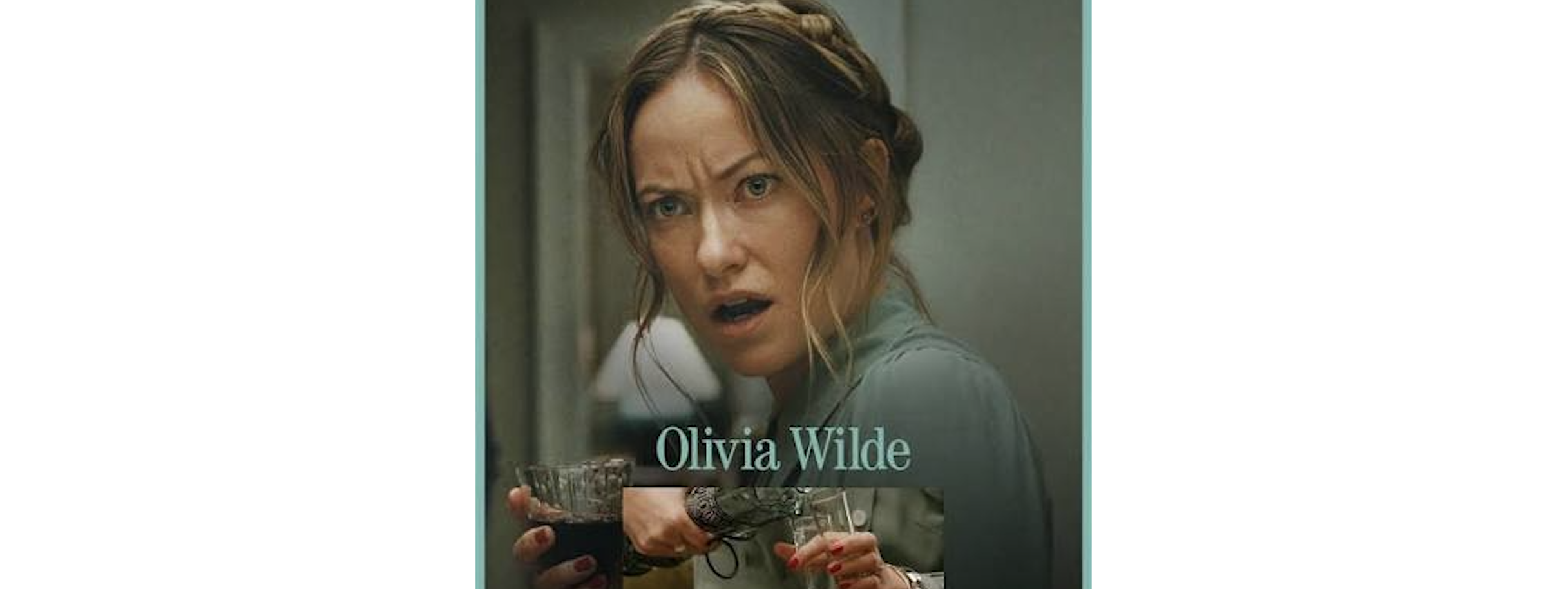
The 2026 Seattle International Film Festival closed on May 17th, with a special screening of Olivia Wilde’s third film, The Invite (which I also reviewed) at the SIFF Cinerama in downtown Seattle. It’s a micro-cast dramedy in the style of Mike Nichols, told over the course of one fraught evening, as two couples confront some awkward truths about their relationships. Wilde also introduced the film and was very pleased to announce that the audience was about to see a 35 mm print of the film. The Invite was indeed shot on 35 mm, and it makes a great case for bringing back proper film production. Sadly, when the film goes to wide release, it will be projected digitally, so this was truly a special experience for the sold-out SIFF crowd. After the film, SIFF Artistic Director, Beth Barrett, engaged Wilde in an enlightening Q & A. She discussed the film’s influences, the benefits of working outside the studio system, and the joys and challenges of shooting a film in chronological order with continuous improv and collaboration from all four actors. This is Wilde’s best film yet.
The following transcript has been edited for clarity.
Olivia Wilde: It’s an honor to screen this film at SIFF… And I’m here on behalf of the entire team that put this together. There is something very excited about tonight that I am thrilled to announce, which is that you are gonna watch The Invite tonight on a 35 mm print.
[Audience cheers]
O.W.: It was a big deal for us to shoot it on film and it’s very fun to be able to show it the way it’s meant to be seen… [I’ve been] told something really extraordinary, which is that this is the first 35 mm print to be projected [at Cinerama] in over a decade.
[Audience cheers]
O.W.: I hope that you enjoy all the beautiful idiosyncrasies of film and everything makes it an entirely different viewing experience in my mind. This movie is a love letter to so many filmmakers who have inspired us all. It’s really a tip of my hat to Mike Nichols and I think and any of you who love Mike Nichols as much as I do will recognize that very quickly… and several other filmmakers. But really this is a love letter to film and to film lovers themselves. So, thank you for being here. Please… have a good time and laugh… uh… if you feel inspired to laugh.
[Audience laughs]
Don’t feel bad if you don’t. Just do it if you feel like it. One thing I’d like to mention actually… This is a fun way to contextualize the experience for you, is that this movie was done in a kind of experimental fashion where we gathered as a very small crew, and as a creative team. And we workshopped this material, which is based on a Spanish film called Sentimental by a great filmmaker named Cesc Gay. He wrote a play. He then adapted the play for film. Rashida Jones and Will McCormack then adapted that into a screenplay. And then Edward Norton, Penelope Cruz, Seth Rogen, and myself got to gather with our writers and workshopped together for two weeks and then make this film in order so we could continue to workshop as we shot the film. None of us had ever shot a film in order like that and it was a totally different atmosphere and experience. So that’s a little tidbit bit for you guys while you watch. And I’m very, very grateful and I look forward to having a conversation after the film, if you guys can stay for a little Q&A.
[Audience cheers]
The film looked absolutely stunning on the Cinerama’s huge screen and the audience did indeed find many occasions to laugh and cry.
Beth Barrett: Please join me in welcoming back director and star Olivia Wilde.
[Audience cheers]
Olivia Wilde: How good was that “Our House” demo? [The song that plays through the end credits is a 1970 demo of “Our House” performed by Graham Nash and Joni Mitchell.] It’s so good. It’s the first time they license that [for a film], which was a huge honor for us… It’s totally trying to praise your heart strings because of course Graham Nash and Joni were so in love. And maybe the point is that love stories aren’t meant to last forever. I don’t know. But every time I see audiences listening to that demo, it makes me so happy.
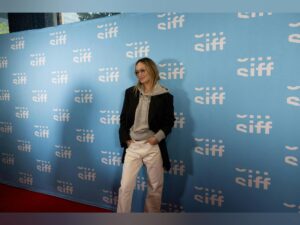
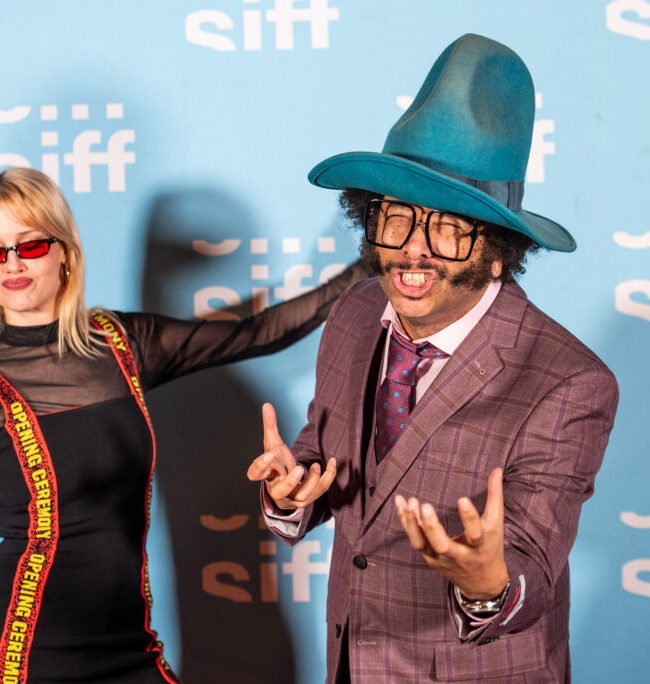
Olivia Wilde, closing night of the 52nd Seattle International Film Festival
B.B.: First off, it’s a beautiful film. It’s just a gorgeous film. And it’s so contained. It’s that beautiful chamber piece like Rear Window or Who’s Afraid of Virginia Woolf, where explosive things happen because they’re contained. And I’d love to hear about the apartment and about finding that space to tell the story.
O.W.: I love how you put that. “Explosive things happen because they are contained.” And I think that’s clarified that’s a [good way] to describe marriage.
[Audience laughs]
The challenge became our greatest asset. The challenge of the limited space was, I think, what probably scared a lot of people off of this project. I got really lucky because it came to me and I called up some of the most brilliant people I know: Our cinematographer, Adam Newport-Berra; our production designer, Jade Healy and I said, “How do we make a contained space feel interesting and like a labyrinth.” And then, together we embraced it as this really exciting challenge. And I think it’s a testament to the work of this crew that you feel like you’ve travelled somewhere… hopefully.
But yes, the films that inspired us are those great films, like Virginia Woolf, which is kind of the North Star of this film. And the original Spanish film is of course also set in one apartment – a very differently designed one. But I admired that undertaking and I thought, “Lets find our own way through that.” It was because of that that we were able to shoot in sequential order. So, again, the challenge became our greatest asset.
B.B.: So, the original Spanish film was based on a play. And I can actually see your film being turned into a play because it has it feel of… You know, you move from one area to another in a really interesting way and so much of that is about the dialogue. Rashida Jones and Will McCormack‘s dialogue. Did you all stick to that dialogue in those weeks of prep?
O.W.: It was a living, breathing thing. So, the workshopping process… The two weeks before we filmed, Rashida, Will, Penelope [Cruz], Edward [Norton], Seth [Rogen] and myself sat around and we just kind of chewed on the material together. And I would say it changed a lot in those two weeks. And we personalized it. Everybody was just sort of confessing all over this movie, you know? Which is appropriate because that Thelonious Monk song they played on the piano is “I’m Confessin’ (That I Love You)”. And this film was just confession from everyone. And it was, like, incredibly therapeutic and cathartic for everybody. But we personalizing it in a way that was thrilling and that process continued through the film. So, there’s a lot of improvisation in the film.
I have to share… because I think it’s so thrilling… One of the parts I’m so stunned by – among others – is the story that Hawk [Norton] in the third act was entirely improvised by Edward. And I was in complete awe of that moment. He came to me as we were filming… We were filming in order so, it was about a week out from [shooting] that scene… He knew that I needed a kind of ramp from some of them were comedic tonal points to the dramatic place we were going. He said, “I have an idea. I want to tell a story, but I don’t wanna tell you [ahead of shooting].” And I said, “Don’t tell me, because I can hear it for the first time on camera.” And we’re shooting on films so I said, “How long, roughly [audience laughs] do you feel like it is?” And he was like, “I don’t know…” And I was like, “Okay. We’re gonna put a 1000-foot mag on this on this camera and we just rolled… Well, actually two cameras. It was the only day we had two cameras. And the reaction I have on camera is my reaction to hearing [his story] for the first time. So, that’s an example of the improv that… It wasn’t just jokes, but there were tons of improvised jokes. But people really coming up with… having real authorship. And it was so incredible to feel the true results of collaboration when people actually trust… Which takes a lot of trust from producers who had never worked within the studio system. There’s no way a studio would’ve let me start a film without telling them what the ending was gonna be. No way.
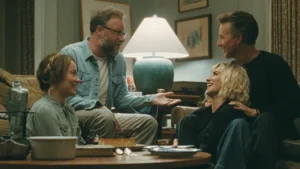
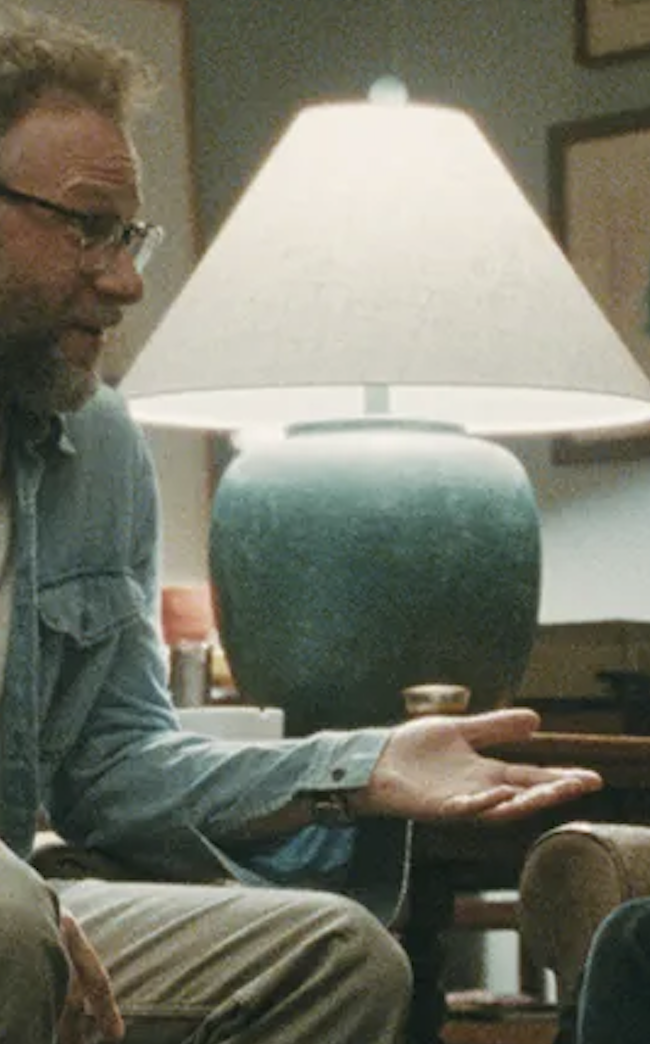
A still from THE INVITE
B.B.: You know, you can only accomplish it because you’ve got such great actors with obvious chemistry. And the four of you have obvious chemistry together. Was it always gonna be the four of you?
O.W.: No. It was definitely not gonna be me. My dream cast was them. But I was like, “Who should we go to for Angela?” And there were all these brilliant actresses who would’ve been great and I kept suggesting them to the group. And they weren’t, like, really getting back to me… They weren’t making choices. And I was like, “Guys, we have to cast Angela.” And they got together, and they called me, and they said, “We’ve decided that you should play her.” And I was stunned because I just thought, “In what world can I act with you guys?” Like, somehow, I felt capable of directing them but too terrified to consider being their senior partner. I don’t know why. But I just never would have thought of it. So, it was because of them that I’m in it. But they were, like, my dream cast… Seth, I worked with on The Studio [Apple TV] … It’s funny, because we were working on The Studio, we were shooting nights and he just off hand was like, “I think I’m done acting in, like, friend’s movies. I’m not gonna do that anymore.” And I was like, “Really? What if you did one more?” And I gave the script to him and I said, “What if we do this as, like, an experiment? We shoot it in order. We improvise, we write, we workshop it together…” And he was like, “…OK I’m down.” And there is no The Invite without Seth. There is no movie without Edward or Penelope because you can tell that they authored those characters. It’s so deeply them. I mean, Edward’s character was originally named Lance and he didn’t have any of those layers. He gave it so much texture. He’s obviously, like, the G.O.A.T., so it’s not surprising. But it was so generous of them to remain so engaged at all times. I’ll just say for any filmmaker here, you know, sometimes your actors… you can expect them to come and work when they’re on the clock, but they don’t always remain engaged 24 hours a day throughout the entire process. And these guys would go home and think about things and come back in the morning and say, “I have a new idea. I’m gonna try stuff.” And it was like that every day. Penelope came up with the whole Sadé scene. She was like, “I think that I should sing to him.” And I was like, “This is a gift. I did something good in a past life to have this.” I was so happy. And I was like, “But I’m sure Sadé’s gonna be really expensive.” And she is. And she should be. And so… I mean, I could go on. But they just kept giving and giving and giving.
B.B.: So, shooting sequentially… Did those characters change from where you thought they were going to be from the beginning to the end? Because you have this sort of broad idea about where it’s going to end. But with improv and people coming up with new thoughts, was there something really unexpected?
O.W.: Yeah, so like Edward’s a good example of that. That Hawk story was totally unexpected to me. And another example of that is Pena (Cruz) and Hawk and their fight… That was something developed as we were filming in it and it was… We didn’t want to vilify the idea of conflict within relationships because it’s not about not having conflict. It’s about how one deals with it. We wanted to celebrate rupture and repair. But the way it would manifest was kind of mysterious to me until we got closer to it…
Seth and I realized that we were so… like, our characters were so verbose, even in our improv with each other. There are so many moments where we’re speaking simultaneously. And Seth and I found that we could almost, like, harmonize with our improv and hear each other at the same time as speaking. We are having so much fun with it. And we got to the last scene we thought, “How would they really fight?” And we thought, the most tragic thing would be for them to have no words… One thing that surprise me was the amount of silence that felt right, which meant removing huge swaths of dialogue, which again took a lot of trust from the Powers That Be. And I’m always so grateful that audiences hang with us for that silence. It just moves me that people are patient and listen and… You know, studios assume that audiences don’t have that kind of patience, and it’s obviously bullshit.
[Audience claps]
B.B.: So, with your filmography… you start in high school with this coming-of-age [story] (Booksmart). And then you move to a young adult suburban… you know, what you think the future might be (Don’t Worry Darling). And now you’re sort of in this married, middle aged…area. But all of them are about women. All of them about the stories of women… how we age, and how we interact, how we change. I mean, nobody talks about Perimenopause in movies. So thank you.
[Some audience cheers from real ones]
What makes that so satisfying for you?
O.W.: It’s so liberating to prove that men are just as interested in women’s stories as we are. And it’s so great when… Booksmart is about two teenage girls, but I’ve had just as many men come up to me and tell me they love that movie. And it just proves over and over again that we’ve over-gendered film in this way. And it’s become so binary and it’s become really exclusive. And I love that I have the opportunity with this job to – if I’m lucky – to be able to show that over and over again. Again, not underestimating the audience in that way. And I think exploring relationships in these different movies in different ways. They’re all about the combustion point of relationships. Kind of realizing that we don’t know everything about someone. And how can we move past that? And it’s inevitable that you explore these things as you’re kind of exploring them in your own life. And yeah… To go from high school to dystopian incel manosphere to [laughs]… to that middle-aged love in San Francisco… it pretty much mirrors my own experience.
[Audience laughs]
B.B.: I wanna shout out the soundtrack and that cello [score]. It is so extraordinary. Because the tension… like, everyone’s yelling at each other there’s lots of messy emotions flying. And there’s a cello just amping it up to 11.
O.W.: Well, Dev[onté] Hynes who’s the genius behind Blood Orange… He is an incredible cellist. And when I went to him, I said, “I want this score to feel disproportionately dramatic. I want it to feel like it’s the Greek chorus reflecting the emotional mistakes. Sort of like, the bow is playing the nerves of these characters.” And he completely understood. One of our references was Force Majeure and how Ruben Östlund used [his score]. It immediately tells you you’re in a much more dangerous, higher stakes world than one might assume from a kind of domestic situation.
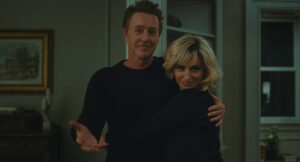
Edward Norton & Penelope Cruz in THE INVITE
And that’s another creative choice that, just in celebration of independent film, would not have been supported, I think, at a large studio at all. And I loved that we were allowed to be bold with it… It makes so much sense for the movie. It felt so right to me. It was the kind of thing where no one really understood what we were doing until we were done with it… But I’m lucky enough to kind of mind meld with this great artist. We found it together and I’m just so happy that people are connecting with it because we’re gonna press that score on vinyl. And I want people to be able to listen to it and be able to go through their own kind of existential dramatic crisis.
[Wilde and audience laugh]
B.B.: So, 35 mm… Thank you for shooting on 35 mm. It’s a beautiful medium…
[Audience claps]
You know there’s that sort of classic movie feel that creates an intimacy… The 35 mm creates an intimacy that I think digital can’t. Because there’s a sharpness, but a muted-ness. And it’s in conflict constantly… Does that resonate?
O.W.: Totally. I think that’s exactly what it is. Also, 35 mm activates a different part of your brain. It’s an active/interactive experience when you’re watching film. You’re filling in gaps between frames. You are participating. You ever wonder why when you watch a four-hour film or a three-hour film on 35 mm film and you’re really exhausted; but you can watch, like, seven hours of scrolling digital media and somehow, you’re like shockingly sort of OK? It’s because your brain isn’t participating in the same way. There’s something about the magic of film that lights us up in a different way that’s a much more interesting experience, even subconsciously. And it’s part of the magic of production, as well. I always say that shooting on film makes acting a little less embarrassing. Because you hear the film rolling through the camera and it almost puts this… kind of like spell on everyone. So, it’s like you hear the film roll and everyone’s like, “OK. It’s okay to completely depart from reality now.” And we’re all in kind of this hushed understanding of what’s happening. I think it also makes people rise to the occasion. Actors certainly feel that. And I just think that audiences appreciate the… kind of, imperfection of it. And the fact that… when you watch it projected, you are seeing… It’s almost like watching a live experience because it will never look like that again. You’re watching this specific interaction of this projector; the light going through the film at this rate; the grain is actually moving. It’s not established print that’s digitally created. It’s a very different experience and there’s an Uncanny Valley Effect… when you watch a digital print. Like you said, [you have] a very muted experience.
B.B.: I need to call out the trailer because it’s so great. Because it is like, “What is happening here?” But you don’t get too much information. How much control do you have over the trailer?
O.W.: Well, I’m really lucky because the good folks at A24 are incredibly collaborative with their filmmakers. And we worked with a trailer house in L.A. called GrandSon, who are very talented. And my dream was that we would make a trailer that [would make] people think that, like, maybe everyone dies. And they were so open to not giving everything away. And, with a comedy like this, it could be so easy to ruin every joke in the trailer. And I was so grateful that they were very collaborative. We went through many versions, and it was so much fun. The same thing with the poster. Our first poster was just a window with our names… When they first showed me the poster, it had our faces in it. And I was like, “I have a pitch. What if it’s just none of us, and it’s just a window with our names on it,” And they were like, “Ooookay…” When you work on a film like this… it’s so clearly ingrained so deeply in all of us. We really feel like we know the story. And I really feel like I know what I want audiences to discover in the moment. And… it’s not like there’s a big twist that’s gonna ruin it. But I do want to maintain some sort of surprise. And I’m grateful… You know, to make noise in this world when you’re up against all these giant movies… To have a trailer even be seen is a real coup. And I’m grateful that anyone’s noticed it at all.
B.B.: Which leads me to… The film is coming out in theatres late June?
O.W.: Yes. New York and L.A. limited is June 26th. And then it goes a little wider from there. I believe it’s out here [Seattle] July 3rd. And then it goes wide wide, July 10th, against a little tiny independent movie called The Odyssey…
[Audience laughs]
…that some people may also see. We’re really lucky that we get to be in theatres with a wide release. And we hope to be able to be in beautiful theatres like this [SIFF Cinerama]. But it entirely lives and dies based on word of mouth. It’s been incredible to be able to take it to film festivals like this. To be among the films that you guys have programmed for this festival is extraordinary. Film festivals are the best. I could just go to film festivals for my entire life and be happy. This is the best part of making movies. I don’t know what else there is. The box office? That just feels scary and stressful. This experience is why we did it. So, I’m so grateful.
B.B.: Well, thank you. Thank you so much.
– Jessica Baxter (@TheBaxter)