





HADESTOWN: THE MUSICAL
(Check out Brandon Wilson’s Hadestown: The Musical movie review, it opens Thursday, July 23. Seen it? Join the conversation with HtN on our Letterboxd Page.
Is it any wonder given the events of the last five years (of this century, really) that we are turning more and more to tales from antiquity? So much of what we have believed could never happen has happened. So much we thought we had transcended was merely lying dormant. And in trying to cope with all of this, stories that span the millennia have a special place for us. They tell us who we were, who we have always been, and they remind us that all that is happening now will one day be ancient history for someone else to unearth.
Just as Christopher Nolan’s new film of The Odyssey lays siege to the box office, Hadestown: The Musical, a filmed documentary of director Rachel Chavkin’s eight time Tony-winning production of the musical by Anaïs Mitchell (who wrote the book, music, and lyrics for the show) is coming to theaters for a five night run starting July 24th. The performance was recorded at the Lyric Theatre in the West End of London in 2025, directed by Australian filmmaker Brett Sullivan.
Sullivan documented a special revival of the show that featured the cast and crew of its 2019 Broadway production which won Tony Awards for Best Musical, Best Original Score, Best Featured Musical Player (for legendary actor André De Shields), Best Scenic Design, Best Lighting Design, Best Sound Design, Best Orchestrations, and Best Direction of a Musical. So the audience for the film is a huge and integral part of the film. They are fans of the show who are enthusiastically reveling in the chance to see it done by the team that made the musical a phenomenon. Sullivan’s documentary excels at capturing the energy and excitement of seeing a Broadway show with people who live for that experience.
Unlike the recent filmed version of Sondheim’s Merrily We Roll Along which filmed before a live audience but never showed them or any behind the scenes footage (and often used close-ups and editing in ways to make the film more cinematic), Hadestown: The Musical opens with observational footage in a way that makes the filmmaker’s intentions clear. This film is a celebration of the musical theater experience. To that end, we start with the crowd outside the Lyric Theatre and then we cut to quick glimpses of last touches backstage. The stage is not expansive, but the team has made the most of it with expressionist lighting, a staircase and balcony reminiscent of A Streetcar Named Desire, seating for the musicians who are part of the show, and a turntable on the stage with an outer ring that can move in such a way that performers are able to walk and stay in place, and a center that can descend or ascend as the story demands it.
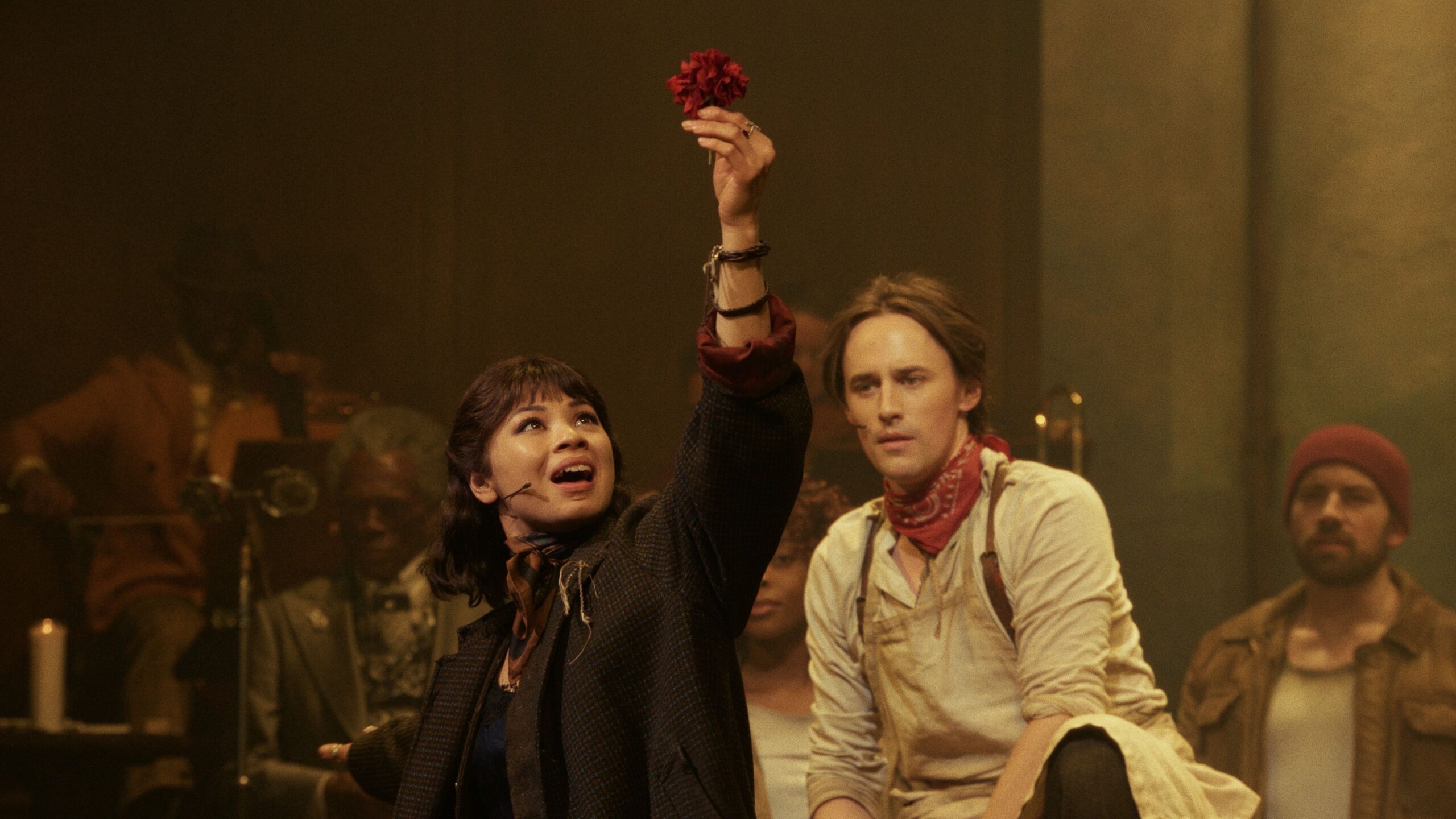
There’s a thunderous ovation when De Shields emerges. He plays Hermes, our master of ceremonies, who tells us the story of Orpheus (played by Reeve Carney) and Eurydice (played by Eva Noblezada, Carney and Noblezada married after meeting on the show). The mythical Greek musician is re-imagined for this New Orleanian early 20th century setting as a guitar-strumming troubadour whose collectivist ideals and red bandana suggest he is a labor man. But he’s too much of a luftmensch to be an organizer. The object of his love, in contrast, is a survivor with her feet on the ground and her eyes searching for her next meal. This is a piece all about contrasts. There are clashes between idealists and pragmatists, between men and women, between labor and capital, between youth and age, between mortals and divinity, between hope and despair. Some of the characters even embody such contrasts, particularly Persephone (played by Amber Gray), a tragicomic character who is both Queen of the Underworld and the Bringer of Spring. Her husband Hades (played by Kevin Page who returned to the production after an injury; he wears a boot and uses a cane and it really works for the character), the King of the Underworld is, in this telling, an oil and coal magnate whose workers are under his thrall. He is the nominal villain of the piece, but Page gives him a humanity that keeps Hades from being merely a two-dimensional plot conceit.
Given the ubiquity of the two myths surrounding these characters, I don’t think it’s a spoiler to say this is not a musical with a happy ending. It is instead one that says sad songs have their place in our lives, even if we hope each time we sing them that maybe it will end differently this time. This is nothing less than the human experience itself.
The film gives us all a chance to be a part of the ephemeral experience of a great show, and marvel at the gifts of the performers. Noblezada’s number “Flowers” (early in Act 2) is for me the emotional heart of the show. The performers are all off on other shows right now, such as the recent Great Gatsby andCats: The Jellicle Ball, but Sullivan’s film will endure to remind us tragedies have their place and spring always returns. And these days, that can be easy to forget.
– Brandon D. Wilson (@GeniusBastard)