


A Conversation with Charles Melton & Nicolas Winding Refn (HER PRIVATE HELL)
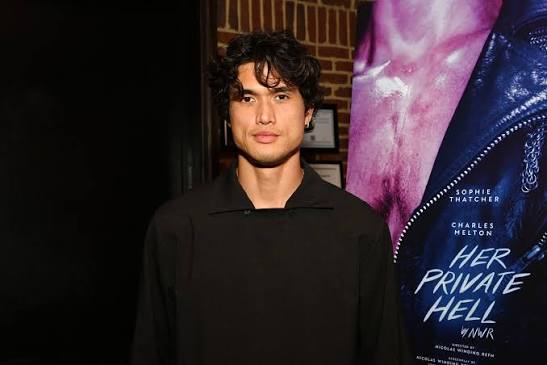
Below is a spoilery add-on to Jack Scehnker’s earlier conversation with Nicolas Winding Refn and features one of the stars of Her Private Hell, Charles Melton. Be sure to check out the full Winding Refn interview here.
****SPOILER WARNING!!****
Hammer to Nail: I’d love to discuss the opening moments for Charles’ (Melton) character. We transition over to your storyline through this metaphysical connection you and Sophie have. You both smoke your cigarette, Private K slicks back his hair. Then we see him in a dark space eating a meal, smoking super seriously. Your narration tells us that the Leatherman took your daughter and you’re searching for him as you roam the dystopian streets. As you approach a small clothing shop, a police officer spits at your feet and calls you a Yankee. You walk into the shop and give the owner a copy of a comic book. Hidetoshi Nishijima approaches the counter, and you guys have this great exchange where you give him the Private K lighter and say, “compliments of Uncle Sam.” Can you talk about what was important to both of you in these introductory moments of Private K and also collaborating with Hidetoshi?
Nicolas Winding Refn: Well, Hidetoshi is probably one of the greatest Japanese actors. One of the reasons why I wanted to have a Japanese angle on the film was because I really wanted to work with him. He agreed, which was terrific. But the way you describe it is very interesting because it’s really all about, you know, it’s almost the alter ego of Elle, the same way that Charles is my alter ego in the film or my obsession as Sophie or Havana or Christine.
The idea of this foreigner in a strange country that’s so alien at that time especially has almost a science fiction feel to it, even though it’s part of the past. Because I could build the city on stages, it became artificial. That gave him almost like he’s floating through space and time within the mist, looking for a glam monster that took his daughter. So he’s like the perfect father, but it has pop iconographies like comics and cigarettes and hair. Very sexualizing elements at the same time. So that it almost becomes a kind of Voyeuristic experience. I remember when I was very little, there was a Woody Woodpecker cartoon that I really loved where Woody Woodpecker is on a boat and he’s being captured and he’s going to get killed. Before he gets killed, he says, “Can I call my uncle?” The guy says, sure and Woody Woodpecker takes the phone and calls his uncle, says, “Uncle Sam, help!” Then obviously the planes arrive. I thought that the idea of, “compliments of Uncle Sam,” was a way to obviously have a sense of imperialism and what it means to be an American at that time, which again added to the science fiction nature of the whole storyline.
Charles Melton: Wow. Woody Woodpecker. Who would have thought? That’s amazing. With Private K, all these things that you mentioned when we were introduced to him, the combing of the hair, the kind of rigidness, it’s all this attempt to control this pain that lives deep inside of him. He’s a superhero. He’s been discharged from the army. I don’t know if that’s clear in the film, but we talked about it. He’s been discharged, but his uniform is his Batman costume. This is my first superhero film, and it’s with Nic Winding Refn.. But it’s all those things of just containing this drive and this rage, this hope and this love to be reunited with his daughter.
HTN: Absolutely. Like you said, Private K is Elle’s imaginary alter ego, possibly even a part of you, the father she wishes hers was. Charles, you and Sophie really only share that final scene together. How did you calibrate playing someone who is essentially part of her interior life? Did you watch her performances during the shoot? Did she see yours, or were you working in isolation and trusting Nic to knit that together? Can you talk about collaborating there?
CM: Trusting in Nic and the isolation in our world. Nic treated it as its own film, and simultaneously, there were parallels that were happening that Nic was aware of, in filming, because the script was so alive that there was no script. It changed, it constantly evolved. This atmospheric setting, when I stepped onto the set, you’re in this unreality, this world. As an actor, it’s like there is no structure or confines to what you can or cannot do, and to shoot that in order and just to be in the moment with Nic. It’s complete trust in Nic.
HTN: He’s a good person to trust! Nic, you mentioned to me previously the utility belt, the whole GI iconography, as part of how Private K gets objectified. Charles, when you put that costume on for the first time, how did it change your body? Was there a specific piece, the boots, the belt, the jacket, that unlocked the character for you? And specifically, the way you adjust your jacket, was that something in the script or something you found in the character?
CM: That is something we found in the character, right? The adjusting of the jacket. Love that.
NWR: I think it was by accident in a way.That’s great, Charles. Run with that. So we did it every time. Then it became part of his mantra that he always had to fix his suit and look presentable.
CM: Going back to what I was saying earlier, he’s trying to contain. When you put on the costume, when you put on the jacket, boots, your hair is done a certain way, there’s just something about it. Private K is very specific and particular, and he does everything a certain way. That was what the process was like too when I was in hair and makeup and costume. All of that just feeds into who Private K became. That was his exterior, which was the metaphor for what he’s trying to contain that we see unleashed. There are certain scenes where he’s just adjusting himself or combing his hair. It’s all your astute projection or interpretation. That’s what the movie is.
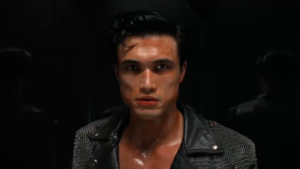
Charles Melton in HER PRIVATE HELL
HTN: These final moments are really incredible. The Leatherman stalks Sophie in our crystal sci-fi realm. Then, with your slicked back hair, shirtless in your own leather jacket, you appear out of the mist to face the Leatherman. The Leatherman turns, his eyes go red. The camera pushes up into your face, and we intercut with Sophie’s face, eyes bulging out of her head. In slow-mo, as triumphant orchestral music plays, you two face off. You put up a valiant effort, but the Leatherman is too strong. Before he can finish you off, Sophie runs in and chops his arms off. This leads us into a very emotional and impactful ending as Pino’s score pierces the soul and your daughter appears. In your final moments, you’re back in your Private K uniform, cleaned up from the fight. You give your daughter a little nod, hold her hand, and disappear. Can you walk us through crafting these final moments and just what was most important to both of you?
NWR: Well, we were running out of time. So it was about getting it right, production-wise. I think that at that point in the film, everything was so instinctual, that it became very easy for us to work. It was always a very easy film to make in a way because all the actors were so amazing and to collaborate with, and they were game. I had this idea that when we do see the daughter, it’s actually Elle’s lover as a child. So it adds another sense of her own personal demons that she’s struggling with, her own private hell. But in a way, like a fairy tale, everything had to come back to perfection. Everything that Private K went through has a finale of success and beauty. He gets what he wants, he gets what he desires. That’s her story, in a way. That’s Elle’s narrative. But it never stops because it will always continue to haunt her, which is the father figure, the complex story that we will always die with our issues. We’ll never really resolve them. We may be able to live with them. That’s obviously what the ending is partly about.
CM: I just put two and two together with Elle’s young lover, Private K’s daughter. See, you learn something new every time. I remember shooting that moment. Nic, not only is he creating this world with color and the lights and the textures of that, but he would always play music. I remember that moment when we were filming. Nic was just talking to me. Music was playing, and he was just talking to me. I don’t want to share too much because it’s very special, but it’s beautiful. At that moment, I’m listening to Nic just talk to me about what he was talking to me about. And I’m seeing my daughter.
HTN: Well, can you guys please work together again cause you just bring the best out in each other.
CM: Oh for sure, we will work together again
NWR: Definitely.
– Jack Schenker (@YUNGOCUPOTIS)