


A Conversation with Nicolas Winding Refn (HER PRIVATE HELL)
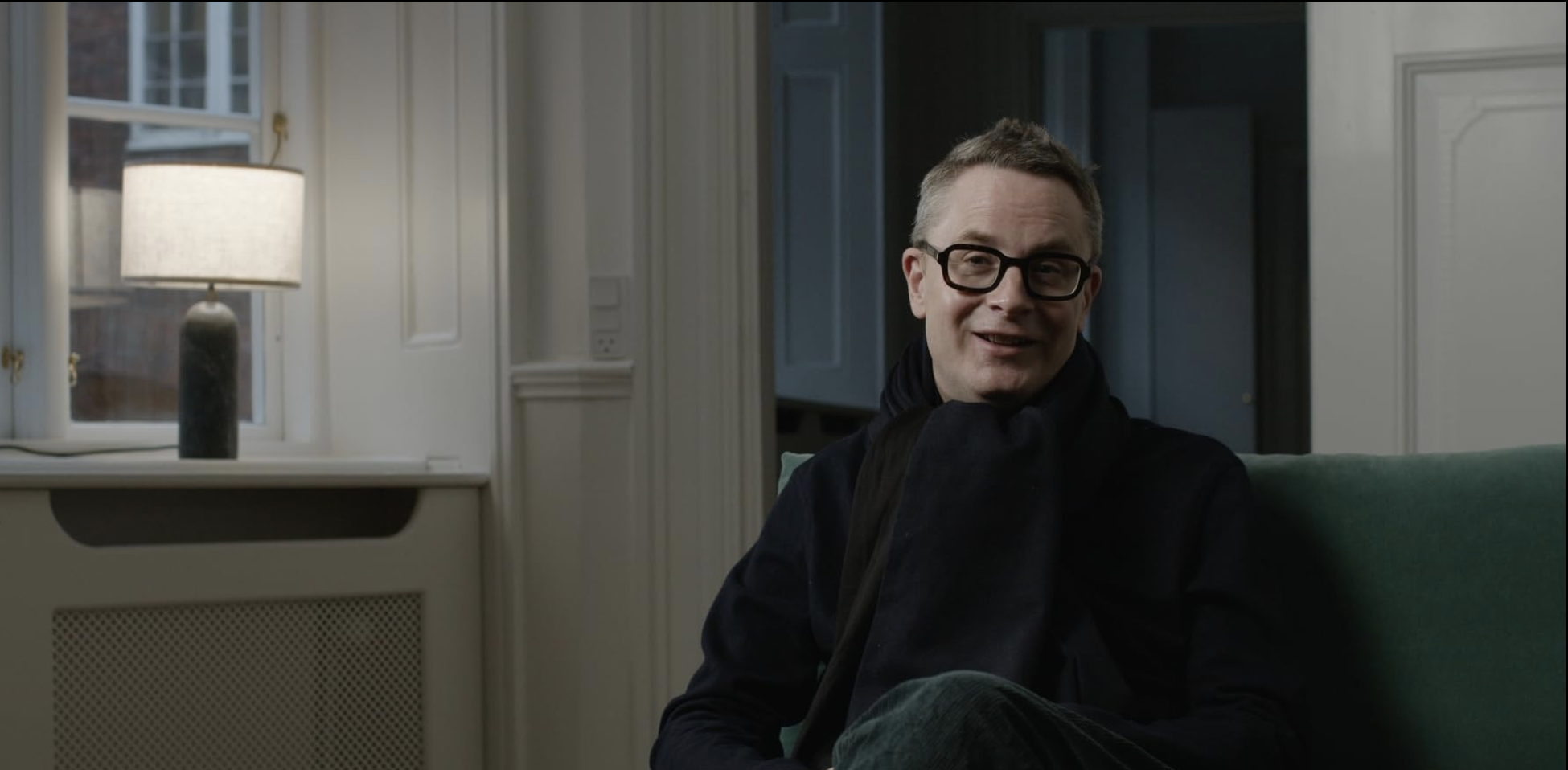
Nicolas Winding Refn has been one of my favorite filmmakers since I first saw Drive as a kid. In the years since, I have watched every Refn picture across every format he has worked in, from the grainy Copenhagen of the Pusher trilogy, through Bronson, to Only God Forgives, The Neon Demon, Too Old to Die Young, the Prada commercials, his restoration work with BYNWR and Copenhagen Cowboy. It is his Post Drive work that resonates with me most deeply. With each feature he has established a signature style marked by, an obsession with surface, with violence as ritual, with light as a language, bassy, synth filled scores and yet each mutates the formula past the point where lesser stylists would settle into self-parody.
Her Private Hell, his first feature in a decade, arrives at Cannes Out of Competition carrying the weight of a personal reckoning. It is the closest thing to an opera Refn has made, scored not by longtime collaborator Cliff Martinez but by the legendary Pino Donaggio, the Italian maestro behind Don’t Look Now, Carrie, and decades of work for Argento. The film follows Elle, played by Sophie Thatcher, an avoidant young actress shattered by her father’s marriage to her former best friend Dominique, played by Havana Rose Liu. Threaded through her story is the parallel journey of Private K, played by Charles Melton, an American GI traversing an underworld in search of his lost daughter. The two narratives, one a neon-noir action thriller and the other an operatic melodrama, knot together into something that resists genre even as it bear-hugs its inspirations.
The only thing I am more obsessed with than NWR’s post-Drive output is giallo. Coming into this film knowing it would be Refn’s giallo, I could not have been more pumped. His sensibility and the genre go hand in hand, the fetishization of surface, the over the top violence, the color, the leather wearing killer stalking, the camera as voyeur etc. Donaggio’s score is a character itself, often taking over the narration entirely, Refn deploys sparse dialogue and lets the camera and the orchestra do the talking. I was most surprised that the signature of this film is not the lurid emptiness that typically defines both the giallo and Refn’s post-Drive work. Following a near-death experience that NWR has spoken about openly, Her Private Hell contains an enormous emotional weight, an existential gravity that is atypical of his work. This is a late-era piece, made by an artist who has looked at the end and come back, and you can feel that in every frame. The film is still a feast of surface, still cruel in the ways you want it to be cruel, But underneath there is something heavier, a real sense of mortality and time. That is the new thing here, and it is what makes the picture more than a stylistic exercise.
Crucial too is what the film does with violence. The three fight sequences anchoring the picture, choreographed with a Japanese stunt team Refn brought to Copenhagen, are staged as ritual performances rather than typical action set pieces. The first, a battle between Charles Melton and a large man, is one of the most beautifully lit hand-to-hand sequences I have seen since Only God Forgives famous “Wanna Fight?” sequence.
As with all of NWR’s post-Drive work, in the days following the screening I could not get it out of my head and wanted to watch it again immediately. Her Private Hell triggers that response more powerfully than anything he has made. I will certainly be in a theater on July 24th for my second viewing. It was an honor to speak with my hero for a second time (https://www.netflix.com/tudum/articles/nicolas-winding-refn-copenhagen-cowboy) in the following conversation edited for length and clarity.
Hammer to Nail: I want to start with the music. The score on Her Private Hell is very different from your post-Drive work. Since Drive with Only God Forgives, Neon Demon, Too Old to Die Young, and Copenhagen Cowboy, you’ve collaborated with Cliff Martinez and achieved a signature style marked by his synthy, bassy, punchy music. For this film you tapped the legendary Pino Donaggio, who delivers an orchestral and emotional score. What about this film called for a change of composer, and can you discuss your general collaboration with Pino?

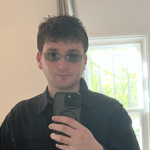
Nicolas Winding Refn and HtN’s Jack Schenker
NWR: Pino became an evolution. Meaning, that when I was thinking of the movie and the ideas, I obviously used different kinds of music. When it got to the shooting there was a lot of music on set, it helps the actors, helps me, helps everyone to get in the mood of what we’re going to make. I would use a lot of Pino’s previous work, and I’ve done that since Drive. So he’s always been in the playlist sense of, oh, let’s put the Pino piece on here, let’s do this, let’s try that. Once the film had finished shooting, I didn’t know through the process what kind of sound this movie was going to need. I just knew it was going to be different. Once I began to edit the film, I realized I wanted to turn it into an opera. Who would I then need to compose it? I actually thought, well, Pino Donaggio would be perfect, but is he still alive? It turned out he was. I reached out to him through a friend of mine, asking if he would be interested, if he wanted to do some work, and he happily agreed. I met with him in Milan the first time. We discussed the approach, and I said, “I want you to write an opera for me. I’ll provide you the images and the story, but you have to fill in the emotional narrative with the music.” And he was like, “absolutely, no problem.” In his Italian. I don’t speak Italian, but he did it through translation. That was it, basically, very smooth. Obviously, when he started sending his demos, that affected the editorial. Oh, we could do this, or we can use that, or we can prolong this, or stay longer on that, or shorten this, or whatever. It became a part of the collaboration. In the end he tied the film up in a very nice way, in my opinion.
HTN: I’ve always seen a connection with your post-Drive work and the giallo genre. Here, you’re more obviously paying homage to the genre with the Leatherman and with Pino, but in your own very personal way. You met with Dario Argento a year ago, per your Instagram, in November at what seems like some kind of event. Can you discuss your connection to the giallo genre and maybe shed light on any advice Argento gave you for this film?
NWR: Well, I met Dario because we were both going to meet the Pope last year. The best Pope visit I ever had was going to meet the Pope with Dario Argento and my friend Gaspar Noé. We have never really talked in a sense of more than just always about his life and what it was like making the films he made. But I’ve always very much admired his work and a lot of his contemporaries of that time in Italy. I generally love Italian everything, I love Italian fashion. So it’s more that my interest is in the kind of fetishization and the objectification of elements that a lot of these films would practice. I’ve always liked it, because I do like objects myself, you know, so it became like a perfect marriage of also using some of that into the film.
HTN: Charles Melton is amazing in this movie. His introductory sequence is beautifully rendered. I want to discuss his fighting scenes, particularly the first one with the large Japanese man. You have shot many legendary fight scenes over the years. This one feels as hard-knuckled and as well thought out as anything you have shot. I was in a chokehold and the lighting was so incredible. Can you discuss collaborating with Charles on these fight scenes and what was most important to you?
NWR: I have a trainer that I work with three times a week in Muay Thai. His name is Jason. He’s an ex-champion who ended up playing Leatherman. So through my process with him, I wanted to use that kind of fighting technique that I myself just practice out of just cardiointerest, and health reasons. With Charles I brought on a Japanese fight coordinator that I’d met in Japan, and he brought his stunt team to Copenhagen to work with us. I wanted to approach it in a very, almost like an operatic way. It’s like a stage play, where lighting would help to create the narrative between the two, three, or four battle scenes through the film. With that, you need a great stunt team, first of all, that can support the performer, which we had in the Japanese crew.
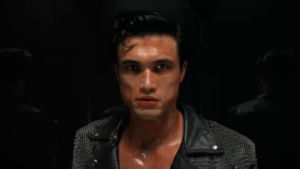
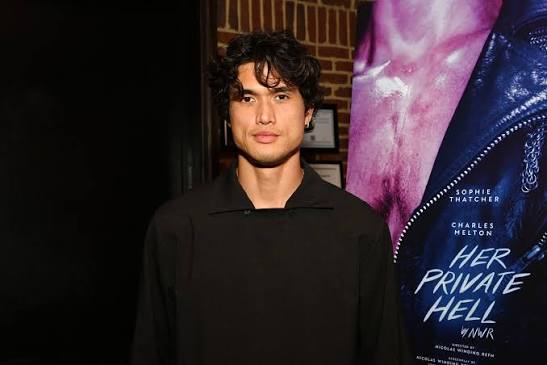
Charles Melton in HER PRIVATE HELL
But I also like this very almost mythological kind of setting between the antagonists and what they’re up against, and the protagonists fighting the antagonists, in a way that becomes mythical, like two men dueling each other out, or making it fetishized and how it’s objectified or sexualized, things where the violence becomes fun. I mean that in a good way, that it becomes operatic, it becomes like a performance piece. It was also important that the three fights throughout the movie were different. The third is really not a fight, because that’s all about Elle’s inner odyssey, that he actually is her alter ego, and it’s all about her own overcoming, her final defeat against the mythology of the Leatherman. So for the two other ones one was to be very chaotic with a lot of people, and then one was to be much more singular, in the sense that it was going to be this larger-than-life character versus Private K. So it’s almost like he’s a superhero who broke into a place where he needs to do good, and he fights these larger-than-life characters.
HTN: Those scenes were absolutely incredible. But my favorite sequence in this film has to be the scene where at the club, Elle and Nico have sex, Hunter watches, the Leatherman stalks behind her, and behind them in some sort of metaphysical space, Private K watches the event unfold. Right as Elle and Nico orgasm, the Leatherman tears Hunter open, spraying blood all over the window. Private K bangs on a glass cage, trying to save Hunter, but it’s too late. Elle cleans herself off, and they do not acknowledge Hunter’s death. A scene like this one is why I’m so obsessed with your films. It’s just totally singular and completely hypnotic. Can you talk about crafting this moment from the page to the set to the edit?
NWR: Well, it was always a climax where everything kind of comes together in Elle’s own existence, because obviously Elle is going through her demented detour of her insanity from the beginning. I wanted this, because it’s called Her Private Hell for the reason that she is in her own hell and can’t get out of it. For many different reasons, that obviously some are verbalized, some are not, you know, but clearly there is an issue with her father marrying her lover, her lover taking her father away from her, her imaginary alter ego is a father that would go to hell and back to save his daughter which is what every child craves from their parents. So it had a lot of thematics that crisscrossed into each other, where the climax in the club scene became where everything comes together and boils it down to very specific conflicts between Dominique and Elle, which is the stepmother and daughter.
HTN: I love this transitional moment from Elle to Private K. They seem to connect and see each other through this metaphysical world you’ve created. Something about their energies as they both smoke cigarettes collides, and that is what transitions us into Private K’s underworld. Can you talk about this transitional moment? Was this always how you would switch over to Private K’s story?
NWR: No. Originally it had a different structure. But I felt that the fun part of editorial post-shoot is, what can you do with this? I was like, well, we can do it like this, or how about we start doing it like that? The more that we cut things into each other, rather than having separate narratives, it became more and more one singular narrative. Because at the end of the day, Elle is the hook, she’s our way in. The title came to me because I saw a cheap paperback book from the 60s called “Her Private Hell,” where on the cover a woman was looking at herself in the mirror. I thought, oh, that’s a great image. I wonder what that could be. So I started with the title from that image. But the idea that Elle’s alter ego is a man who obviously is objectified the same way that I objectify the women as dolls, he’s my Ken, he’s my action figure, you know, with a utility belt and a uniform, the same way. So it’s obviously my own desire and pleasure in collecting and fetishizing objects. That connection between them, suddenly, he’s essentially the father that she wishes her father was like. That became another layer, that again was there, but I had to figure it out to combine it together more directly, rather than make it a more classical thing where you go back and forth between two narratives that are supposed to meet. To me there was something we had to dig deeper into, the real core of everything, which is the creative process, and obviously that’s what I enjoy.
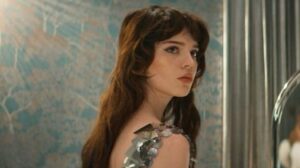
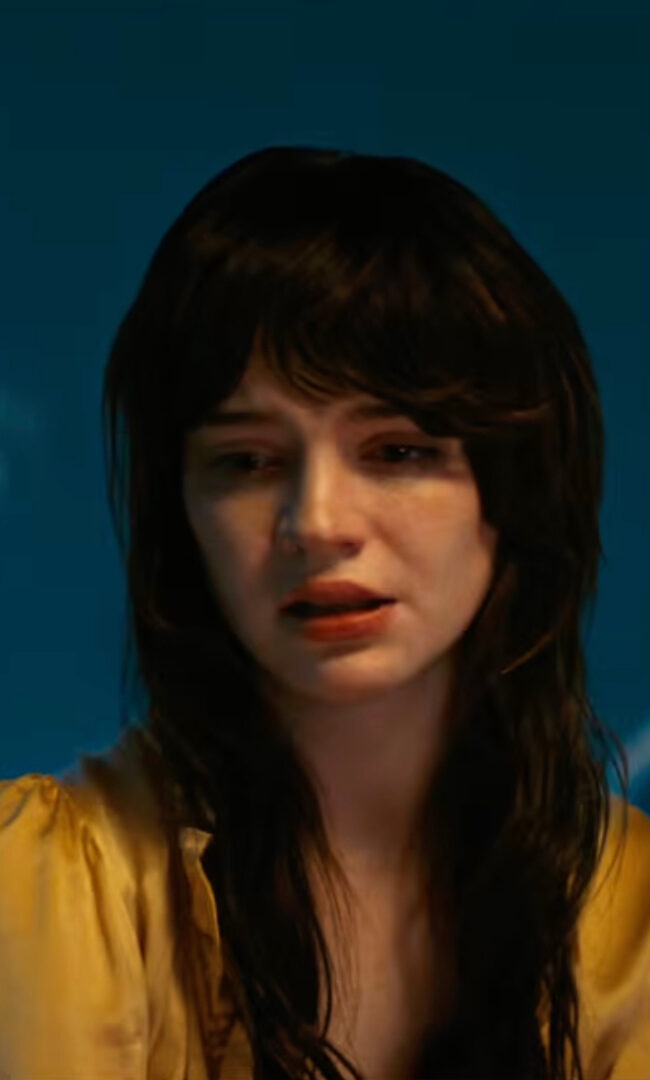
Sophie Thatcher in HER PRIVATE HELL
HTN: It came out beautifully. I love that moment. Nico’s introductory sequence is very memorable to me too. His discussions of the freaky shit he’s involved with, Sophie Thatcher’s incredible facial expressions, and this amazing lighting. Can you talk about creating that beautiful set, collaborating with Diego Calva, and what was most important to you in his introductory moment?
NWR: Diego plays the man that every father wants to protect his daughter from, which is very important. He’s such a photogenic personality, just a larger than life man. He’s very sexy, so it was very easy to objectify him as a kind of product. Then I had this story about what he experienced with Elle’s father, which is part of something I experienced myself many years ago. So the idea is that he is kind of this wolf that walks into the world and is, in a way, more of an object for Elle to essentially avenge herself over her stepmom. He’s something that looks like a dangerous object that’s inserted, but yet becomes an actual useful component to Elle’s own journey. Can any of this really be explained, do they exist, or is it all just in her own private hell?
HTN: Right. I love Diego in this movie. This is your first feature in a decade after two television series. Television is now where many auteurs go to do long-form cinema, essentially. What did Too Old to Die Young and Copenhagen Cowboy teach you that you then brought back to a 109-minute feature?
NWR: It’s more fun to make movies. I’m not bound, or at least confronted, so much by the algorithm’s control. Most of all, I think that cinema brings a certain sense of kindness to the world. Where everything is so polarized, we live in such inequality. I don’t like the way things are moving. But if at least through art we can all come together in the same room, isn’t that what art can do? When all the politicians have destroyed our humane beliefs, art can reinstate it. But it can only reinstate it if we collectively experience it. If we just sit around ourselves watching it, well, then we’re just feeding into our own algorithms, which is not a healthy way, in my opinion, because you’re never challenged. It’s like if you only have sex one way your entire life, you are going to run out of steam. If you have sex many different ways, you’ll never stop having it. So the idea is, a collective experience is cinema. Cinema is something everyone has access to.
HTN: Everyone’s algorithm is their own private hell.
NWR: Absolutely. I couldn’t agree more. That’s a very good way of looking at it. Everyone’s algorithm is their private hell.
The conversation also includes actor Charles Melton, check it out here!
– Jack Schenker (@YUNGOCUPOTIS)