


A Conversation with Katie Aselton (MAGIC HOUR)
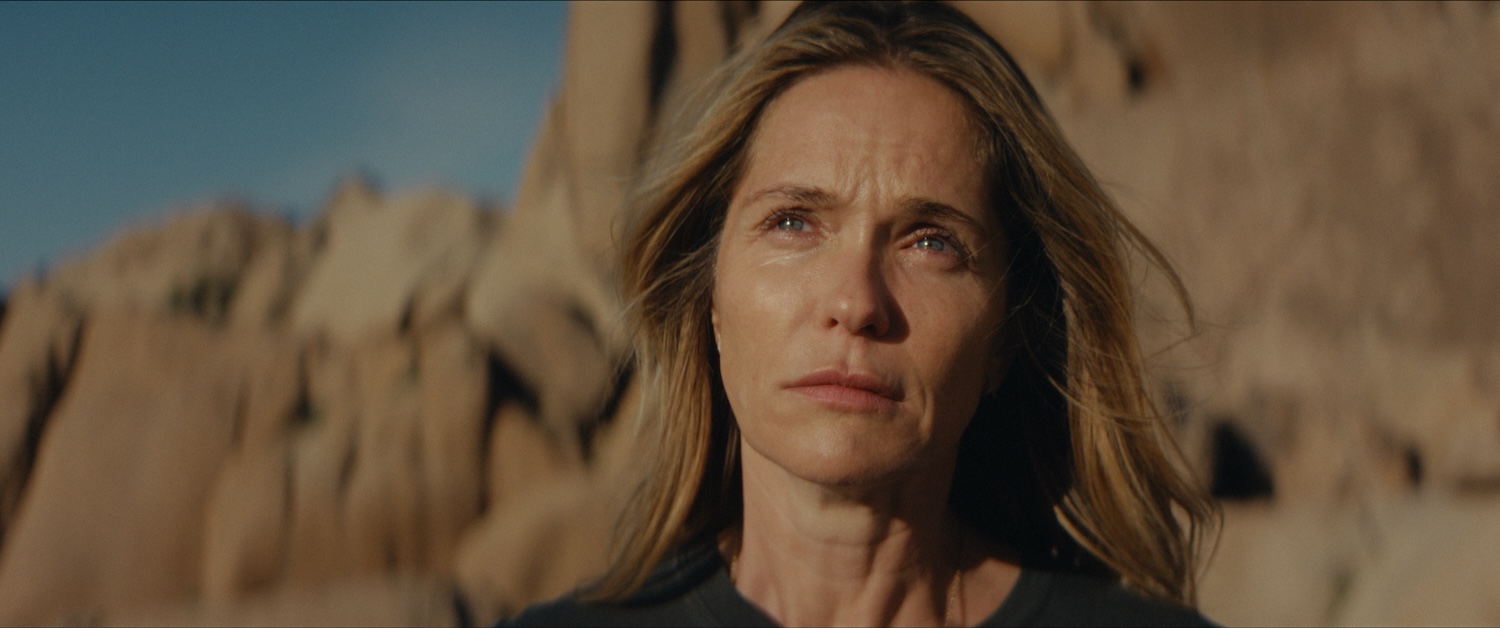
Director Katie Aselton (Mack & Rita) is out with a new film, Magic Hour (which I also reviewed), in which she also stars, joined by Daveed Diggs (Blindspotting), Brad Garrett (Cha Cha Real Smooth) and others. Co-written with her husband, Mark Duplass (Creep 2), the movie is a meditation on loss and grief, set in the beautiful location of California’s Joshua Tree National Park. Magic Hour (which I just reviewed) premiered at the 2025 SXSW Film & TV Festival and is getting its current release courtesy of Greenwich Entertainment. I traveled to this year’s SXSW with a group of students from Stevenson University (where I teach), and Aselton nicely agreed to let us both screen her film in class and then chat with her afterwards. What follows is a digest of that conversation—including questions from some of my students, who have allowed me to name them below—edited for length and clarity.
Hammer to Nail: You wrote this film with your husband, Mark Duplass, and he’s very much alive …
Katie Aselton: Yes! (laughs)
HtN: … but the story deals with grief and loss. What was your personal motivation for exploring this topic, the both of you together?
KA: There’s a shorter answer and a slightly longer answer. The shorter answer is that our ethos has always been to use your own material as inspiration. So The Puffy Chair, which was our first film, was very much rooted in what we were going through, what Jay [Duplass] and his now-wife were going through at the time, and what our friends were going through at the time. So we were mining all of those situations for material. Things are different now. We’re married, we have kids and dogs and mortgages and the whole thing. So our stuff is different and we’ve already made The Puffy Chair.
So I guess this is where we go into the longer answer which is that when this idea was first born, we were driving from Big Sur down to Los Angeles. Every year after the holidays we do this trip to get away from the kids and reset and recenter. And so we were driving back and Mark was like, “What do you want this year to be? ” And I want to say my dates are fuzzy on this, but I’m pretty sure this was 2019, which is wild because we usually move really, really fast. If we have an idea, we flesh it out and then we shoot it. This one was a slower one, but I’m pretty sure it was 2019.
I said, “I really want to make a movie.” And he was like, “Well, let’s do it. ” So in this six-and-a-half-hour drive we were like, “What are we going to write about? ” And in that time we were like, “Ugh, we’ve already made The Puffy Chair.” The idea of making a movie about our relationship, because it was something we really wanted to write together, felt like it had been done. So then we were like, “Well, what if we went into the hypothetical? What if we forecasted into the future of what would it be like for this incredibly functioning codependent relationship? What happens if you lose one person in that relationship?”
HtN: Let’s talk about the look of your film. It’s beautiful. Your cinematographer was Sarah Whelden. What was that collaboration like? What did you talk about in prepping to make the film?
KA: It’s my first film where I’ve gotten to sort of dabble in magical realism. And so we wanted it to feel magical. The dream is to always shoot during magic hour, which was pivotal, obviously, for our story of it being this beautiful in-between time of light and dark and playing into that. The funny thing about that is Sarah was like, “When are you guys going to shoot?” And we said late May in Joshua Tree, and she was like, “There’s no magic hour. There’s no magic hour at that time.” (laughs) Also, Joshua Tree, when you’re not in the park itself, is incredibly flat. So your horizon line just goes from day to night. You’ve got five to seven minutes of magic hour. (laughs) So that was a fun challenge, but I wanted it to breathe into what is real and what is not and make it sort of just this beautiful in between. And I’d never gotten to play like that aesthetically. And she just really understood the assignment immediately and we shared this vision of this sort of dreamlike middle ground.
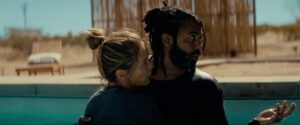
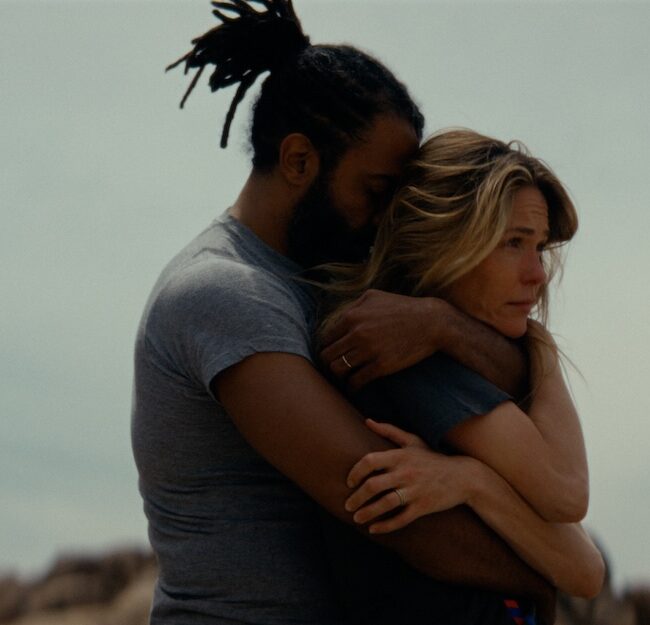
l-r: Katie Aselton and Daveed Diggs in MAGIC HOUR ©Greenwich Entertainment
HtN: She does a great job and you did a great job directing her. I want to live in that house. Where in the Joshua Tree area is that house so I can go squat?
KA: (laughs) I still don’t fully understand the geography of Joshua Tree. It all feels like you’re on the surface of the moon. So it’s in the middle of the moon, but it was just an Airbnb we found and it really was such a cool location. I loved it. And I got to stay in that house. That was where I slept. The whole crew would leave and then it would just be me by myself, which was wildly eerie. I think Joshua Tree in general is a wildly eerie location. The wind is very unsettling. And since making the movie, I can’t go back. I’ve tried to go back and I’m like, “I don’t know.”
HtN: But that was probably great prep for playing your role, staying there alone.
KA: Oh, 100%.
HtN: So, I have one more question before I turn it over to the students behind me. Your film premiered at SXSW in 2025 and now here it is about to come out in 2026. Could you briefly describe the journey from that first exhibition to distribution?
KA: Look, the business ain’t what it used to be. They’ve sort of rewritten the rule book where when my first couple of movies premiered at Sundance, you sold them overnight. You knew exactly what was going to happen with your movie; the geography is just different now. Distributors are very careful about what they take because very few people go to theaters. Where I think filmmakers used to sort of hold the power, the distributors hold the power now. So I had another movie [Their Town] premiere at SXSW this year and the reactions were like, “We’ll see it; we’re still in the middle of watching every movie from Sundance and then we are going to watch every single movie from SXSW.” And it’s like the dating game has really changed. And so I think we’re at a real turning point in our business and I think this happens every so often.
I think Cassavetes and his friends ran into this, as well. We’re sort of redefining things and figuring out what it is, but it’s definitely a slower process and a less lucrative process than it used to be. But I’m hoping that we still find audiences and I’m hoping that there’s still an appetite for smaller movies that don’t star massive movie stars and set pieces. And I hope character-driven stuff still has its place in the marketplace.
HtN: Well, it seems like streamers are still interested in a lot of that and clearly Greenwich Entertainment was or they wouldn’t have banked on your film. All right, let’s let my students ask questions.
Stevenson student Riley Frutiger: I loved the idea that Daveed Diggs is just there, even though he’s obviously just like a ghost in the situation. What was the process of deciding the production design of what his ghost was going to look like, in terms of either leaning into that magical realism or making him just look like a normal person?
KA: As a low budget movie, you can’t go too crazy; you have to stay within your parameters. So very early on we just had this idea that he would exist when it was just her. We had all these levels of her sanity and sometimes he was very real and right there with her and then we had times where he didn’t exist at all and that was usually when there were other people around. It was all predicated on her mental state and where she was. Sometimes he existed only in reflections and then sometimes she lost him all together. She couldn’t figure out where she wanted him to exist. And I think that is an interesting thing to explore, when you look at grief, of how present do you want this person to be that you lost? It’s not healthy if he’s there all the time, but it also is heart-wrenching if he’s gone completely. But also, I didn’t have a budget to make him look like a ghost. (laughs)
Stevenson student Holt Hendershot: You mentioned having a very narrow window for lighting. How did you go about navigating that when you were on set?
KA: Quickly. (laughs) Having a very tight team who can move very quickly and without a lot of bells and whistles. When you’re making something with a very small budget, you have a small crew, anyway. So you work within your limits, but I think what’s wonderful about that is you can move really fast. A great example of that is there’s a quick shot of me sitting outside and there is a massive full moon rising behind me, which was like in the movie Joe Versus the Volcano. I don’t know if you guys are too young to have seen it but it was a John Patrick Shanley movie with Tom Hanks years ago that had this huge moon that was clearly very fake.
HtN: I love that film.
KA: You know what I’m talking about. But this moon was so incredible and it was a complete fluke that we found it, but we were able to capture it because Sarah just flew into action and set the camera up and I flew into action and threw the chairs out there and you move quickly and you grab what you can when you can. So a lot of the fever-dream stuff where she’s losing it out in the field, we would catch when we could. None of that was shot in one day. That was over the course of the entire film. We also shot it when we had my queens there and when we had the therapist there. And so you’d just sort of pick things off when you could and the light was great. So it was a lot of just being flexible and down to do what you had to do to grab the light when you could. But it was a lot of early mornings and early evenings.
Stevenson student Cam Fox: You mentioned the queens and I really liked their inclusion and I love that the queer community comes to support this character in her time of grief. And I’m just curious as to why that was important to you to include them in this movie.
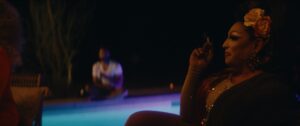
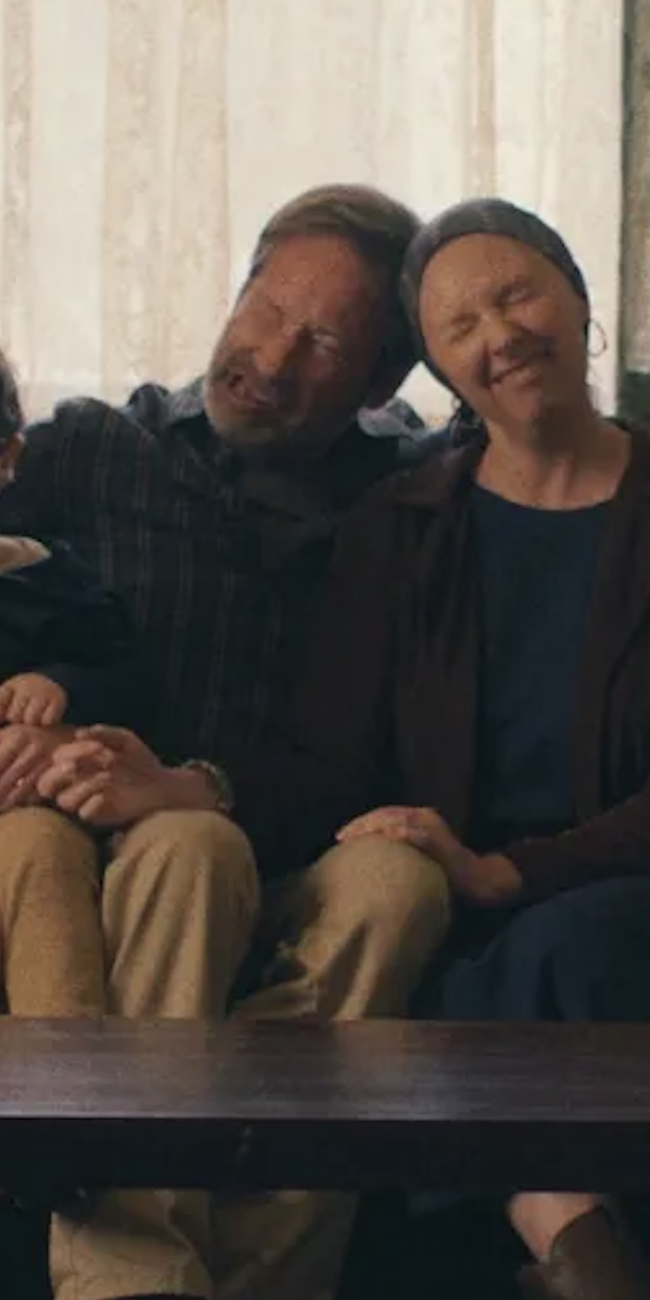
A still from MAGIC HOUR @Greenwich Entertainment
KA: When I was putting this film together, it was right around the time where everything was going on in Tennessee and I was just apoplectic about it and it felt really important to me to do something. I also think that there is so much interesting history within the Latin American community; there’s what they call the third gender and they were the people who helped others move through grief and it was just such a beautiful thing. And I also find it really fascinating to explore their optimism and hope and energy in a time where things are really hard. I loved having that energy for her of, “You’re going to fucking dance through this and you’re going to be okay because we all have to be. We have no choice.”
Stevenson student Quinn Bonnan: How and when did you find time to take your mind out of the director headspace into the actor mindset or find time to specifically dedicate to directing yourself while simultaneously being able to direct the other actors?
KA: It just requires so much extra prep. You have to just work so closely with the team around you so they know what the deal is. And it was a lot of conversations with the crew of like, “I know it’s going to look like I’m losing my mind. I’m not. Maybe I am, but it’s going to be okay because Neumann, the producer, has got it and Sarah, the DP, has it. But it was really being able to rely on the small, very mighty team I had, where they were like the infrastructure and they knew my intention for every scene as a director. They knew what I wanted.
And look, there were certain concessions, like the massage scene doesn’t look exactly the way I wanted it to look, but I also was naked under a sheet and couldn’t get up and look at monitors. And so there were times where you’re just like, “It’s going to be what it is and you’re going to look at your team and rely on them to make the call. And it’s not always going to be exactly right, but that’s also part of collaboration and being okay with it.” So it was really just like you sort of have to weave a very tight safety net and cross your fingers.
HtN: Katie, thank you so much. We appreciate your time.
KA: Thank you guys!
– Christopher Llewellyn Reed (@ChrisReedFilm)