





(Check out Savina Petkova’s Fjord movie review. The film just had its premiere at the Cannes Film Festival. Seen it? Join the conversation with HtN on our Letterboxd Page.)
A small town on the fjord-laden west coast of Norway has just become a new home for a religious family of seven – Mihai (Sebastian Stan) is Romanian, Lisbet (Renate Reinsve) is Norwegian, and their five children speak both languages freely, a fact which, coupled with the conservative values forbidding them from using the Internet, unsettles the locals. But Norwegians are polite and private, welcoming instead of meddling in other people’s business. Such is the set-up of Fjord, the new film by R.M.N. (2022) director Cristian Mungiu, and a timely depiction of “East meets North” in this year’s Cannes main competition.
Mihai now works in the community center, while Lisbet is a nurse in the care home. Just like the children are instructed in school—“no religious stuff”—the parents too, are warned against it; they mostly obey the social code, except for Lisbet leaving a small wooden cross in the casket of deceased elderly residents. Renate Reinsve plays a stoic, hyper-controlled character for what feels like the first time ever and her modest clothes and hair tucked away by a headband bear no resemblance to the buoyant roles she’s been to Cannes recently with (Armand, or Sentimental Value). Her subdued presence matches Sebastian Stan’s Mihai, who is reluctant, yet angry deep down, channeling a frustrated immigrant who faces discrimination, despite making a good name for himself. It’s an accusation of domestic abuse that throws the family in disarray, as Child Protection Services swoop in and take away the children, even before an investigation has begun.
The evangelical Gheorghiu family’s upward social mobility corresponds with the geographical ascension – from the Southeast of Europe (Romania) to the Scandinavian north (Norway), from patriarchy to wokeness, universal care and egalitarian state politics. Within this context, Fjord already is the kind of social commentary the films of the Romanian New Wave are characterized by, but the twist here comes entwined with religion. In a tolerant but atheist country, how does one practice their faith? Mungiu, however, is not as interested in the practice or community itself, but more in the way society treats difference, penning the script with the critical sharpness of someone who’s obviously skeptical towards that kind of coveted progressivism. In that sense, everything that happens in the film is a result of prodding the societal ideals we so easily take for granted.
The issues at stake in Fjord are ones of power and autonomy, distilled in a harsh, but realistic example. Norwegian law allows the state to interfere in people’s personal lives to better support them and while living there, I have heard many people complain in a similar vein about the government-mandated maternity and paternity leave, while my parent-friends abroad were kicked off back to work a few weeks after the birth. Mungiu spins a whole narrative around social workers, lawyers, and administrative staff who are “just doing their job” while believing they, the external people, know better than the parents themselves and in this gesture, however truthful the cause for concern, lies the film’s contentious provocation.
Fjord works as an understated critique of the far left and the far right, of allowing too much and not allowing enough and this conceit becomes even clearer in the film’s third act which takes place in court. There, with the benefits of a tense courtroom drama, Mungiu’s script sways between the two extremes, asking the viewer to take a side. That very ask, however, is taunting:
if you side with the Gheorghius, you align yourself with conservative values (and perhaps people who slap their children as punishment); if you don’t, you’re supporting a system devoid of humanity. In that regard, it’s harder to view Fjord as a social drama with actual concern for its characters as people. Instead, you’re damned if you do show empathy, and damned if you don’t.
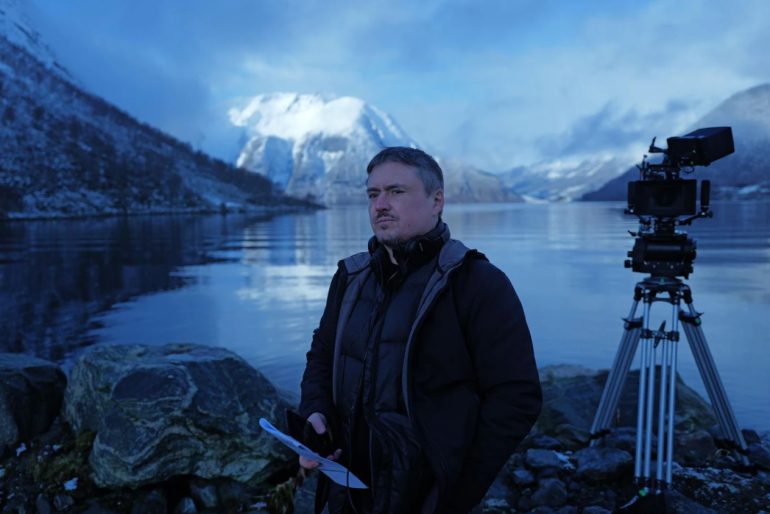
It’s not a bad thing to put your audience to the test or to examine their moral concerns beyond political frameworks, and Fjord allows a few detours from that mission. The Gheorghius’ elder daughter Elia (Vanessa Ceban) befriends her Norwegian neighbor Noora (Henrikke Lund-Olsen), forming an effortless, potentially queer-coded relationship, which signals a possible future for the two seemingly opposing sides. That said, amidst the wondrous winter landscapes of Fjord, the mountains and the sea with only a few houses huddled in a valley, hope is an endangered species.
– Savina Petkova (@SavinaPetkova)