


A Conversation with G. Anthony Svatek (HUMBOLDT USA)
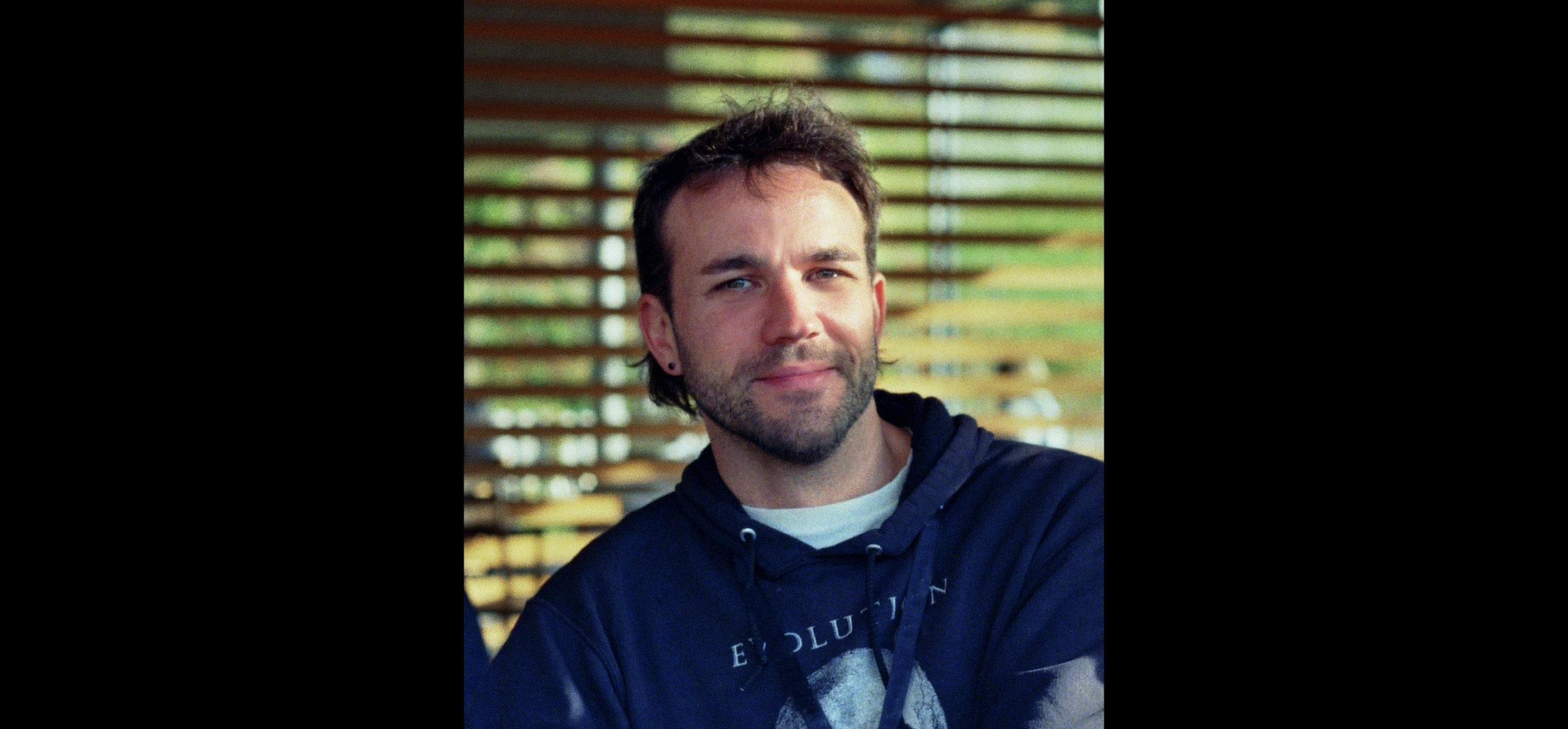
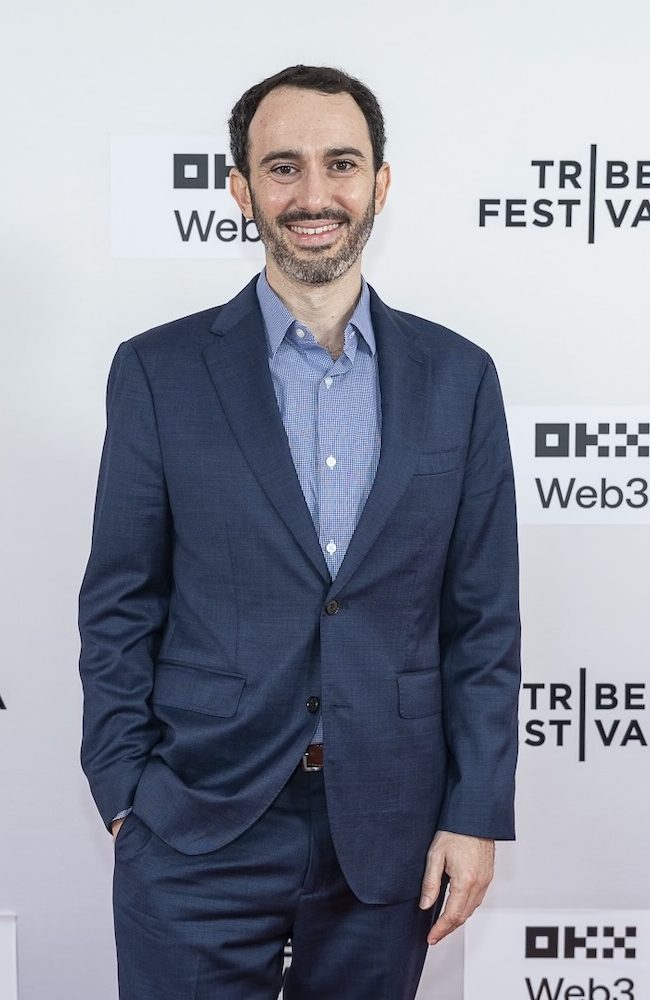
Multi-talented Austrian-born / U.S.-based filmmaker (as well as film-editor and cinematographer) G. Anthony Svatek is arguably best-known for his remarkable festival-screened shorts and his collaborative work on the films of others (such as Lynne Sachs and Jem Cohen). Yet that awareness seems destined to shift in the weeks ahead as his long-anticipated feature-length—Humboldt USA—premieres at Visions du Réel (in Nyon, Switzerland) on 22-April and then debuts state-side shortly thereafter at First Look at MoMI (in New York) on 2-May.
Humboldt USA visits a trio of locations in North America named for the ecological pioneer and weaves his lingering influence from the past into the numerous concerns of our present. The film, like its namesake, isn’t satisfied to be any one thing. It is many things at once (and that unconventional aspect is made all the more extraordinary in its ability to pull disparate threads into a unifying whole). It resembles, at times, an environmental documentary. At others, a purely observational documentary. On occasion, it can resemble a personal documentary. Yet it is a hybrid of all of those things. It is also among the most fascinating nonfiction experiences of the year thus far.
This particular conversation was remotely recorded and transcribed by Jonathan Marlow, SV Archive [Scarecrow] Executive Director, mid-April from a hotel room in Columbus, Ohio (upon the conclusion of the Orphan Film Symposium).
[A brief excerpt from the then work-in-progress film screened at the Tenth (and final) Annual Report of Camera Obscura in 2024. G. Anthony Svatek curated a program of eclectic shorts from the Film-Makers’ Cooperative collection for an earlier Report and his association with the (previously) annual gathering goes back to its re-founding.]
Hammer to Nail: I will begin with the most obvious of all questions (for the sake of others): Why make a film—at this peculiar moment—about the polymath Alexander von Humboldt and why place him in the confines of the United States, a location of his brief association? How did you initially arrive at this approach?
G. Anthony Svatek : I grew up in Austria and I knew about his name my entire life but I did not really know much about who he was as a person was until I’d read [Andrea Wulf’s] book in 2015 called The Invention of Nature. The biography gave this impression that he was a gay proto-environmentalist who predicted man-made climate change. He was this heroic figure who was once the most well-known person in the Western world—after Napoleon—two-hundred years ago. This very graphical portrait of him was extremely appealing to me. There were all these biographical parallels between him and me that also kept me interested and hooked. From there, I just did more and more research. I started reading other biographies with a much more complex view of this figure whose name is everywhere but nobody really seems to know him. I knew that I did not want to make a biographical film. There are more than enough biographies and films and books out there. It felt to me much more exciting to make a kind of a collective portrait of him and his ideas of everything through contemporary stories and images. Seeing his name like red dots on the map all over the United States. It felt like a rabbit hole that I could engage in and jump into. To see that his vision of interconnectedness still existed and in what form it existed, specifically in the United States. The U.S. has such an extreme conception of what environmentalism is and what nature is. Ideas that he planted in the United States two-hundred years ago on his six-week visit to the U.S. infiltrated American history.
HTN: This contemporary approach is extremely more interesting and exciting than taking a more traditional, biographical route. I think it says something very interesting about the U.S. at the time, a vision of which was largely known through landscape painting. This beauty of the American outdoors, filtered through the eyes of various artists and displayed throughout Europe and elsewhere. There can be complications with naming places after individuals and there are many instances where this has proved problematic. Naming a place after a person can come with potentially unintended baggage. With Humboldt, most individuals these days do not know or remember much about him. This says something about the course of the U.S. in the early days of its founding and the U.S. now. There was a time when the majority of this country cared about science and nature. What happened to the country in the meantime?
GAS: There are many things in that question (and comment). One, of course, is that he did not name any of these species or places after himself. They were all named by other naturalists and scientists afterwards. That was how famous he was at the time. That was how much he was an inspiration in the west for explorers and scientists (as the U.S. was expanding as well).
HTN: An important and essential bit of context there.
GAS: Then there is this idea of American landscape paintings. How it is tied to history and politics and science and Humboldt is such a useful tool. An anchor in history to talk about these two paradigms with which we—people in the west—approach the natural world. Either, as you say, landscape paintings or fenced-in national parks or this sort of completely romanticised idea and idyllic view of what nature is. That is a very mediated romantic experience. Then, on the other hand, there is “hard science” that is all about abstraction and distilling the physical, tangible world into something that is quantifiable and measurable. It also becomes extremely abstracted through that process. There are these two kinds of paradigms that I feel like we are still struggling with. Humboldt perfectly embodied this because he was a child of the enlightenment. He moved within a sort of German romanticism, approaching the natural world with feeling and through aesthetics and through a true sense of empathy that was very radical at the time. In the face of what is happening to the planet and our relationship to it, I thought that the film could ask these questions: Is it okay to have these two paradigms? Is that enough? What is missing within that equation, within this western scientific and cultural paradigm? Humboldt felt like a good foil to push against that from within.
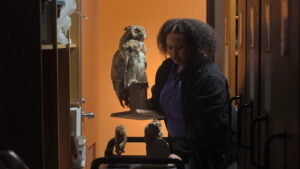
A still from Humboldt USA
Credit Space Time Films
HTN: Knowing your work and a relatively fair amount about the subject, I had expected that your film would integrate these elements together rather well (and it does). We have talked about this before but I truly appreciate that you opted to use your own voice for the narration. That dialogue breaks down the tenuous line between a personal documentary and an environmental documentary or a political documentary.
GAS: Many different things at the same time.
HTN: I’d anticipated that Humboldt USA was, visually, going to be a beautiful thing to behold. But the combination of the visuals with an elegantly constructed sound design effectively evokes all of the many things that you’re discussing.
GAS: Kaija [Siirala], our co-editor, did the sound design. This was my first time working with a professional sound designer and it was a revelatory experience to me. Then we add to that the work of our composer, Celia Hollander, who combined the soundscape with a musical component. Those combined elements felt almost technological. Glitchy, along with romantic instrumentation (such as the cello). Science versus romanticism. These are the two approaches that I tried to combine. Then, in regards to your comment about the voiceover, I always felt there was this question in the film: Why Humboldt? Since no one from these three places ever discussed Alexander von Humboldt, he was something of a shadow. There needed to be a bit of exposition, of course. The three storylines in these three Humboldt places are humanistic in a way that it felt like there needed to be a glue that held it all together. It needed to have a similar, personal approach. When I learned about Humboldt as I researched, it felt like falling in love. I fell in love with him over time and space and history. I wanted that kind of experience of falling in love and then falling out of love to be reflected in the film. That was the approach that we settled on, eventually, for these three stories.
HTN: How did you make your selections for the individuals that you wanted to follow? I know these weren’t the only folks with whom you spoke. How did you identify them as the essential thread?
GAS: I started by broadly selecting the Humboldt place-names that I’d wanted to travel to and which I found interesting. It started in Northern Nevada, in Humboldt County, a very rural, high-desert environment. Then I moved to Northern California, into Humboldt Redwoods. From there, eventually, I looked at Humboldt Parkway in Buffalo, where I’d originally started but then abandoned and returned later. It was very intuitive in a way. I started by mostly talking to museums and local culture institutions, befriending the people who ran them. The historical societies and regional history museums—specifically small, local history museums—are often highly connected and embedded in their communities. Through them, for example, I met the folks who work at the Nevada Wildlife Department, relocating bighorn sheep. Visually, that just became so stuck in my head that I couldn’t let it go. It seemed apt to talk about machines and technology and infrastructure to save a specific species. What does that say about our relationship to topics of environmentalism and conservation in the west?
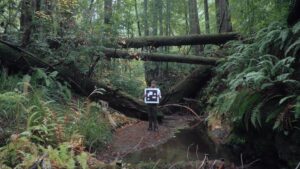
A still from Humboldt USA
Credit Space Time Films
In California, I always wanted to have the Silicon Valley tech aspect of the narrative. For years, I was describing these characters that I’d invented in applications for grants and other funding but I never actually found them. Then, randomly, through a filmmaker colleague, I was told that there was a group of people trying to scan nature and landscapes, attempting to make organic algorithms from their work. They existed in my head and then they were real, in front of me! Incredible and very satisfying. Lastly, the Buffalo storyline, because I always wanted to have part of the story set in an urban environment. With the beautiful natural environment, it always needed to have an urban environment. I always want to work with young people as well. I connected there to the residents around the Humboldt Parkway, part of a [Frederick Law] Olmsted-designed park system in Buffalo that was destroyed in the 1950s by a highway. The science museum is located on Humboldt Parkway and there are many Humboldt references within the museum as well. I met a very young educator there and she is one of the protagonists in that storyline. She had incredible things to say about history and this was the neighborhood where she grew up. I was there with my camera one day and that was how I met Terry, a local activist. He asked what I was doing and he was one of the only individuals who knew about Alexander von Humboldt when we met. We spoke the same language immediately! He is very charismatic and he and wife, Marcia, embraced me very quickly.
HTN: Have all of the subjects seen the film at this point?
GAS: They all watched a cut of the film before picture-lock because I wanted to give them the opportunity to weigh-in. I wanted to make certain that they felt comfortable with everything. I wasn’t too worried, though. The only part that worried me was the personal tension between the engineers in the redwoods. I felt that it was extremely endearing—sometimes difficult to watch (and occasionally difficult to be around)—but it felt extremely rich and humorous and redeeming in the end. They completely approved of it. Thankfully, all of the participants sanctioned their scenes.
HTN: Although each of these locations is relatively far apart, I appreciated an unanticipated interconnectedness between all of the subjects: a shared inclination to dance. The music invites and folds into these moments. I did not foresee that development.
GAS: I needed something to change. I always wanted to change the pace at some point and break the film. There are a few moments where the film nearly breaks but I always wanted it to have a joyful, energetic energy as well. I had always imagined a kind of dance scene where each of the storylines collapse into each other and it felt appropriate for that to happen after—not to give away too much—but [spoiler] after the solar eclipse. Everything falls into one another. This is the place where everything becomes one. It wakes-up the audiences before we switch again into a more somber tone. The we get pulled back…
HTN: …in a coda! This isn’t readily apparent to the casual viewer but what was the duration of your filming or the number of years that you’ve spent on this project? Not brief.
GAS: My first research shoot was in November 2019, in Winnemucca, Humboldt County, Nevada. I spent about a month there and then I came back for the first bighorn sheep relocation in early in January 2020. Then, of course, the pandemic hit and not much happened for about a year-and-a-half. I had a full-time job and I was doing a number of different things. I tried to be very patient with it. Throughout the years, I went on different research shoots, mostly by myself. Then, eventually, when I knew what I need to film, I brought our cinematographer and co-producer Sean Hanley with me. It was just the two of us shooting. It was never more than us two. Over the years, bit by bit, it all came together, even though there were many points of doubt and questions about whether it was feasible financially, logistically or creatively. I am glad that the team we put together—with Elijah Stevens producing and Kaija editing—the four of us really made it happen. They all believed in the project. In that way, filmmaking is family-making. I always feel very strongly about that.
HTN: Much of your work is created independently but you tend to always find a collaborator. To put something or someone else in the mix.
GAS: Absolutely. That is what directors do, relying on the expertise of others and reaping the benefit from that experience. I have—on the receiving-end—experienced that many times as well. Collaboration is absolutely key. Elijah, aside from being a producer, is a very creative person himself. He helped us get through many tough points. He believed in the project and he believed in me and in everyone coming together. You have to rely on people. You really have to rely on people and become interdependent with others.
HTN: With this approach to filmmaking, you are reliant on your subjects and yet it is an observational process. You only have limited control over what you observe in these interactions. You much be patient. Taking six years or more is ultimately a benefit but it requires persistence. Our initial interactions were at the Flaherty Seminar [more than a decade ago] yet we’ve crossed paths at many other places over the years since. You are constantly seeing other work. You are regularly making other work of your own and work with others.
What happens to new influences and new inspirations in a multi-year project? That evolution of experience continues as you now share it with audiences and witness how they respond and react to it. It is a different kind of film. It is not a straightforward documentary in any way but there are guardrails of a sort to guide unaccustomed audiences along. A moment of beckoning from within. Come in, rest a while and experience this world.
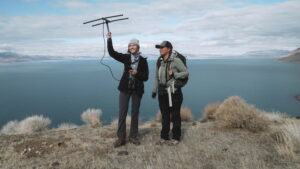
A still from Humboldt USA
Credit Space Time Films
GAS: That was really important. You mentioned the observational approach and, in the beginning, this was a very much an ideas-driven film. That was how we’d pitched it, too. It wasn’t until we started editing and I started collaborating with Kaija that I realized how much warmth there was and how much came through in these observed scenes that we shot. How much humor there was, along with absurdity. You know me. I am not someone to approach this in a purely conceptual way. I like laughing! I like being pulled in and I like being given something to hold onto while I am watching a film. We looked for those moments where there was vulnerability in our participants.
HTN: There are moments of humor that would engage anyone with little interest at all in Humboldt. You can laugh with us. You can have complicated feelings as well. You can appreciate this film without a need to know much about nonfiction filmmaking or specific documentary traditions.
GAS: This is the second or third consecutive film where someone has described it with some variation of “surprisingly entertaining!”
HTN: Even when you are dealing with serious subject matter—and there isn’t much more serious that the willful destruction of our environment—it isn’t entirely grim. Life can also be great. We’re not overwhelmingly depressed all the time. Not all the time! We’re trying to make a difference. Particularly in this intersection with rewilding and game-hunting. There are a number of individuals who have encouraged outlawing or banning hunting altogether. Yet the fees associated with hunting partially fund this rewilding.
GAS: Those complexities and contradictions were really important for me. Environmentalism and the protection of the environment can be quite messy. It is not a clear or clean process. There are red-lines, obviously, and principles. But we’re all caught-up in systems that are difficult to untangle. That felt extremely related to Alexander von Humboldt. Here was an aristocrat from Germany who traveled to the Spanish colonies in the 1800s with a passport given to him by the Spanish King. However, he financed the entirety of his travels himself. He was never obligated to share any of his information with the Spanish crown and he was extremely outspoken. Once he was back in Europe, he wrote books and gave lectures about the things that he witnessed through the exploitation of both the natural world and local inhabitants and the evils of colonialism. He was one of the first people to propose human-caused climate change.
The Spanish colonisers clear-cut forests which had changed the water levels of a lake, changing the temperature in the surrounding area. He observed the destruction and made connections that no one within the western context had considered. However, he was still working within a colonial framework. He is not a saint. He made many questionable decisions that he reflected on and regretted later. He was a grave robber. That is what you’d have to call him. He also had these personal longings for one of his male collaborators which he describes in his diaries. It is all very coded in a way that feels as if he was a fully-rounded, complex figure. He is fascinating but he is neither the hero nor the sort of colonial naturalist that people describe. It is much more complicated than that. That complexity is reflected in the stories in these three storylines of the film.
HTN: A reflected complexity which achieves all of its aims and much more.
HUMBOLDT USA (2026) dir. G. Anthony Svatek [89min.]
– Jonathan Marlow (@aliasMarlow), SV ARCHIVE [SCARECROW VIDEO] Executive Director
[with thanks to the filmmaker and publicist Sylvia Savadjian]