



(Check out Savina Petkova’s Fatherland movie review. The film just had its premiere at the Cannes Film Festival. Seen it? Join the conversation with HtN on our Letterboxd Page.)
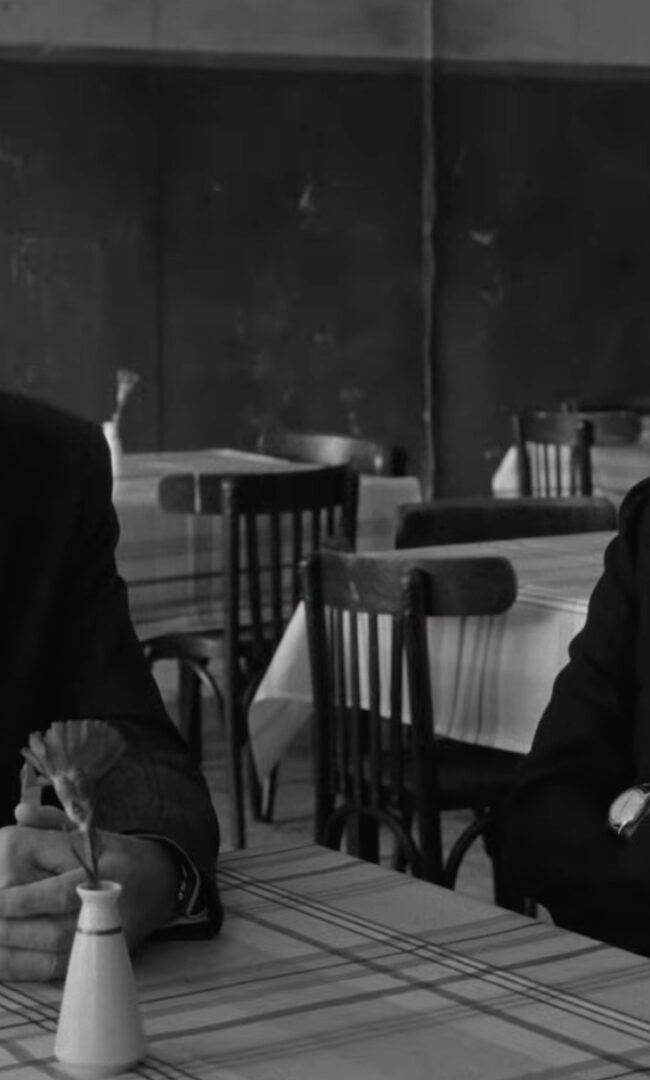
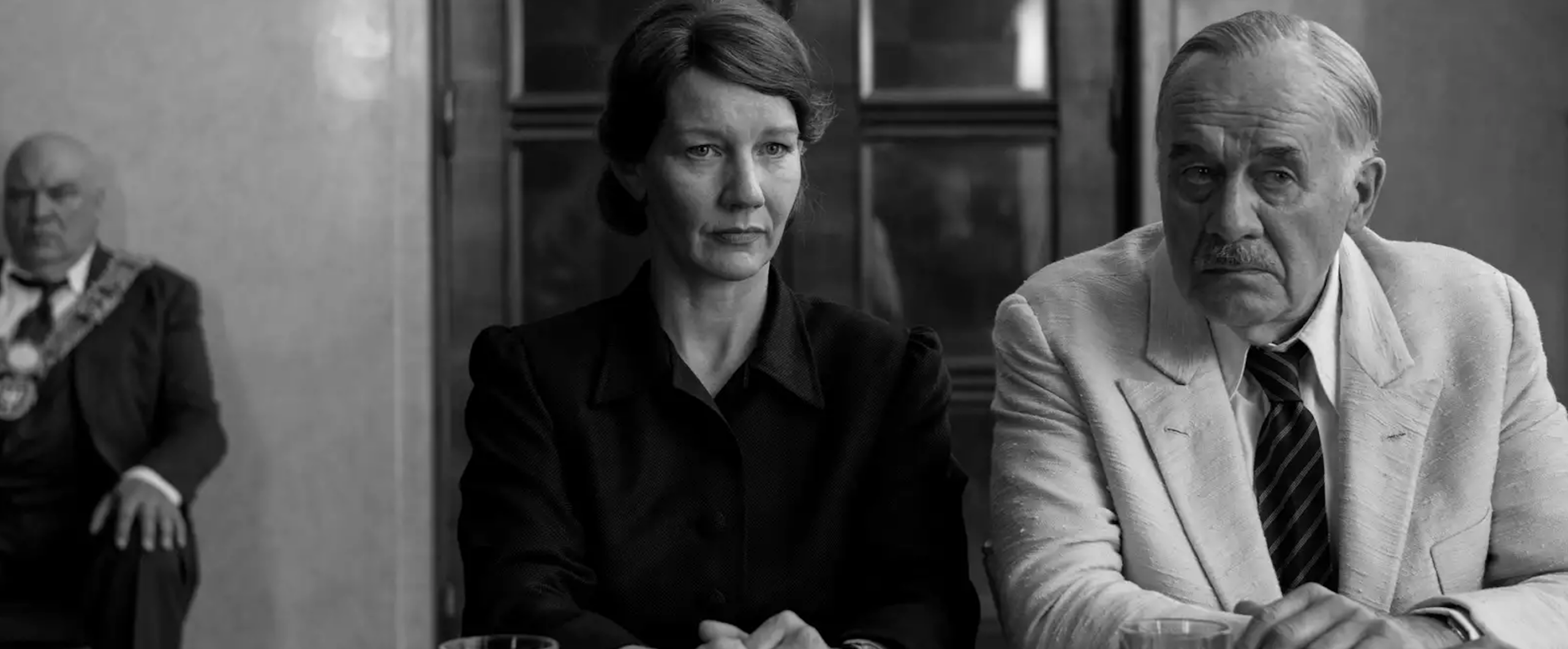
Eight years after he was named Best Director at Cannes for Cold War, Pawel Pawlikowski returns to the Croisette with a similar brief: a period film about interior exile, shot in spellbinding black and white, lensed by cinematographer Lukasz Zal. Fatherland slots nicely as a finishing touch to a trilogy held together by formal and thematic means: like Ida (2013) and Cold War, it’s a stylized, intellectually rigorous engagement with European history in the aftermath of World War II.
Unlike the former, however, the protagonists of Fatherland are historical figures, rather than fictional composites. For his newest film, the Polish Oscar winner goes hyper-specific, setting the scene in 1949, just as the novelist Thomas Mann is about to return to his native Germany from exile, a price he’s paid for standing up against Hitler’s regime. Unfolding over the few days of a roadtrip from West to East Germany at the height of the Cold War, the film’s plot is quite condensed – Mann (Hanns Zischler) is joined by his daughter and right hand Erika (Sandra Hüller, The Zone of Interest, Toni Erdmann), who looks after him and his speeches, but the presence looming is that of Erika’s twin brother, Klaus (August Diehl, A Hidden Life).
Klaus is an author, much less successful than his decorated father, but most of all he is the anguished man we see in the film’s opening scene, on the phone to his sister and when he talks, he sighs with pain, lamenting that “there’s nothing left to believe in.” His is the ghost that haunts the film, a personification of the country (and perhaps the world)’s identity crisis, post-war. In being precise to the point of a chronicle, the film manages to tap into a recognizable sense of desolation we very well can identify with, today.
Fatherland transports us to a point in history where bombed buildings lay in ruins while people go about their day wearing fine clothes, but typically for Pawlikowski, most of the scenes take place indoors, forcing the characters to sit with their demons (yet never talk about them openly). As a historical drama, the film is quite dense and period-specific; not only when it comes to reconstructing places and looks, but dialogue can sometimes come across as scrupulously devoted to allusions to and analysis of German literature and philosophy (think Goethe) as symbols to rebuild the nation’s identity on. However, balancing out the intellectual weight is the human aspect of the film – a daughter, a father, and a son who’s never there, all trying to figure out what they mean to each other.
The script written by Pawlikowski and Henk Handloegten (Babylon Berlin, Goodbye Lenin) paints Thomas Mann as a figure upon whom the contemporaries project their political hopes, as well as doubts, inviting the audience to do the same. He, however, is very much a reflection of his times and family, and this mirroring game makes Fatherland feel less a memoir than a fable. Hanns Zischler, prolific German actor and familiar from Steven Spielberg’s 2005 Munich, towers as an effigy whose poetic sense of justice, voiced in the two speeches we see in the film, could perhaps promise a stable identity for a divided nationstate. Hüller, ever so razor-sharp in her performance, alternates between being acerbic and soft at times, embodying the disjointed family as a whole. As if to preserve the riddle at the heart of the film, one scene has a journalist ask Thomas Mann “Where is home?”, to which Mann replies with the important distinction between “home” and “Heimat” (belonging) without giving an actual answer. The film’s title, then, can be read as a limbo of time and space, since home is just as much a myth as is a nation.
– Savina Petkova (@SavinaPetkova)