




AGAIN AGAIN
(The 52nd Seattle International Film Festival runs May 7-17th in and around Seattle. Check out Jessica Baxter’s Again Again movie review, fresh from the fest. Seen it? Join the conversation with HtN on our Letterboxd Page.)
For their feature debut, co-directors Heather Ballish and Mia Moore Marchant unquestionably drew inspiration from the time loop film that defined the genre, but Again Again completely upends the premise of Groundhog Day by daring to ask the heady philosophical questions. What if the person stuck in the time loop is not a selfish, curmudgeonly, white cis man who needs to learn to love someone other than himself, but a young trans woman who can’t love herself? Moreover, what if after the loop breaks, she doesn’t just get the girl and live happily ever after? Instead, their relationship picks up in the messy place where it left off pre-loop; only now one half of the couple has acquired a decade’s worth of baggage that the other half blissfully forgets with the dawn of each new day. What this fantastic genre bender presupposes is, maybe the looper would have intense PTDS from this experience, that would only be catastrophically exacerbated by the sudden and unexplained end to the phenomenon.
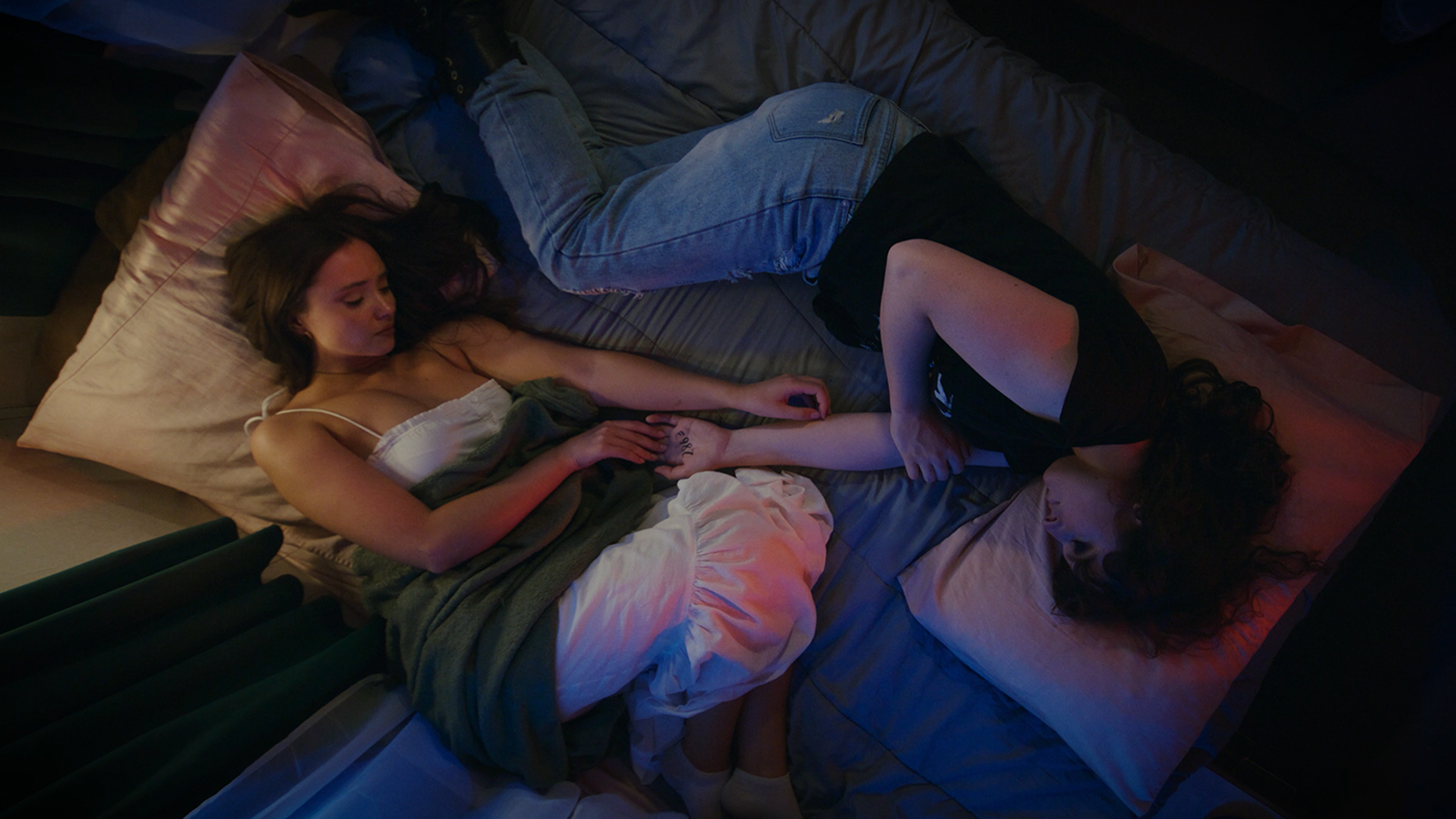
We first meet Agatha (Marchant) on her 2863rd go-round of a day that follows a traumatic event. She spends a lot of time in bed in a yin-yang configuration with her unaffected girlfriend, Tessa (Aria Taylor, Charlie Says). Aggie is painfully aware of how long she’s been stuck because every day she writes the new number on her hand in permanent marker. This is a brilliant story device (not to mention a powerful repeated image) because it helps orient the audience as Aggie’s story unfolds through flashbacks. In fact, Marchant’s entire script is exemplary at metering out exposition. It’s not just what you learn, or how you learn it, but also when you learn it. As we jump through time with Aggie, we learn details of her and Tessa’s history at the most emotionally impactful moments. I don’t know how many drafts there were of this script, but it feels controlled and fine-tuned in a way that is very rare for debut films.
I’ll try to keep plot details to a minimum because everyone should be able to experience the thrill of discovery that Marchant’s script provides. But what we know pretty much right away is that these two young women were childhood best friends since before Aggie’s transition, and now they’re in love. But Tessa, who is cis, is also engaged to a cis man. Most of the film takes place in a tastefully and lovingly adorned camper van where the two women have circular conversation about their past, present and future. Most of these conversations have already taken place many times, but Tessa can’t remember. On day 2864, Aggie wakes up, looks at her hand baring the number of the day before, and realizes she’s free. But her freedom from the loop creates a whole new prison of uncertainty, as Aggie and Tessa attempt to figure out what this means for their future.
Again Again was filmed in and around Aberdeen, WA where Marchant grew up. Aberdeen is best known as Kurt Cobain’s hometown. Much of Kurt’s work was informed by the experience of growing up a sensitive, nonconforming artist in this backwards industrial burgh. The song title “Come as You Are” is a reference to the ironic “motto” emblazoned (to this day) on the sign that welcomes you into town. “Something in the Way” is about the deep despair that Kurt felt when he hid under the Young Street Bridge, which overlooks the “Muddy Banks of the Wishkah” (also the name of a live Nirvana album). A pivotal scene in Again Again takes place under Kurt’s bridge, which has since become a shrine emblazoned with fan-scrawled messages and even a plaque. Marchant’s deft utilization of this location is subtle. No character calls out its historical significance. But if you know, you know, you know?
Marchant’s Aberdeen is also sometimes quaint and inviting, such as when she visits Boom Town Records and flirts with the trans woman (Abigail Thorne, HBOs House of the Dragon), who works there. And because it’s the Pacific Northwest after all, the scenery is sometimes arrestingly beautiful, such as when Aggie kicks along the beach in her combat boots and flannel in the cloudy, cool morning. This town, like it’s inhabitants, contain multitudes.

A still from AGAIN AGAIN
Cinematographer, Laffrey Witbrod achieves miracles with natural light, imbuing many of the scenes with a dreamlike quality. But their camera also slams us into harsh reality, such as when Aggie and Tessa must leave their love nest and face the people who help make their relationship complicated. Many of those complications exist independently of that whole time loop business, such as Tessa’s bigot mother and well-meaning but jilted fiancé. Some of Witbrod’s shots of greater Hoquiam and Aberdeen paint this part of the Pacific coast with a bleak, industrial brush (if Eraserhead swapped out Philadelphia). But the shots of downtown Aberdeen are contextually striking. At night, they are cold and sinister. In the light of day, it seems like this could actually be a decent place to live, if only the residents could catch some fucking breaks once in a while.
Marchant is electric in her acting debut (delightful cameo in The People’s Joker notwithstanding). The layers of her performance are stacked like a baklava of trauma. Drizzled on top is the painful coating of being a small-town trans woman in a problematic relationship. But each layer underneath reveals another aspect of her unique circumstance. Just to name a few: having experienced a decade of life beyond all the people who used to be her peers; the frustration of having to repeatedly reveal herself and her circumstances anew, often with unexpected outcomes; and being trapped inside your own PTSD surrounded by triggers that you can’t get rid of. Some days start with a fight, prompting Aggie to seek the company of other queerdos in town. But the relief of their company is fleeting because tomorrow she goes back to being a stranger to them. Sometimes Tessa asks questions she’s asked before and you can tell from Aggie’s face and the way she meters her response, that this topic of conversation has gone poorly in the past. Other times, we see these conversations implode in real time. And yet, there’s still room for humor, such as the montage of Tessa struggling to play the same song on the guitar repeatedly, without ever getting better at it. Very tasteful scenes of sapphic romance also help to take the edge off.
Marchant deftly juggles all of these complex themes without ever spelling it out for the audience. She lives at the intersection of subtle writing and subtle performance. And again (again) this is her first movie. Marchant is ably backed by some tremendous co-stars including Jon Meggison (Jason Voorhees Nightmares), and the aforementioned Taylor and Thorne, all of whom manage to convey very realized characters with just a few hints of backstory leaked into their dialogue.
The soundtrack is comprised of modern songs (all by trans artists, I believe) that evoke the storied musical history of the region. Many of them sound like hits that you can’t quite place. Along with the marriage of obsolete media (long live VHS!) and modern cells phones, the soundtrack conjures the powerful sense of a small town stuck in time. At other times, it feels like we’re in a parallel universe where pop culture evolved just a little differently.
Marchant and Ballish had a small budget, but they absolutely made the most of it. It doesn’t look polished, but that reads as an aesthetic choice rather than a budgetary one. And although I’m sure this can’t be true, it also feels like they didn’t have to sacrifice anything to tell the exact story they wanted and to do it beautifully. Like all the best sci-fi, the mind-bending themes of Again Again stretch far beyond the fantastical premise into real-world interpersonal struggles that are rooted in everything from identity, sexuality, and love to crippling regret to the perception of time itself.
Colloquially, folks utilize the magical realism of Groundhog Day to describe a reoccurring unpleasant experience. But Again Again takes that concept and throws it into a Large Hadron Collider, birthing something far more complex and impactful. The result is much more rooted in existential sci-fi like Eternal Sunshine of the Spotless Mind and Blade Runner 2049. Bound also springs to mind, and not just because it bears the bona fides of executive producer Lilly Wachowski. But for the most part, Marchant and Ballish wield these influences with a light touch. At the end of the day, this film is wholly unique. Get excited. We’re getting in on the ground floor with an emerging auteur who future filmmakers will one day cite as an influence. I spent a long time swimming around in the themes of this film, and the waters continue to deepen.
I think people are drawn to the sci-fi concept of time manipulation because in life, time is the most fleeting thing we have. In fact, we don’t have time at all, because it’s a human construct to help us make sense of the way we move through life. And yet the very idea tortures us because we can’t forget that the clock is always ticking. Each new moment is a reminder of the one we can never get back. We fantasize about going back to erase our mistakes. But nearly every single story that incorporates time travel also shows why even if we *could* have that moment back, it probably wouldn’t fix anything. It’s more likely that it would make things much worse.
It’s worth noting that the SIFF premiere of this film was the first screening in the entire festival to sell out, prompting the festival to add a third screening to meet demand. Marchant and Ballish made a film they wanted to see, and they are clearly not alone. In her director’s statement, Marchant wrote that she wants to make films about “fully fleshed out people whose characters are informed by their identity but not defined by it.” I’d say she’s off to a bangin’ start.
– Jessica Baxter (@TheBaxter)