

(The 52nd Seattle International Film Festival runs May 7-17th in and around Seattle. Check out Jessica Baxter’s The Life We Leave movie review, fresh from the fest. Seen it? Join the conversation with HtN on our Letterboxd Page.)
Since its inception in 1882, The National Funeral Directors Association has essentially offered two choices for decedents: burial or cremation. Within those parameters, there are customizable options, from expensive ornate caskets and headstones to cardboard urns; from grand funeral processions to intimate services. But the transactional nature of it taints every aspect and is very much contingent on what the families can afford. J.J. Gerber’s directorial debut, The Life We Leave, is a documentary that takes an in-depth look at one of the first companies in the world to offer a whole new way. Human composting is not just a green alternative. The “Return Home” model also involves and supports the grieving families every step of the way.
In 2019, Washington state became the first to legalize human composting. Return Home founder, Micah Truman saw a chance to get in on the ground floor of an emerging industry. He had recently left the tech world and initially entered the venture with that bottom line mindset. He came across a youtube video by Dr. John Paul, PHD, who explained his agricultural innovation for composting cows. Truman invited Dr. Paul out to lunch and didn’t even give the man a chance to bite into his sandwich before he got down to brass tacks. “Could you do it for people?” Though taken aback, Dr. Paul considered the question carefully and concluded that it was worth trying. What Truman didn’t know and would soon come to learn is that there is so much more that goes into funeral services besides body disposal. Or rather, there is so much more that should go into it. What “Return Home” offers is a way to reunite lost loved ones with the very elements of creation.
As of this writing, fourteen states have legalized human composting, and the companies that have sprung up accept clients from out of state. Most seem to charge comparable, if not significantly reduced rates as traditional funeral homes. Yes, the traditional places answer the phone and gladly retrieve your loved one at all hours, but after that, your involvement becomes very removed and transactional. When my own mother passed, she had chosen a place I never even visited. They picked her up, took my credit card info, followed her cremation wishes from her will, and mailed the remains. $2000 and a whole life burned into a box of ashes. The vessels provided, beyond the “basic cardboard box” cost extra. To have a service there cost extra. If you lose someone unexpectedly, these costs can feel limiting and blindsiding. But it used to be the only way to go.
It’s not surprising that this $20 billion a year industry side-eyed and shunned Truman at first. His lack of experience and knowledge about the experiential side of funeral service seemed to support their skepticism. Fortunately, before Truman opened Return Home’s doors, he was lucky enough to find seasoned funeral director, Brie Smith. When she first walked through the doors, she was shocked at how little thought Truman, with his team of engineers and scientists, had put into the experiential aspect of the company. The warehouse was stark and cold. There was no space to prep the bodies, talk to clients, or hold services. There was nowhere for people to sit when they visited their loved ones during the process. She likened it to walking into a restaurant with no kitchen.
Another founding member we get to know throughout the film was initially one of the practice’s biggest detractors. When Katey Houston first met Truman, she told him, “I would never offer your services to my clients.” But he entreated her to visit and something told her she should take him up on it. Before long, Brie and Katey became the heart of Return Home, imbuing the entire process with nuance, artistry, unbridled compassion, and even a little bit of fun. Laughing is such an underappreciated aspect of the grieving process. It’s remarkable to watch these two women unite to provide for families at their most vulnerable moments, offering them an all-encompassing way to work through their grief and say goodbye. Katey puts it perfectly when she says, “It gets tiring trying to change something from inside the box. If you can create the box, it’s much easier.” In this case, they’re creating the box both figuratively and literally. Brie and Katey kept their hearts and minds open, seizing the opportunity to create and customize a revolutionary new option.
What begins as a stark warehouse filled with plain white vessels, transforms into a vibrant green forest where life is celebrated. Each body is washed, dressed in a compostable tunic, and placed in an 8 foot by 3.5 foot vessel that is filled with organic material including alfalfa, straw, and sawdust. Before the composition process begins, the families can hold their chosen celebration. We witness several such services throughout the film, and each one is as unique as the person they’re celebrating. Families are also invited to decorate the vessel in whatever way they see fit to honor the decedent. Over the next 8-12 weeks, as the organic materials work together with the body’s natural microbes to create the soil, the families are invited visit, during which time the staff are available to answer questions, or provide moral support. The families tend to “pick their person” from the staff, and once they’ve been chosen, they honor that calling through to the end. Every soil pickup results in tears, hugs, and parting words.
In conveying their wants and needs at their most trying time, the families we meet in the film are instrumental in shaping the experience and culture that will service future families. Families leave with up to 500 pounds of rich, usable soil. They are welcome to take as much as they want, and the remainder is donated to a “privately protected” forest called “The Woodland”.
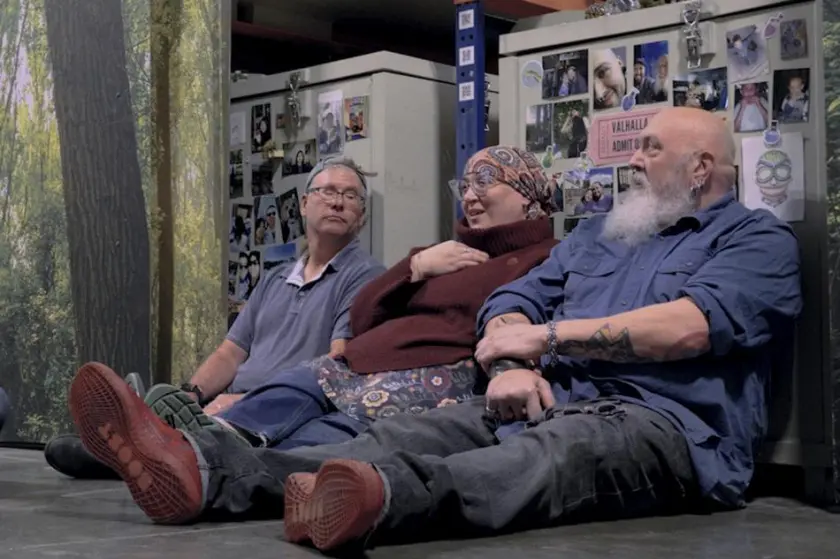
Since the body temperature naturally increases to 140 degrees or more during this process, some clients find it very comforting to sit against their loved one’s pod and feel their warmth as the microbes do their work. Brie and Katey talk about the specific earthy smell the soil produces. Families are even invited to join in the body preparation, which includes full washing, reconstruction, and even hair styling. The result is a full-sensory experience for the grieving families.
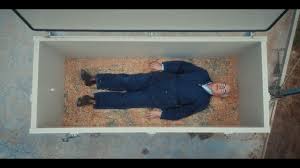
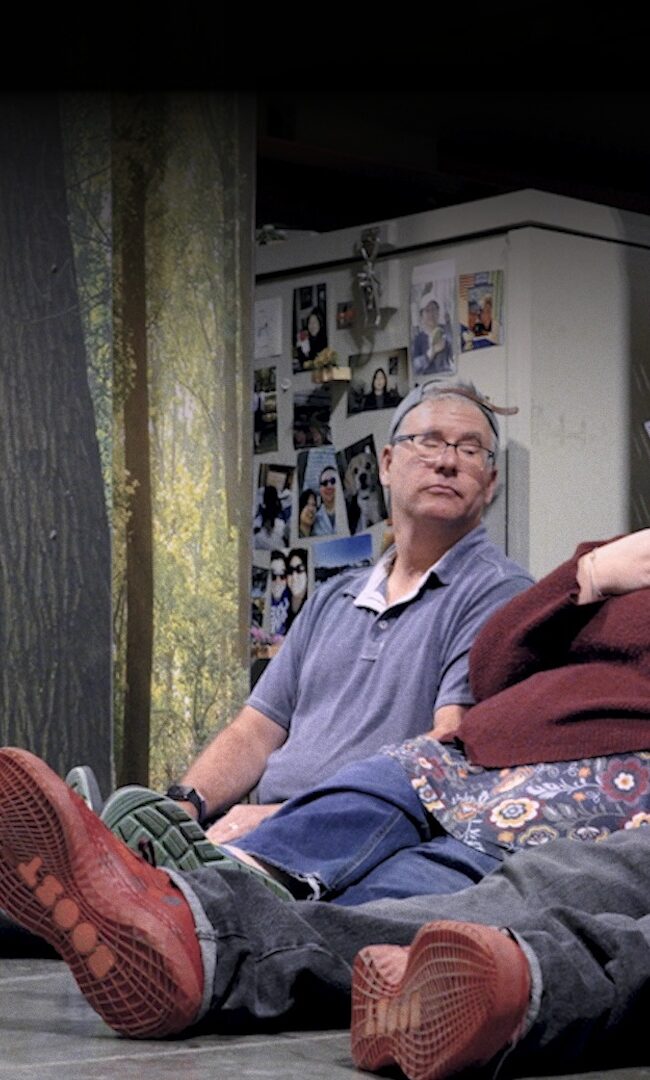
A still from THE LIFE WE LEAVE
This involvement becomes especially important when families lose children. Brie and Katey agreed early on that the worst thing about being a funeral director is swiping the credit card of a parent who has lost a child. That’s why they don’t charge for children under eighteen. Initially, they lost a great deal of of money on this policy, but the fact that they never wavered, even under financial duress, speaks volumes about their character and their mission.
In a particularly poignant moment, Micah captures Katey reading a “last story” to an infant. Until then, he had no idea that this was part of her process with children. She doesn’t do it for the benefit of cameras or an audience. It’s a moment between her and the child she has prepared for their transformation journey. With something as senseless as the death of a child, you search for meaning anywhere you can. As one parent says, “There’s comfort in knowing he is here,” metamorphizing into something that can create and sustain new life out of the one that was lost.
The decedents aren’t the only ones who change. Throughout the course of the film, we watch Micah Truman change from a tech bro with a start-up idea into an empathetic person with a calling. “I don’t ever wanna be numb to what happens in here,” he confesses to the camera. For better or worse, Truman throws his whole being into Return Home. At one point, he describes it as his “mistress”, which certainly helps to explain the circumstances that lead to the dissolution of his marriage. We don’t see much of the “Return Homies” outside of the facility. It seems that providing an all-encompassing funeral service can also be all-encompassing for the ones providing it. Whatever the extent of their sacrifices, it truly does seem to be in service of the greater good.
Experience aside, the film also briefly touches on the environmental mitigation of human composting. Early on, a google search montage delivers some very alarming statistics about the impact of burial and cremation. Those two options combined form a $20 billion a year market in the United States, using enough wood to build 1800 single family homes, enough metal to build to Golden Gate bridge, and 2-4 million gallons of embalming fluid, which eventually leaches into soil and ground water. Embalming fluid also creates a long-term occupational health hazard for undertakers many of whom develop respiratory issues, nervous system disorders, and blood and nasal cancers. Even cremation (which perplexingly requires embalming first), has a huge environmental footprint, accounting for around 60% of all post-mortem services. 600 pounds of CO2 is released with every cremated body.
This film makes a great case that human composting is not only a more environmentally ethical choice, but also the only option with a transparent cost. Much like this film, it forces you ponder the physical process of decomposition and come to see the beauty in it. While the person you loved is gone, they have become something bigger than themselves. Forget “ashes to ashes”. This is soil to soil. I can’t think of anything more comforting than that.
– Jessica Baxter (@TheBaxter)