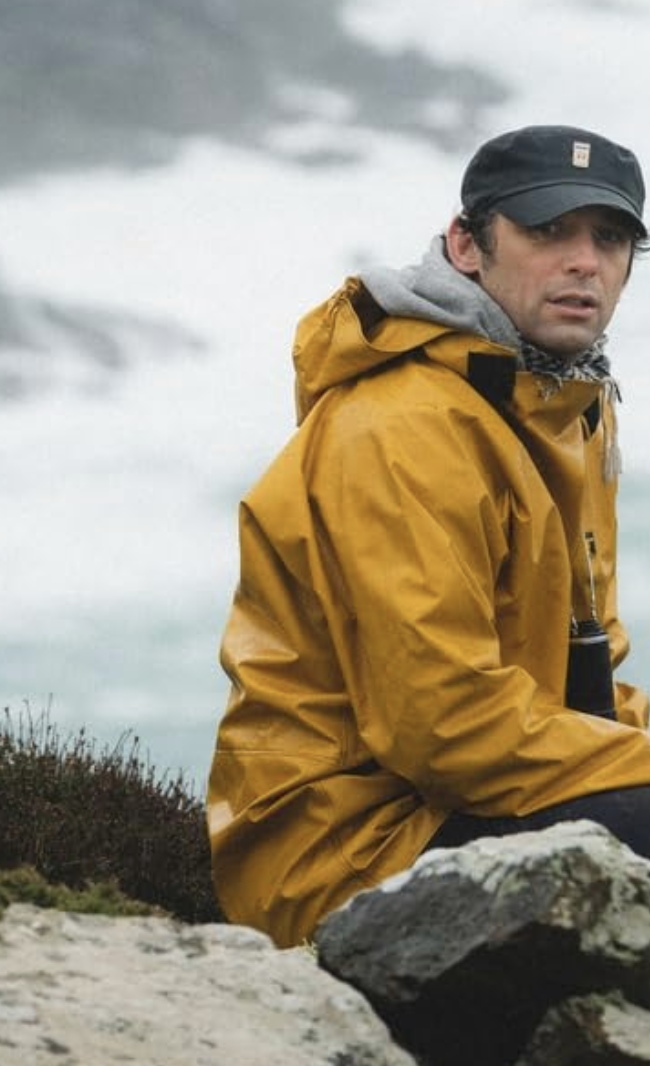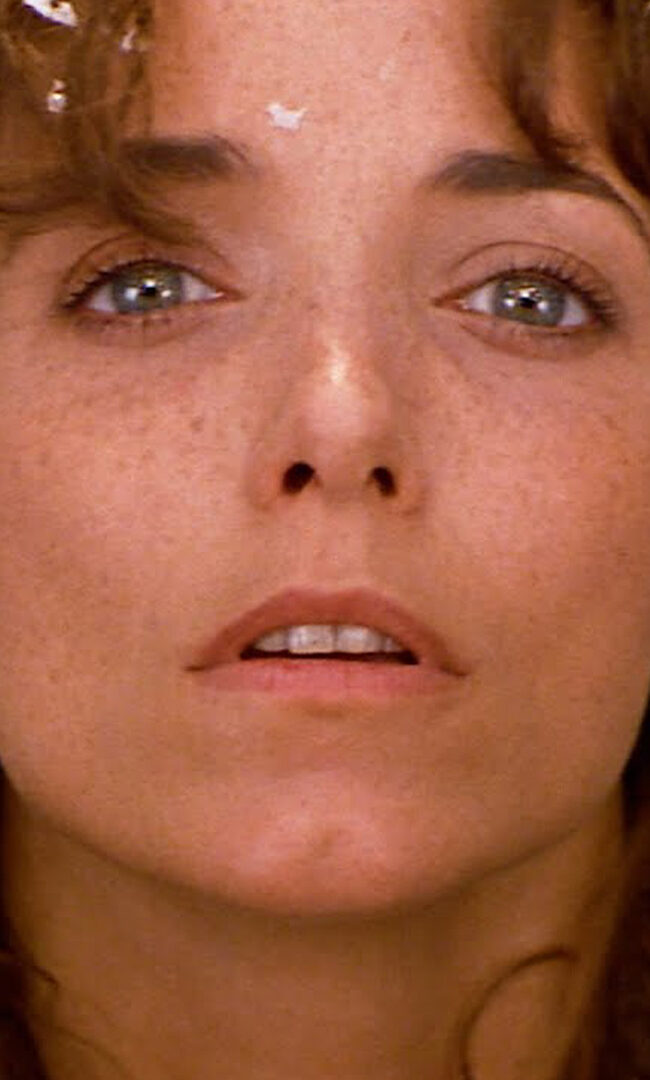





A Conversation with Reed Birney, Kieron Moore & Elliot Tuttle (BLUE FILM)
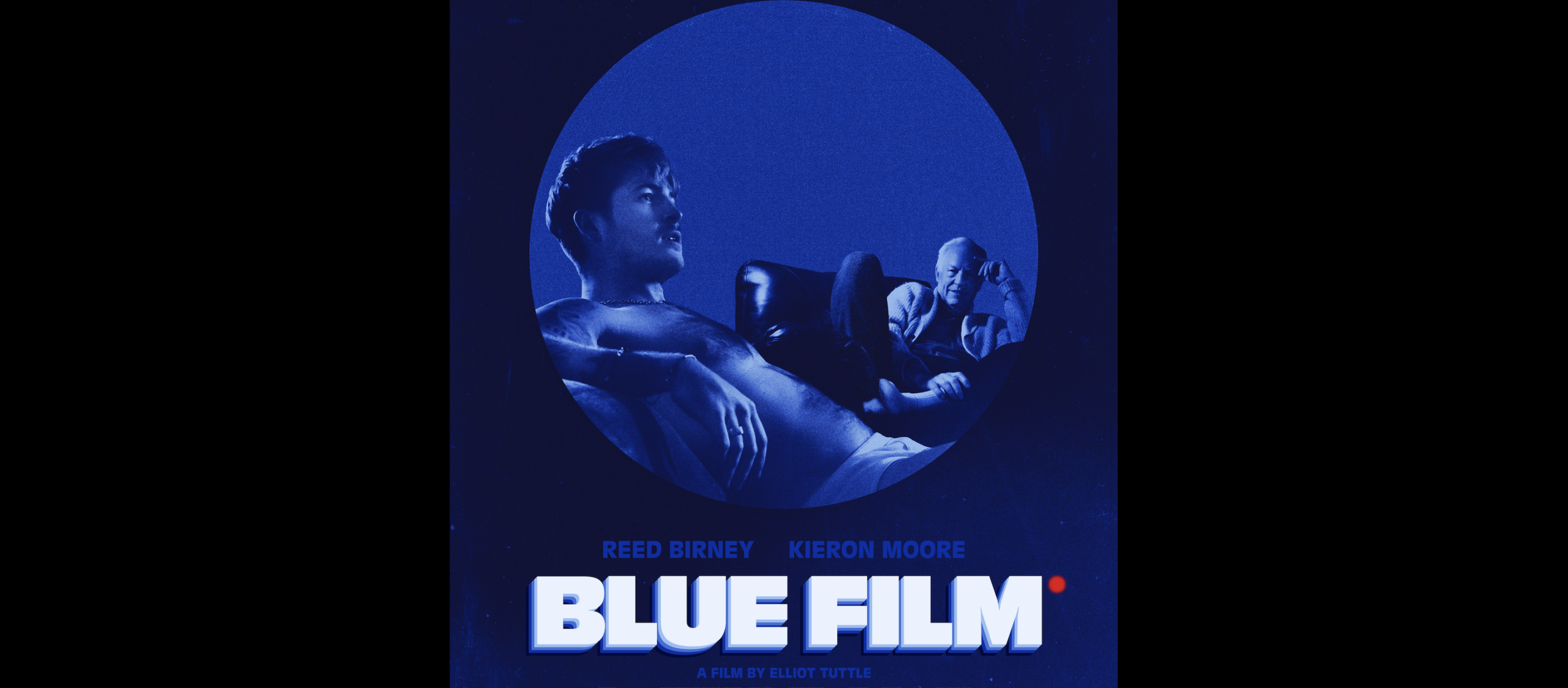
Blue Film is one of the most daring American debuts in recent memory. Written and directed by Elliot Tuttle, the film traps two men in a Los Angeles Airbnb for a single night and refuses to let either of them off the hook. Aaron Eagle (Kieron Moore), a hypermasculine fetish camboy, has been hired anonymously for fifty thousand dollars. His client, Hank Grant (Reed Birney), is a masked stranger with a camera and an unsettling line of questioning. When Aaron recognizes Hank as his former middle school teacher, who served prison time for attempted sexual assault of a minor and was once in love with him, the masks come off and a marathon of confession, role-play, and reckoning begins.
Tuttle, making his first feature, draws on Catherine Breillat, Pasolini, Lars Von Trier, and the icy chamber horror of Agustí Villaronga’s In a Glass Cage, but the film does not feel derivative. Shot in twelve days in Hancock Park with consulting producer Mark Duplass behind it, Blue Film operates with an art-house European boldness that American independent cinema has largely abandoned. The film moves between cinematic 4K and a snuff-adjacent camcorder format, threading home video footage of Tuttle himself as a child through the chamber drama. Isaac Eiger’s score deepens its dread.
Reed Birney, a Tony winner whose work on stage and screen needs no introduction, gives one of the most heartbreaking performances of his career as Hank. Kieron Moore, a Manchester-born actor previously seen in the Netflix series Boots, is a revelation as Aaron, calibrating between bravado and devastation with terrifying precision. I sat down with the three of them to discuss the moment the mask comes off, the documentary research that shaped Hank, the cinematic reference points, the format changes, the score, and the chronological shoot.
Hammer to Nail: I’d love to first discuss the moment the mask comes off, after Hank calls him by his real name “Alex.” What was important to each of you in that transitional moment?
Kieron Moore: For me, I just wanted to get as close as I could to feeling like a little boy again. All the bravado kind of drops and you’re transported back to a time in your life where you lose your physiology. I don’t know if I achieved that, but I felt it in the moment. The look that Reed portrays in that moment as Hank has such a vulnerability and tenderness to it that it comes this whole other life. It’s such an interesting moment in a movie where the big twist comes so soon. You kind of have to have enough weight to keep you intrigued. I think it does that. At that moment, all I could remember feeling was that it was the first time a real mirror had come up. I always like the idea that Aaron’s audience is always through a lens, so he’s never actually seeing himself be perceived, he’s kind of gloating in his performance. Whereas once that balaclava comes off, it’s like he sees his first real viewer, he’s actually being perceived by someone who knows him, and that is terrifying for most of us.
Elliot Tuttle: In the original script, Aaron said something else when the mask came off, didn’t he? He didn’t say Mr. Grant.
KM: I said something about you look older. We changed it to no hair.
Reed Birney: I’ve lost some hair.
ET: Or I just gave that line to Reed.
RB: It’s a wonderful moment. It was a wonderful thing to play.
HTN: Elliot, you watched a lot of documentary material, Pervert Park especially, before writing Hank. What specifically about him came from listening to those personal stories that you wouldn’t have been able to find on your own?
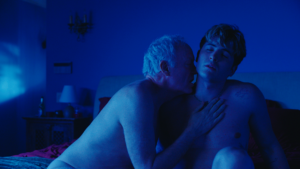
A scene from BLUE FILM
ET: From listening to all of that personal testimony, it was hearing how wracked with guilt so many of these people are. So many of them have experienced child sexual abuse themselves. It’s a staggering amount of the sex offenders I was researching who had experienced some form of it in their childhood, and it completely warps the way they think about sex and love as means of connection. Then it seems like many of them are also wracked with guilt. So much of the Hank character is kind of a self-flagellation. He still lives in the town that he did this in, he’s still gone back to church, so much of his life is trying to contend with what he’s done in a way that he’s wrapped up in his own moral existence. That definitely fueled how I thought about the Hank character. He’s probably on a never-ending path of guilt. He feels guilty for James, but he also feels guilty, period. He feels bad about himself. He’s elected to face James on a weekly basis at the grocery store. That seems like some huge atonement.
HTN: Elliot, the film comes from your own adolescent memory of wanting a teacher to want you. Reed and Kieron, when did you guys learn that, and did knowing the origin change how you carried these characters? Even your home videos are spliced into the film.
RB: I don’t remember when you told us that, probably at dinner the first night we got to LA, but I was struck by Elliot’s candor and openness, which was a great boost to all of us trusting him and each other.
KM: With any character that I play, the other performer in front of you finishes your character for you. As does the writer. You can only bring so much, and then it becomes a collaborative thing for me. My Aaron and Alex are informed massively by Reed and his performance, because you bounce off each other, you fill in that gap, you mold and you dance, and that’s quite exciting. On the Elliot front, when Elliot told me that, I do remember in the back of my head going, I know who he is. I think there was a final little bit of a gap that may have been there, and I knew I could probably steal from watching Elliot and getting closer to Elliot, because we put so much of ourselves in what we do. When it comes to the home footage, it’s a really brave thing.
My acting coach and Reed and I have talked about this. My acting coach said something when he first watched the movie. He always challenged the idea that, what if the baby footage just represents innocence? What if it’s not Alex? What if it’s not Hank? What if it is Hank? What if it’s just a metaphor for purity? A symbol of innocence that’s taken away in some way. The movie changes if you watch it as if the footage is Alex, if you watch it as if it’s Hank, and if you watch it as if it’s neither. That’s quite exciting, really. I don’t think a lot of people will do that, but if you come away and try it, it makes the movie something else. It is very jarring when you watch it. Every time I see the movie and that first comes in, this weird thing starts to happen, which is beautiful, you start to relax after this chemistry washes over you, and then it comes and gets you and sobers you immediately. So you’re constantly reminded of this shadow or this darkness lingering in the undercurrent.
HTN: Elliot, you cited Breillat, Pasolini, Von Trier, and In a Glass Cage specifically. Reed and Kieron, were those reference points useful to you as actors? You can feel those cinematic references, but these performances are so grounded, it does not necessarily feel like it stems from those films. So as actors, did you reference those movies prior to the shoot? And regardless, Elliot, can you talk about working off those references?
RB: I’ve never seen any of those filmmakers’ movies. Not one. There’s the headline. I need to. I want to, but I haven’t.
KM: I’m a big supporter of cinema, I love what we do and watching all the performers. But I think it’s really difficult to watch anyone’s performances when you’re preparing a performance. If you’re an artist that does that, all credit to you, that’s amazing. But I don’t want to see someone’s version of grief. I want to find my own version of it. I want to find my own version of shame, I’ve got enough of it. I’m a human being. So a lot of it for me is relying on the writing, again, Reed and Elliot, but then our own imagination. It’s my version of that. It’s my attempt to create something that people can sit with and explore their own ideas through. If I’ve done justice to any of them or to the performers, that’s incredible. They’ve probably shaped me in some way subconsciously. But there’s a danger in recreation. You’ve got to find your own way a little bit.
Yeah, it’s not my job. I wouldn’t go to Reed and Kieron and be like, the movie needs to feel like this when the movie’s done. Those would not be helpful to them.
A scene from BLUE FILM
ET: Yeah, it’s not my job. I wouldn’t go to Reed and Kieron and be like, the movie needs to feel like this when the movie’s done. Those would not be helpful to them. There are films that I could probably tell, like, I wouldn’t change anything about the performances, but in terms of the characters, My Own Private Idaho would be a cool Aaron reference, and Visconti’s Death in Venice could be a cool Hank reference. But the movie Blue Film doesn’t feel like either of those films. It’s a different beast. All those filmmakers I’ve talked about, Breillat, Pasolini, Von Trier I took something different from all of them. Breillat has such honesty in the way she excavates adolescent sexuality. Pasolini does something that’s very gay all the time, even in his sensibility, and also a kind of complete refusal to bend a film to a social norm or cause. Von Trier, for his irreverence, the feelings of the audience are almost secondary in the making of the movie. He doesn’t care what crazy shit he’s putting on screen. He’s just doing it and he trusts that the audience will receive it. There’s so much I feel like I pulled from these masters, that I could only hope to one day reach them. But I wouldn’t subject Reed and Kieron to hearing me say any of that when we’re making the movie.
HTN: Can we discuss the decision to switch the camera for the shaving scene to halfway through that role-playing sequence? What was your thinking with Ryan Jackson-Healy on that, and as actors, how does playing to that new camera impact your performance?
ET: I love the format changes in the film. We made this film on a very low budget and very short on time, and you have to find ways to energize the frame as you’re getting standard coverage. To me, that camcorder aesthetic straddles a line between snuff film and family home video in a way I think is very interesting and puts an audience member on their back foot. It’s used in these dissonant ways when Aaron is slipping out between Alex and Aaron, when it’s a textural way to tell the story. But I tried to use it sparingly. If I went crazy in the editing room, I feel like I could have told half the movie with that, but I wouldn’t have.
RB: I wasn’t even aware that the camera changed when we were doing the shaving scene. I know we were stuck in that bathroom on top of each other and Kieron was wet, and I had other things on my mind than what camera they were using. I was wielding a razor. I think the most upsetting thing in the movie is that I shave him with a ninety-nine-cent disposable razor.
KM: I don’t think you notice it. Some people say your camera is your bridge to the audience. I think the best thing to do is forget the thing. I’ll do it, please catch it, I don’t have to think about that. But I do remember the first time I watched it at Edinburgh in the cinema and the switch happened. Part of me subconsciously was like, wait, they’re really going to do this on a camcorder, what have I signed up to? It was a fear. And then I remember watching it and the impact of it is pretty remarkable. There’s something, I love Polaroids, I love 35-millimeter photos, it feels like a memory because it’s not polished. There’s a vulgarity to it. It feels very, very real, but at the same time it also feels like you’re in that fucking room, sorry for my French. You can’t look away. It’s like we’ve stopped being in a film. You think the film couldn’t get any deeper, and it does.
RB: The jump from the camcorder interview of Aaron on the couch to the 4K shocks me every time. It suddenly becomes so crystal clear and scary.
HTN: It creates a real immediacy and intimacy. Credit to your director for disappearing the camera for both of you.
KM: Ryan would hide under a blanket in the room, so it’d just be us two. Elliot would sit in a corner, invisible. They did everything to make this as safe and as intimate as possible. I have to give him a shout-out for that, because I’ve never been on a set where the actor gets thought of that much. For a small-budget indie with a first-time genius film director and writer, the way things were thought about, I’ve never had those experiences, and I’ve been on some pretty big sets in my short career. That thought of, we want to get this as authentic and comfortable as possible, is really a treat.
HTN: Isaac Eiger’s score is doing a lot of emotional work and provides a lot of eeriness. How early did music and sound enter the conversation? Did either of you guys get to hear any of the music before you shot, and was there any music played on set to create a certain mood?
KM: Elliot sent me a playlist for Aaron, which is our little secret. I’m not a massive music guy, so I lean into that a little bit for roles. That was another layer of transcendence. A couple of scenes, Elliot would be like, just go and listen to the song, that one on the playlist, have a think about how that makes you feel. There was the AW for Lana that day. He’d say, remember that song, that bit in the song. Especially for my first day, which was the cam scene, that was a lot. Elliot sent me these great songs, and music does transport you. I’ll never forget the first time watching when I got to do the monologue about becoming Aaron Eagle and that score kicked in. It’s like my dream to be in a movie and a score is transcending with my dialogue. It makes that dialogue way better than I was on the day.
ET: Isaac Eiger, our composer, is great, he’s so talented. He came on after we had finished production. He’s a genius, and I love his score for the film.
A scene from BLUE FILM
HTN: Obviously, the scenes pre-and post-shave needed to be blocked in sections, but how much of this could be done chronologically? It’s a film that builds and builds, and I can imagine it’d be very helpful as a performer to experience this film as chronologically as possible. Can you talk about the order in which you shot it, and collaborating with your first AD?
ET: It was very chronological. Shout out to our first AD, Mark, because he helped facilitate that beautifully. Our second AD, Lana, was great too. It was necessitated by the shaving, but also just because we were all at a different place on the last day than we were on the first day, which would always be the case. That was a joy of making the movie for me, that I got to shoot it pretty much that way.
RB: I don’t know how we could have shot it out of order, honestly. It would have been a lot tougher. It at least would have required a lot more rehearsal than we had time for. So it was great doing it chronologically.
KM: Life gives you what you need, I always think, on a job. The shaving was a big dictator of certain scenes, obviously. It was always agreed upon, because we had to get to a certain point with the shaving, that we’d go as chronologically as possible, and then we knew in the middle that all of the intimacy scenes were going to take place on two days in between. So then the rest of the movie just carried out as best as we could after that. It was really helpful for me as an actor, to be like, right, we’re going to hit this point in the middle that we all know is coming and we’re going to just get it done. The heaviness of that and the expectation and the little fears and the excitement all meld into the performance to give you what you’ve got. The intimacy scenes being compacted together gave me the ability, and hopefully for Reed, to go, this is where we started, this is the middle, this is the finish. So they allowed us to have a mini-movie in between of how that relationship grows or that dynamic grows, before we go back to the emotional weight of everything else. If only every job could be that way.
– Jack Schenker (@YUNGOCUPOTIS)