





(Check out Lauren Wissot’s The Welcome Table movie review, it’s streaming now on HBO. Seen it? Join the conversation with HtN on our Letterboxd Page.)
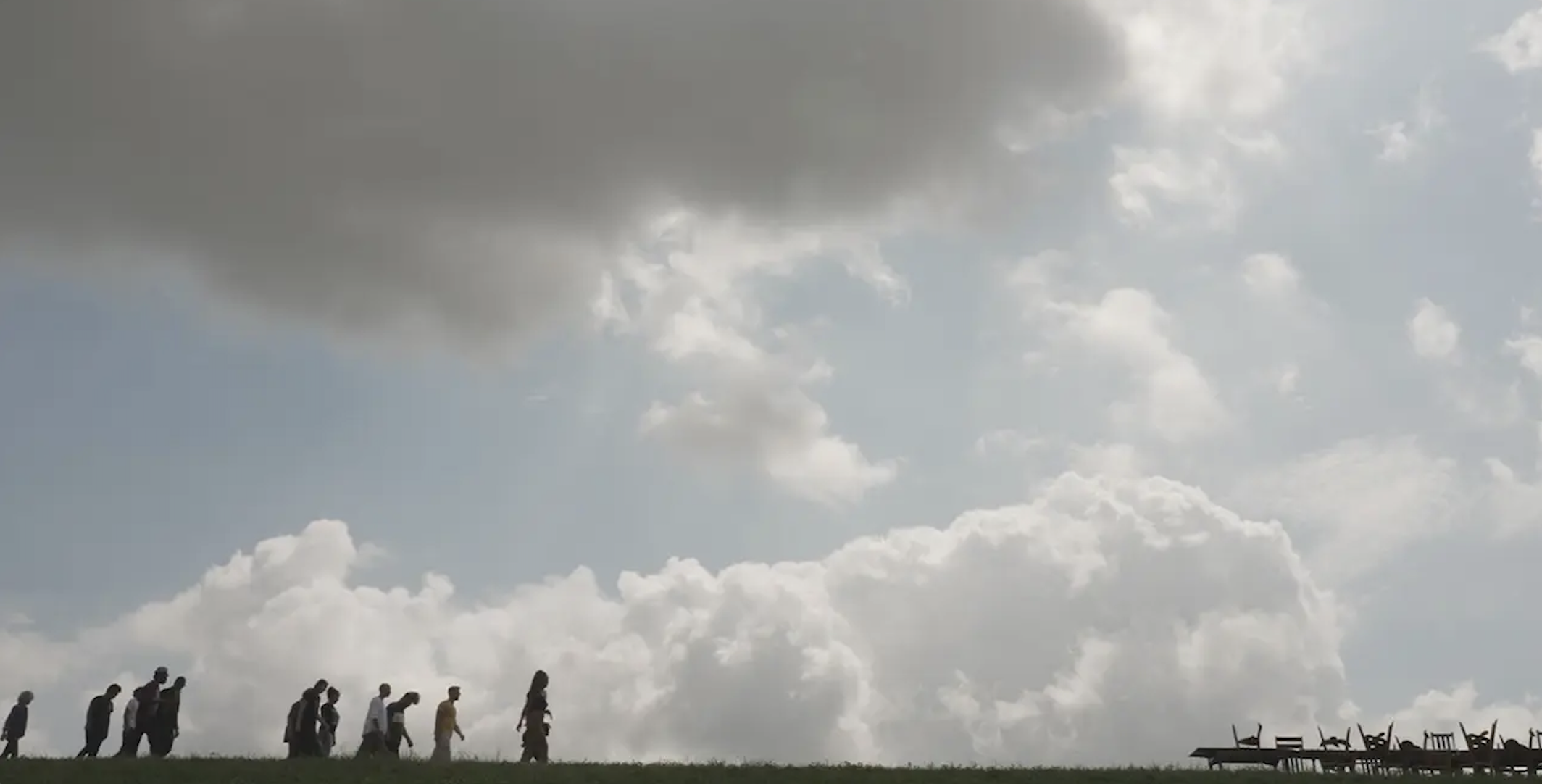
The latest creative endeavor in award-winning filmmaker Josh Fox’s (Gasland, How to Let Go of the World, The Edge of Nature) decades-long mission to spur climate action, The Welcome Table follows the connected tale of environmental destruction across six continents (and one very long art installation), centering the stories of those who call the frontlines home, from Paradise, CA to the paradise lost of the Peruvian Amazon. In turn, these climate refugees are brought together at a thousand-foot table along a New Orleans levee (at least those not denied Visas) to share their experiences, take inspiration from one another, and of course, enjoy some musical interludes as Fox is a fervent believer in “protests that sing.” (Among the acclaimed New Orleans musicians featured is the jazz artist John Boutté of “Treme Song” fame, who serves as both EP and primary offscreen narrator alongside the director-writer-environmental activist who likewise performs.)
From the start Fox makes the point (in VO) that we are all migrating right now as a result of climate change — to a different planet that mankind has never known. We can never go home. And “it’s not like anybody’s got a plan,” notes a wry guy whose house went up in flames out west. “Oh, I guess if my entire neighborhood burns down, where do we go next.” Visiting a favela in Brazil the director follows an impoverished family that’s lost everything in a mudslide. And then suddenly, as Boutté exclaims in VO, “it happened, a queer dream team of mutual aid disaster workers showed up to the rescue.” (Though a gay guy, a Black trans woman and a nonbinary individual banding together to rally an abandoned community isn’t all that surprising given that LGBTQ+ folks of color have long been forced to save themselves.)
Traveling to the Peruvian Amazon, Fox films with the Achuar people (including the tribe’s media coordinator). Their leader stresses the need for the world to transition to a “bioeconomy.” However, as the filmmaker later laments, “Money travels faster than people and rarely respects borders.” And those who stay in climate-ravaged areas, whether by choice or circumstance, become displaced persons in their own communities. For climate gentrification is likewise happening globally, from the Indigenous lands of Australia to the Airbnb-clogged Treme neighborhood of New Orleans in the aftermath of Katrina. Though, as a Maori woman wisely counsels, “If everyone learned like my forefathers, to share, we wouldn’t be in this problem.” Indeed, by the time drone footage sweeps us along the table’s lengthy entirety, every seat around the massive structure filled with citizens from across our endangered planet, such a farfetched dream unexpectedly seems within reach. While environmental collapse respects no border walls, as Fox himself emphasizes at the end, “A wall on its side can be a table.”
– Lauren Wissot