






(Check out Chris Reed’s Romeria movie review, it’s in theaters now via Janus Films. Seen it? Join the conversation with HtN on our Letterboxd Page.)
In her phenomenal 2017 feature debut, Summer 1993, Spanish director Carla Simón brought challenging moments from her own childhood to vivid cinematic life. Now she returns to autobiography in her third feature, Romería, in which her protagonist, Marina, travels to Spain’s Atlantic coast to discover the traces left behind by her long-deceased parents. Combining coming-of-age elements with trauma, memory, and fantasy, the movie proves equal parts compelling and moving, anchored by a strikingly multilayered performance from its young lead, Llúcia Garcia.
The title—which Simón explains in the press notes is a common word in southern Spain—refers “to the pilgrimage of the faithful to a shrine or hermitage to pay homage to a religious figure, such as a virgin or saint.” Though Marina’s mother and father were both serious drug addicts who died of AIDS, and therefore not everybody’s idea of saints, they are presented here as they were: young and full of hope in the 1980s. It was a time when the new generation of Spaniards embraced freedoms once denied them under their dictator, Generalissimo Francisco Franco, who died in 1975.
Unfortunately, though Marina appears to have been raised with love by her adoptive family, she has had virtually no contact with her uncles, aunts, cousins and grandparents on her father’s side. Until now, at the age of 18. In order to qualify for a university scholarship, she needs a document that verifies her lineage, which is what brings her to Vigo, the Galician coast city where she was born.
The film opens with Marina’s point of view through the video camera she brings everywhere. As will learn, she plans to study cinema in college. The story takes place over 5 days, each with its own chapter heading, coupled with an extended flashback sequence in the middle of the final section. With humor and pathos, Simón shows us how a teenager on the verge of adulthood copes with the stresses of her unknown past.
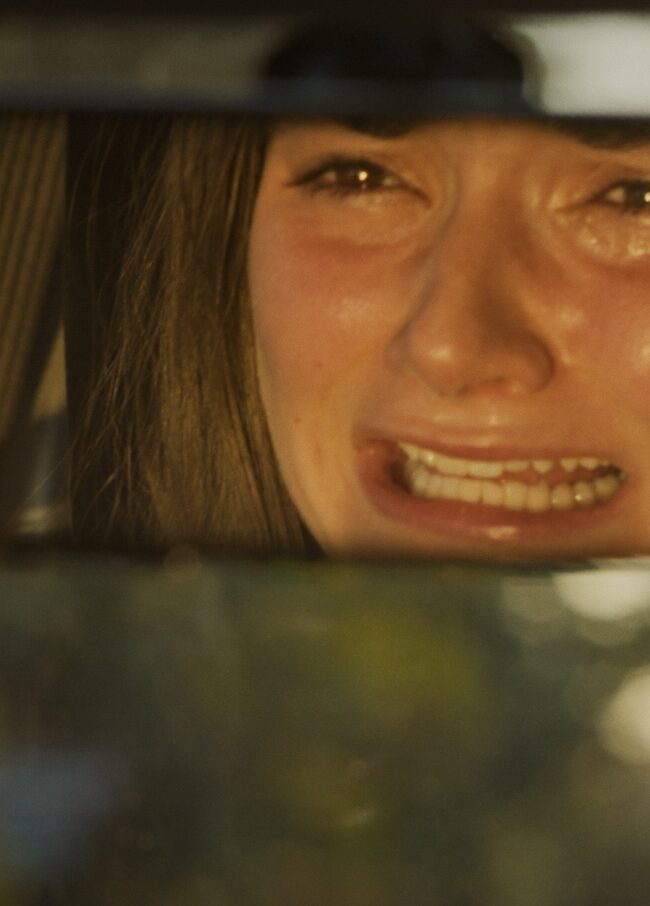
Marina demonstrates great resilience, in fact, and thanks to Garcia’s subtle shifts in mood, extraordinary complexity, as well. When her grandfather—who has heretofore done his best to ignore her existence—gives her an envelope full of cash by way of penance instead of the signature acknowledging his son’s paternity, we see competing emotions do battle across her face. This is not what she wants or needs, but nor is this moment, with her cousins also in the room, to argue.
As goes Garcia’s acting, so goes the movie, with Simón’s bold directing choices providing ample creative support. So invested are we in Marina’s mental health and well-being that it almost comes as a shock when Simón suddenly shifts gears to enter the realm of reverie. Yet that works, too, before the movie returns to the drama at hand, resolving the conflict in the most satisfying of ways. As pilgrimages go, Romería offers a profound spiritual experience.
– Christopher Llewellyn Reed (@ChrisReedFilm)