



A Conversation with Alex Huston Fischer & Eleanor Wilson (WICKER)
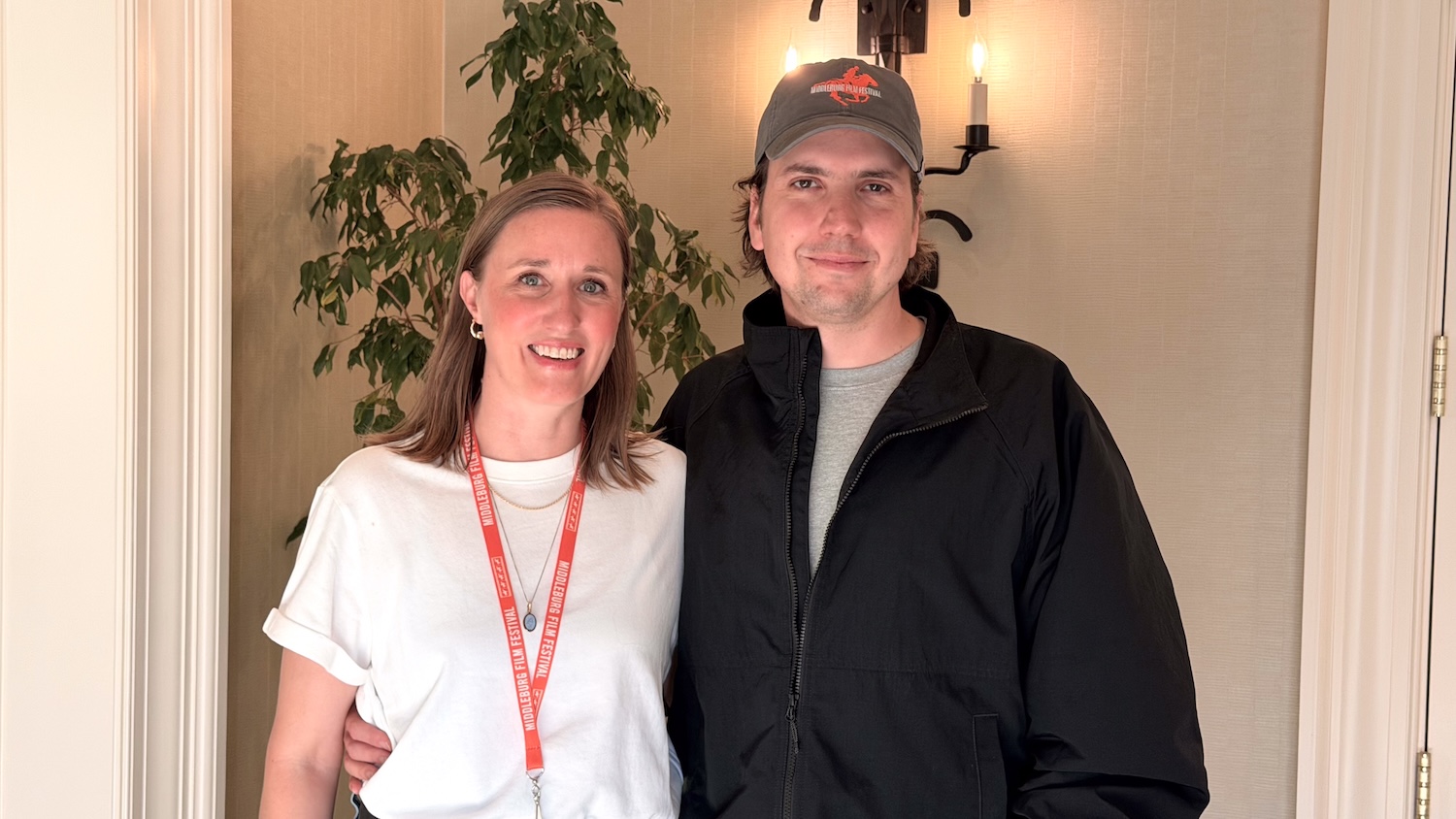
I watched (and reviewed) Alex Huston Fischer and Eleanor Wilson’s new film, Wicker, at the 2026 Middleburg Film Festival. The movie stars, among others, Olivia Colman, Elizabeth Debicki, Peter Dinklage, and Alexander Skarsgård. Set in a medieval village, Wicker follows what happens to Colman’s Fisherwoman after she orders a husband made of wicker from the Basketmaker (Dinklage). Skarsgård plays the new creature, a devoted spouse who is very fond of sex. The happy couple’s conjugal bliss upsets the careful order of things, starting a revolution of sorts that shakes up everyone’s ideas of what’s right. I spoke with Fischer and Wilson at Middleburg, and here is that conversation, edited for length and clarity.
Hammer to Nail: I really enjoyed your previous film, Save Yourselves! Could you tell me about Ursula Wills’ short story, “The Wicker Husband,” which is the basis for your new movie? I haven’t read it. How did you come across it and how does it differ from your movie?
Eleanor Wilson: So, the short story was sent to us by one of our producers, Justin Lothrop, who was a fan of Ursula’s work. And he just thought for some reason that we might be interesting people to adapt it to a film.
Alex Huston Fischer: Which is a surprise based on our first film, which is not the same. (laughs)
EW: (laughs) It’s different. Yeah. And we immediately fell in love with it. It’s such an interesting fable. It felt like it had such a clear reason to be made visual because we thought we’d want to see the Wicker Husband. And so that felt like a worthy reason to make it into a visual medium. And it also was just a very beautiful five-act structure with a ton of tiny little hints. The short story is only 14 pages long, so you wouldn’t think that it would adapt well to a feature-length film, but every sentence is loaded. And there were just so many tiny sentences here and there that just felt like sparks that we were able to really expand into full characters and full scenes and full stories that we loved so much. It was kind of a perfect and joyous adaptation process.
AHF: We exploited every sentence. (laughs)
HtN: I’ve heard lots of opinions on the fact that short stories actually make for better adaptations than novels.
AHF: I think so.
HtN: You can do it more justice. You’re expanding rather than shrinking.
AHF:: There’s room for invention and you don’t have to get rid of anything that is crucially important to the novel. We have adapted one novel. We had a great time with that, as well, but I think the short story is really a one-to-one with a film, almost. And a novel makes more sense for a TV series.
HtN: What would you say to somebody who hasn’t read the story about how your version diverges from the source material?
AHF: In a spoilery way? (laughs)
EW: Well, sure, but I think you could also just say that the story is about a woman who asks the Basketmaker to make her husband and the village that she lives in becomes envious of this relationship in a variety of different ways. And I think that’s probably one of the biggest changes because in the short story they all have a similar intention and become kind of one angry mob. So with, like I said, these little clues …
AHF: More like a fairy tale, the angry mob with the …
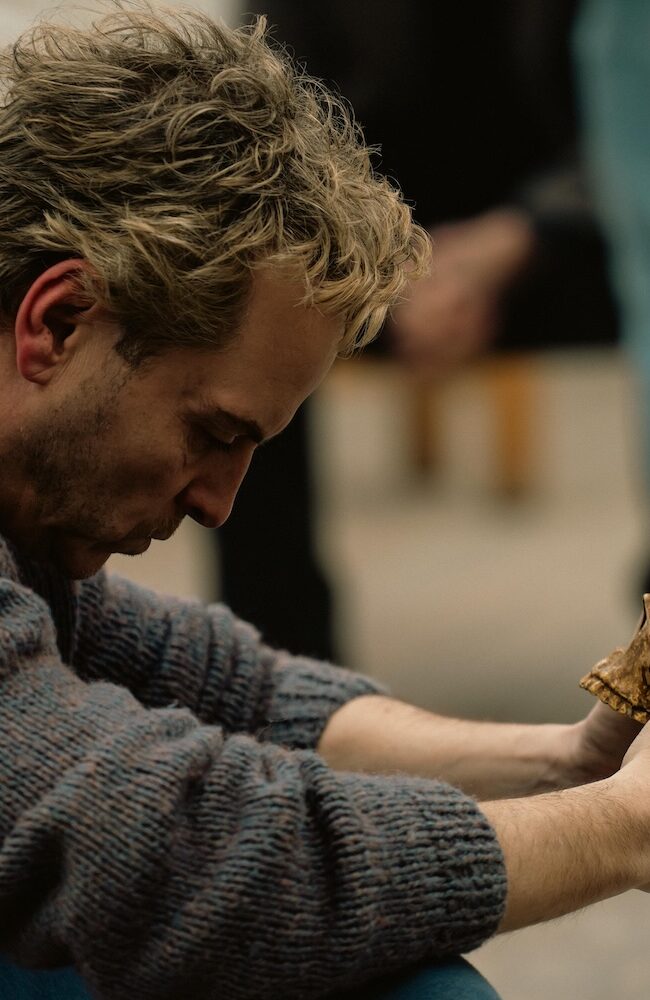
Our Chris Reed, Eleanor Wilson & Alex Huston Fischer
EW: … pitchfork-type thing. So we thought that this was sort of a perfect opportunity to take the village and find out exactly who these individuals were, who these couples were, what their actual problems are and split that apart a little bit and really dig into the characters.
AHF: Dig into the psychology of them.
EW: Character by character or couple by couple, what their problems are. And that was sort of the starting point, I guess, for the adaptation. And then we really just let the characters inform where some of the plot turns went, which was really fun to come at from a character way.
AHF: And the short story is really about envy and jealousy and it’s more of a moral tale. The adaptation—we didn’t necessarily plan this—became more of a romantic story.
EW: Yeah. I guess we fleshed out the relationship between the Fisherwoman and the Wicker Husband a lot. I think some of that romance that came from the process of writing it even took us by surprise, just as it takes the Fisherwoman by surprise.
AHF: We went hard on the comedy.
EW: Yeah, sure. We pushed the comedy a little further.
HtN: Speaking of the romance and the comedy, you two are of course married and you write in the press notes how you basically just roasted each other as you developed the script for Wicker. I’m curious, if you each had to pick a favorite moment of this roasting process as you were writing the script, what comes to mind?
EW: Yeah. Well, we write scenes separately. There’s a lot of really personal stuff in this screenplay, but actually one scene, this is sort of more of a discovery after the fact, but there’s a scene where the Fisherwoman and the Wicker Husband are talking and she’s sort of starting to question him in a bit of a slightly untrustworthy way, I guess.
AHF: She’s skeptical about something.
EW: Right. He’s answering her back very plainly and very …
AHF: … very literally.
EW: Very logically. Alex wrote that scene, which is so brilliant. It’s so funny and I think you even had the Fisherwoman’s intuition, as well. And when we talk about that scene now, Alex is like, “Yeah, it’s so funny because he’s just responding to her in a completely normal way and for some reason she’s …” And I was like, “Oh, is that what you think is happening in that scene? Because he’s clearly not reading her cues that she’s very obviously putting out there.” And we sort of found that it was a very interesting thing that even though you had written that scene, I had such a different perspective on it and both are right. (laughs)
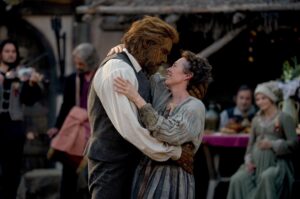
A still from WICKER
AHF: He’s basically answering very literally and logically, and I thought it was funny that that’s how most men sound in an argument. It’s like, “Well, I’m just answering the question that you’ve asked me.”
EW: Which is infuriating because you’re not actually getting at the real problem that’s going on or addressing the person that’s in front of you.
AHF: He doesn’t quite have the EQ yet to read the room, but he’s developing that.
EW: He’ll get there.
HtN: He’ll eventually figure out what subtext is.
AHF: Yes.
EW: Exactly.
HtN: Well, I hope so … in the sequel.
EW: (laughs) Yes.
AHF: (laughs) That’s right.
HtN: So, you also write in the press notes that when Olivia Colman signed on, the movie became real. What kind of back-and-forth did you have with her, or her people, in presenting this to her?
AHF: It was very straightforward and a shock because we just really sent her the script through agents.
EW: As you do.
AHF: As you do, and she liked it and signed up for it without … there was no financing for this movie, no idea how much she’d be paid or what the scale of it would be. She was just like, “I like this and I will do it. We’ll figure it out.” And she came on as a producer, as well.
EW: Not to mention that we had also only made Save Yourselves! before this.
AHF: It didn’t matter. 10 times the scale of that movie.
EW: Right. And it’s really, really wonderful that there are actors like her that exist that are willing to take a risk on filmmakers such as ourselves and say, “I like this. I think it’s good. Let’s do it.”
HtN: You do know what this means for you next, though, right? If you follow the path other indie filmmakers have taken, you have to pick which Marvel film you’re directing.
EW: Yeah, we’ll see. (laughs)
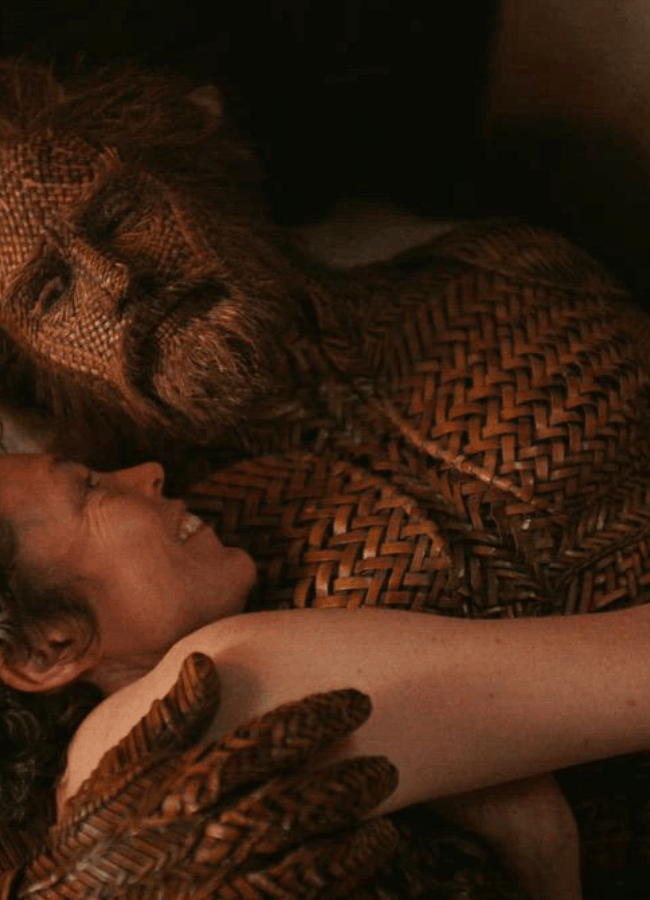
HtN: I love Alexander Skarsgård as the Wicker Husband. And I read with interest in those same press notes about the prosthetics that you developed. Is it all just prosthetics that we’re seeing? Is there any sort of post tweaking of that, as well? How much was actually there, live in the filming, and how much was done in post?
EW: The whole performance is practical and the whole prosthetic, the suit … there’s nothing that we did to his face. We didn’t have to animate it, if that makes sense.
AHF: We did a little bit of cleanup.
EW: In one or two scenes. I mean, not a lot.
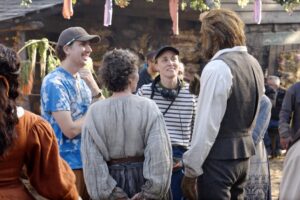
AHF: I would say the amount of cleanup that we did on him is less than a normal human actor would get in a regular Hollywood movie. And then we made him hollow, which was an incredibly technically challenging, but gorgeous, effect that sort of completed the special effect of the whole character. But he walked around like that on set. That’s what he looked like. And you can see it in the BTS footage and it was sort of a marvel to experience in real life.
EW: Obviously as the film goes on, there’s some other …
AHF: There’s some other VFX, yeah.
HtN: I really like the sound design of his body, as well. Can you talk about developing that? Because it’s not just a basket being moved around—there’s more going on—but it is rooted in what perhaps a sentient basket would sound like.
AHF: That’s right. It is completely correct. (laughs)
EW: Our sound designer is Andy Neal, who I’ve worked with for many years. He mixed my short films and he’s a really wonderful creative partner. He came on board really early, before we were picture-locked, which was huge, because he just wanted to get in there. He knew that he wanted anyone who’s watching early cuts of the movie to be able to live with these sounds and it was just wonderful for us to have that layer in the process because honestly we sort of forgot throughout the process that it wasn’t production audio because it was so integrated. He did a lot of early Foley work on his own with baskets and seaweed. He was crunching seaweed.
HtN: Oh, that’s so interesting. I wouldn’t have thought seaweed.
AHF: A lot of textures in there to make it right.
A behind the scenes shot from WICKER
EW: But it was really fun because we had a lot of conversations about what this sound design is adding to the character. It’s showing his fragility, it’s also helping with the progression of the character throughout the movie, going from someone who is very new and stiff, rigid, and as he sort of softens up, so did the sounds throughout the film. We wanted it to both hint at his fragility and his strength and within that it’s sort of a multi-layered sound design. He was amazing and it really added to the character, for sure.
HtN: You have a great team beyond just your sound designer: you’ve got your cinematographer, Lol Crowley, who shot The Brutalist and is clearly a very talented DP [Director of Photography]; and then your composer, Anna Meredith, who did Bo Burnham’s Eighth Grade. You also have a great production designer, whose name I don’t have written down.
EW: Renátó Cseh.
HtN: For the visual side of it, what were you telling them—the DP and the production designer— to aim for?
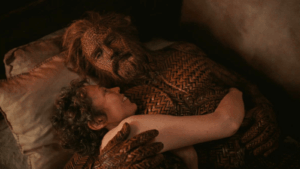
AHF: With Lol, we sat down and we said, “We want to make a comedy that looks like a 17th-century Dutch painting.” So we had almost no film references, only oil paintings. And we said, “Please, can you do this? We’ have no time, no money.” And he said, “Absolutely, let’s do it.”
EW: Working with Lol was a dream. We’re so lucky that he said yes. He had not won his Oscar yet when he said yes to do our movie. So that was perhaps a crucial detail. That’s key.
HtN: Get them before they win their Oscar! (laughs)
AHF: (laughs) Before they win their Oscar. Although Colman still came on board.
EW: That’s true. She still did. But yeah, he was wonderful to work with. Like Alex said, it was a lot of painting references; it was a lot of talk about the color of mud and compositions. But it’s a really fun process with him because so much of the film is very composed. It’s shot-listed and boarded and organized, but then he’s also just a very intuitive DP as well. He loves to operate and he loves to really get in there. So in scenes like the dance, for example—so much of those really beautiful shots between Olivia and Alexander—it’s just Lol dancing with them, really. He’s amazing.
A still from WICKER
HtN: That’s cool. What camera did you shoot with?
EW: The Alexa LF, right?
AHF: LF, yeah, full sensor.
HtN: So what did you tell Anna Meredith you were looking for?
EW: Anna’s … Oh, man, we’re so lucky that she wanted to do this movie. She’s so cool, but we’d seen her play in Los Angeles and we were fans of hers and cold-reached out. We were like, “It’s kind of an open brief.” We knew that we wanted this to probably be not electronic, that it should have a nice organic sound. But that was kind of all we said. But very early on in prep, when we had just basically said we’d like you to work on this, we had to make the dance song.
AHF: The wedding dance.
EW: So she wrote that before doing the rest of the composing. And that was sort of a crazy challenge because we were like, “We have about a week before we need to start choreography up for it.”
AHF: And she was down.
EW: And she just came up with this really interesting, strange piece and that sort of set the tone for what the score became. And for the rest of the score, she had this fantastic idea of creating most of the sounds with recorders because she thought it felt akin to the Wicker Husband that it’s a very naïve instrument, that it’s the first instrument you pick up, that you learn.
AHF: And it sounds kind of like wind blowing through him.
EW: So a lot of the sounds or the compositions that are with the Wicker Husband and the Fisherwoman are recorders and then the village is all strings and they sort of come together and clash at moments.
AHF: And we wanted the score to be foregrounded and bold and we didn’t want to just have it sit in the background. And so we said, “We want you to compose some pieces that really stand up as their own work of art.”
HtN: Well, I really did like the score and I liked the film. Thank you so much, Alex and Eleanor, for talking to me.
AHF: Thanks for having us.
EW: It was great to chat with you. Thanks!
– Christopher Llewellyn Reed (@ChrisReedFilm)