




A Conversation with Hirokazu Kore-eda (SHEEP IN THE BOX)
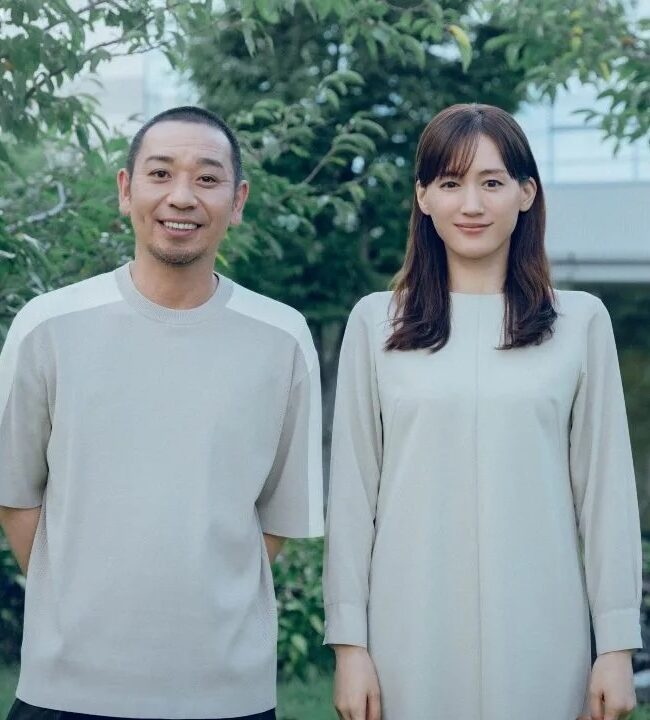
Hirokazu Kore-eda has spent his career making quiet, humane films about families, and he won the Palme d’Or for one of them, Shoplifters, in 2018. Sheep in the Box, his seventeenth feature, keeps its attention on parents and children but moves the setting into the near future. Otone and Kensuke Komoto (Haruka Ayase and Daigo Yamamoto) lost their young son Kakeru in a train accident two years ago. As the film opens, they take in a humanoid rented from a company that leases replicas to grieving families. It looks and behaves exactly like Kakeru. Otone welcomes him almost at once, while Kensuke can barely stand to be in the room. The film premiered in competition at Cannes this past May, and NEON just released it in theaters.
Kore-eda has made films about grief before, but here the dead child comes back as a humanoid the family can live with, not just remember. Having him in the house seems to get things moving again, at least for a while. It also forces out the things each parent never said and the regrets they’ve kept to themselves. And the boy, unnoticed by his parents, starts slipping off to meet other humanoid children.
The film started from something that unsettled Kore-eda in the news: companies using AI to bring dead people back, including a Japanese project that revived a dead singer to record a new song. It left him asking who the dead actually belong to. The title comes from The Little Prince, where the pilot, unable to draw a sheep the boy likes, draws a box and tells him the sheep is inside, and the boy is happy because he can picture the one he wants. The parents are asked to do the same with the humanoid, to look at a machine and imagine their son is inside it. Otone can. Kensuke, at first, can’t. For all the science fiction, it stays a story about a marriage, and about learning to say goodbye.
Hammer to Nail: The first sequence I’d love to discuss is that initial interaction with a humanoid robot. Kensuke mixes his food around, which is a pet peeve of Otone, and Kensuke responds passive-aggressively, “It tastes better, try some.” Takuto, Alice’s humanoid son, comes over and asks if they’re fighting. Otone says no, they’re fine. Takuto asks what Otone is eating, and she says cod roe spaghetti, and Kensuke asks Takuto if he likes cod roe. When Takuto tells them he’s a humanoid, we cut to Otone, who’s utterly shocked, and it leads into the conversation with Alice about how they couldn’t tell he was a robot. What was important to you in this introduction to the humanoids?
Hirokazu Kore-eda: First, I wanted to establish that these humanoids are closer to humans than we assumed, that the couple would come away with an almost positive impression of one. But more than that, I wanted the audience to focus on the moment right after, when Itsuki walks into the glass, because that is where the couple share that Kakeru used to do the same thing. Up to that point, the two of them had been grieving and remembering Kakeru on their own, separately. That is the first time in a long time that they remember something about him together, and it is the moment they decide to try this and take one of these humanoids into their home. That is what the scene is meant to do.
HTN: At the 21-minute mark, Kensuke comes home from his baseball game to find Otone and Kakeru asleep on the floor. The music and framing create an eerie atmosphere. Kensuke wakes them, and Otone is disoriented, not sure what time it is. Kensuke asks accusatorily, “all day since morning?” Otone says, “yes, just the two of us.” Kensuke is a little disturbed, changes the subject, and asks “what about dinner?” Otone covers Kakeru’s ears and scolds him, “don’t say dinner right now, Kakeru can’t eat. Go out to eat! I’m not going to eat.” Kensuke says,” I’m eating because I’m a human being, and if I don’t, I’ll die,” and he walks out to take a bath. I just love this scene. Again, can you talk about what was important to you?
HK: As I was saying about the earlier scene, the couple share a memory of Kakeru, and that becomes the impetus for taking in the humanoid, but they also have very different motivations for doing it. So I wanted to introduce them at a point where the two of them, as a couple, are very distant from each other in their lives, and I wrote the scene to make that distance as clear as I could.
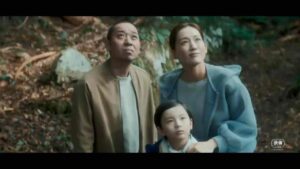
A still from SHEEP IN THE BOX
HTN:At the 26-minute mark, Kensuke and Kakeru are at home looking at books, and Kakeru points out a drawing of a train that his human version once drew, which leads into this extremely cute exchange where they list off all the different train stations and high-five. It seems to bring life back to Kensuke, maybe the most joy we see from him in the whole film, but it quickly turns to panic as he runs down the street repeating, “a machine, a Roomba, a Roomba!” His brain is all scrambled. What was important to you there?
HK: I love that scene too. When we filmed the high-five, I was really impressed with Daigo’s acting. He was able to convey both the discomfort and how happy he was, in a very genuine way. Actually, I wrote the scene of him running only after we had shot the high-five. It was something I felt I had to add. Once we shot the running, I thought it was really great. It’s an important scene, the one where I felt I was finally able to grasp who Kensuke is as a character.
HTN: At the hour mark, we get the confrontation between Otone and her mother. It starts with the mother telling Otone to cut down the tree that the real Kakeru planted. “It reminds you of him every day,” she says. “That’s fine,” Otone answers. “That’s why you can’t move forward, ” her mother counters. And it leads into the mother walking her through the stages of grief and pleading with her to send the humanoid back. She says, “I’m ashamed of what my daughter is doing. “That puts Otone over the edge, and she flatly blames her mother for Kakeru’s death, saying,” if you hadn’t shown up out of the blue, I would have picked him up.” This is obviously a very important confrontation. Again, what was your thinking with this scene?
HK: It is really important. She is in a position where she needs to be able to blame someone in order to stay calm, in order to stay alive. For her, it was important to make her mother the enemy. That was more or less the only way she could survive these last two years of grief, a way of not having to face her own regrets. So her mother, as someone she can blame, is an important presence for her. But toward the end of the film, it becomes gravely important that Otone is able to change how she sees her mother.
HTN: It was a very powerful scene. And shortly after, at the hour and seven-minute mark, there’s a smaller but hugely impactful moment where Kakeru plays with Otone’s models. She tells him to put it down, it’s an earlier model she wants to save, and Kakeru just asks “why?” Otone says,” I don’t look for quick solutions, but you wouldn’t understand, I want to struggle with a lot of different ideas.” Kakeru’s humanoid is perplexed, and asks, “Why do you want to struggle? Otone says, “I enjoy it, it’s the nature of life,” and she walks away. This leads into the moment where Kakeru stares deeply into Otone and it disturbs her. Can you talk about crafting that moment from the script to the screen?
HK: I think that whether you see taking part in a process as meaningful, as having value, is one of the things that separates humans from humanoids. When Otone says something like, isn’t that what living is about, that is precisely what a humanoid can’t understand, because they don’t grasp the meaning or the value of taking part in a process. I wanted to show the contrast between the human and the humanoid.
HTN: At the hour and 17-minute mark, there’s this incredibly powerful moment where Kensuke takes Kakeru’s humanoid to the site of his real death. He’s hoping to gain some insight into why it happened, or who was responsible. The hope surges in his eyes as the humanoid says, “this is where I died.” Kensuke probes him, trying to get more out of him, but it’s drawing blanks, and Kensuke realizes the only reason the humanoid remembered his classmate was a kindergarten class picture they’d sent the company that designed Kakeru’s body. It drains the life out of Kensuke’s face, and he’s arrested right after. Can you talk about what was important to you in this crucial moment?
HK: The couple are each living a different kind of regret over losing their child. For the mother, in one sense, it’s very clear. It’s that she once told him, I want to stop being your mom. She carries an intense regret about what she said to Kakeru. The husband carries a regret about what he could not say, which is that he was sorry. They have these different sources of regret, and they’re unable to share them with each other. Now that they’ve been given this chance to redo the family with the humanoid, I wanted it to come more and more into focus how each of them carries a different shape of regret. That scene is important for showing the father’s side of it.
– Jack Schenker (@YUNGOCUPOTIS)