





THE LAST PICTURE SHOWS
(Check out Jonathan Marlow’s The Last Picture Shows movie review. The film opens in New York City on August 7th and in Los Angeles on August 21st in conjunction with a national theatrical roadshow. Seen it? Join the conversation with HtN on our Letterboxd Page.)
“…what is it about writing* that makes other people think they know how to do it?”
— Rachel Cusk, “How to Get There”
*[Or filmmaking? Or film-exhibition?]
Imagine for yourself a weighty tome of landscape photography. An assortment of stunning images and scenes of decay across the American West with a particular focus on gathering spaces, many abandoned.
Then imagine another book: Larry McMurtry’s The Last Picture Show (where the documentary-herein-and-hereafter-discussed derived its name) or the film-of-the-same-name, adapted by Peter Bogdanovich and co-written by McMurtry. In the loosely-fictional town of Thalia (based on Archer City, Texas), the single-screen cinema was once the center of activity along its main street. When the story begins, the venue is in decline; by the end of the novel/film, the movie theatre closes, symptomatic of the changing fortunes of the town (and its townsfolk). The film acts, in part, as commentary on this absence and what it represents in the lives of its audience. Although The Last Picture Show was released in the early-1970s (and the novel was published in the mid-1960s), the time-period the film reflects is two decades earlier. However, even in the nickelodeon era four decades prior, venues would burst into being and, shortly thereafter, many would close. The boom-and-bust cycle of viewing-spaces is essentially as old as the movie industry itself.
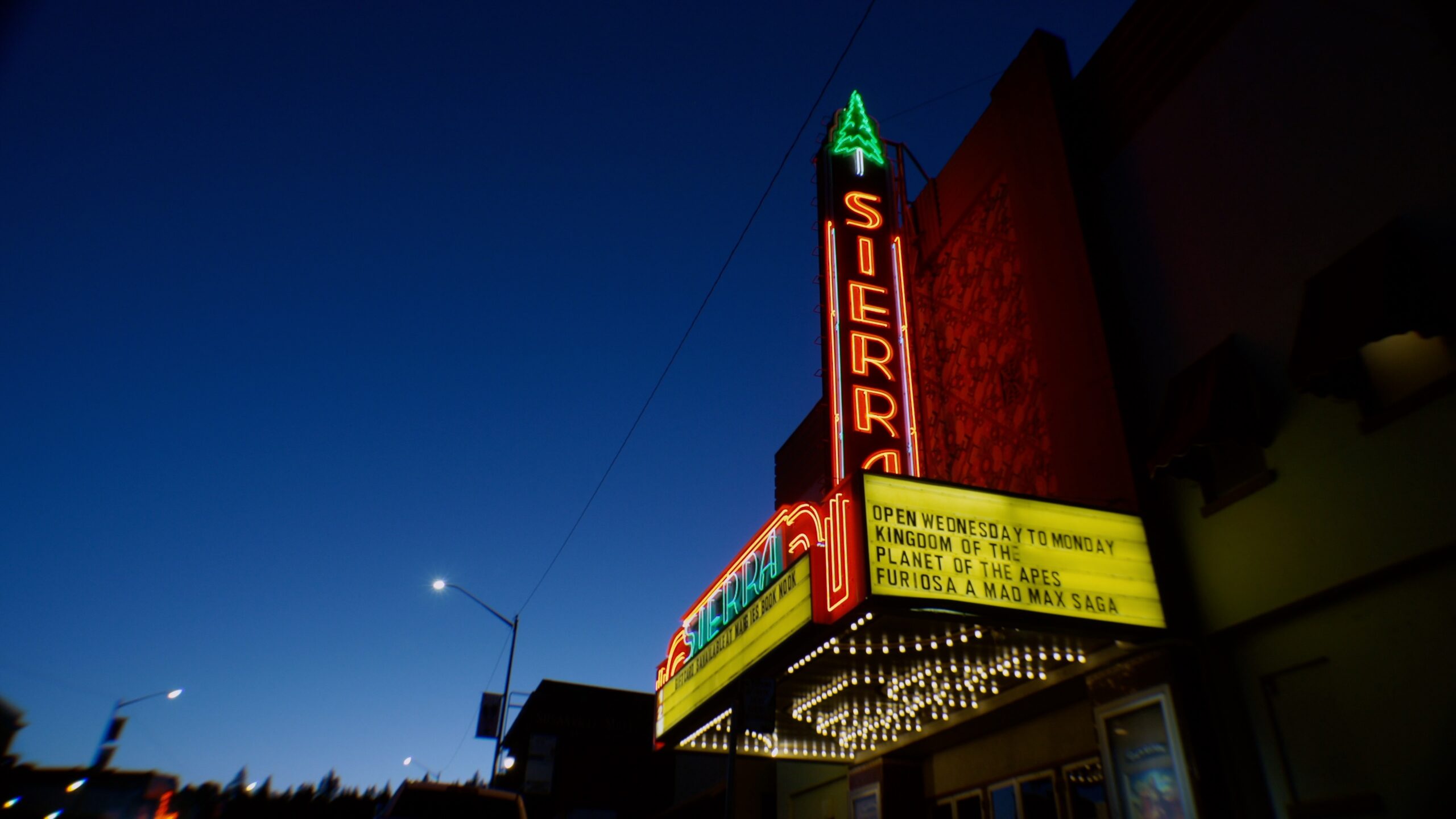
Meanwhile, imagine (if you will) an intersection between the two—photo-journalism and cinematic social commentary—in the form of a travelogue. The trough of our present picture show downturn, following the forced closures of the pandemic, presented a potential opportunity for Pacific Northwest filmmaker Rustin Thompson. In the years since, he traveled through ten states along the coast and adjacent, traversing over ten thousand miles to visit over one hundred cinemas and drive-ins. Many in disrepair. Some closed entirely. Others in the process of restoration or renewal, fortunately enough. California, Oregon, Montana, Utah, New Mexico, Washington, Nevada, Colorado, Arizona, Idaho, reflected in no particular geographic order, interspersed with cinema-setting-appropriate sequences from (natch) Cinema Paradiso (1988), The Grey Fox (1982), The Picture Show Man (1977), Hud (1963) and its titular inspiration.
At the beginning of the sound era, there were more than 22,000 cinemas throughout the United States. These days, that number has dropped to ¼ of that figure, representing roughly 30,000 screens (an average of six screens per location, albeit the range shifts between one to twenty-ish), less than 10% of which are operated as nonprofits. Earnest, well-intentioned individuals keep these cinemas running (despite the persistent foibles of the studios, releasing “product” few sensible cinemagoers are willing to pay to see). The Barnyard Cinema in Winthrop, Washington, for instance, opened in 2016 as a single-screen venue where once there were none. From what is evident in The Last Picture Shows, worthy of a road-trip! Or the built-in-1907 Gem Theater in Athena, Oregon. The legendary F.W. Murnau’s far-too-rarely-screened City Girl was filmed nearby in 1928. By the time it was released in 1930, the Gem had closed as a casualty of the Great Depression. Thanks to a handful of grand individuals in the community, it reopened in 2005. Or (not included on-screen but definitely in the perceptual mix) the eclectically independent City Lights in Florence, along the coast; the ever-dependable Beacon microcinema in Columbia City; the multi-use performance / cinematheque 2220 Arts + Archives in Filipinotown (and others due to open throughout the west over the months ahead).
Despite the doom and gloom of the industry trade publications, the opportunities for running a picture show are better than they have been in… weeks? Months? Years, perhaps? The Last Pictures Shows is ultimately a cautiously feel-good documentary of dedicated cinema-owners and film programmers who keep-on-keepin’-on, deserving of our gratitude and our admission (and concession purchases).
— Jonathan Marlow