



(Check out Chris Reed’s Buddy review. It’s in theaters now. Seen it? Join the conversation with HtN on our Letterboxd Page.)
I was not a child in the 1990s, nor did I have children of my own, but I would nevertheless catch the occasional glimpse of the TV show Barney & Friends in the background, its titular purple dinosaur leading kids in song and dance as they learned valuable lessons. Imagine Mr. Rogers in a large furry suit; the format was not all that different from the earlier program’s (indeed, both were PBS productions). Did you ever wonder what might happen if the host were not, in fact, benign, but actually a narcissistic sociopath? If so, look no further than Buddy, the new film from writer/director Casper Kelly (Adult Swim Yule Log).
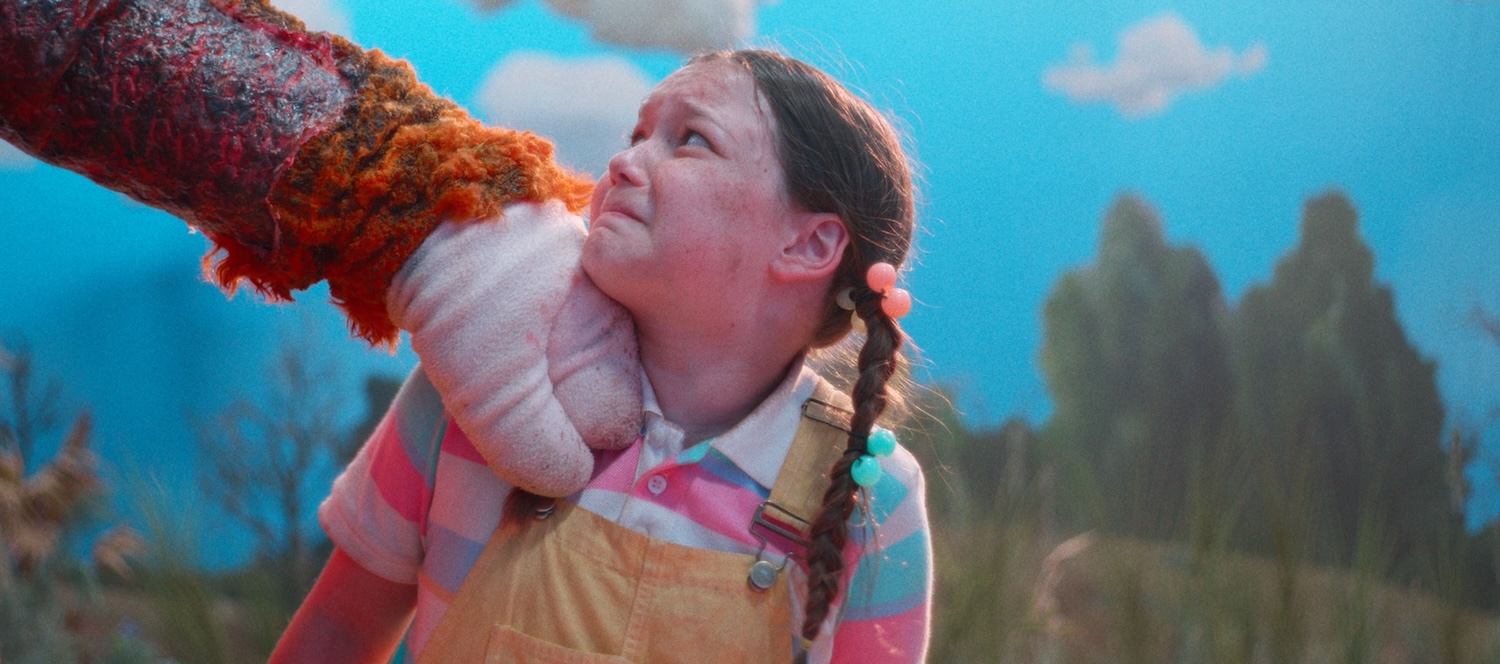
The world-building is excellent, the universe full of carefully wrought details that earn a meaningful payoff … for the most part. Buddy—physical motions provided by actor Sergey Zhuravsky and voice by Keegan-Michael Key (Don’t Think Twice)—is a magical orange unicorn who, like Barney, presides over a vivid playground inhabited by a recurring cast of characters, including four children. He encourages them to be better versions of themselves through gentle prodding and a catchy melody or two.
Until, that is, one resists the encouragement to participate, after which all hell breaks loose. Don’t like watching bad things happen to innocent victims? Buddy may not be for you.
But there is broad humor behind the horror, even as the body count rises. Above all, Buddy does not like being told no. The problem for him, however, is that once folks start dying, it’s impossible for the remaining cast not to notice, no matter how many new actors he imports.
After we watch a number of episodes where events go from good to very bad, we jump out of the 4:3 TV screen to the larger world outside, seemingly abandoning the narrative for something new. The stories will eventually converge.
The great joy of Buddy is discovering the how, what, when, and where of everything, though Kelly plays his cinematic cards close to the chest and refuses to unravel every thread. Unfortunately, this is also the kind of movie that sets up a particular emotional investment that it then bypasses, choosing a different ending altogether. I was disappointed by this development, but still along for the ride.
In addition to Key (who sounds remarkably unlike himself), the rest of the cast is also strong, among them Cristin Milioti (Palm Springs), Topher Grace (BlacKkKlansman), and Delaney Quinn (The Roses). There is a constant heightened reality to the production and sound design that pulls the audience into the nightmarish fantasy of Kelly’s vision. We’re simultaneously grossed out and entertained.
Given the color and temperament of the villain here, it is tempting to view the entire affair as a metaphor for the United States of today, ruled by an orange madman who craves attention. Especially since the members of the cult find themselves strangely mesmerized no matter how much situations devolve. If you’re screwed and you know it, clap your hands.
– Christopher Llewellyn Reed (@ChrisReedFilm)