


THE BEST SUMMER
(The 52nd Seattle International Film Festival ran May 7-17th in and around Seattle. Check out Jessica Baxter’s The Best Summer movie review, fresh from the fest. Seen it? Join the conversation with HtN on our Letterboxd Page.)
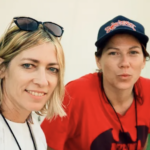
The 2025 Palisades fire had at least one upshot. When her neighborhood was evacuated, director Tamra Davis scoured her house for irreplaceable things to salvage. One such treasure was a box of Hi8 tapes containing footage that she’d shot in the summer of 1995. At that time, Davis was riding high on the success of her first film, Billy Madison, so she ready for an epic vacation. She decided to join then-husband, Mike D on a tour through Australia and Asia. She would bring along her video camera with no specific agenda, except to make some cool ass home movies with her indie rock family, that included Sonic Youth, Bikini Kill, Pavement, Beck, the Foo Fighters, and Rancid. Nevertheless, Davis was well qualified to film bands, having cut her directing teeth on a whole bunch of music videos. What sets The Best Summer apart from other music documentaries is the intimacy afforded by Tamra’s insider status. This means we get to see many of these guarded show folk in an unusually relaxed state. They are further disarmed by Bikini Kill’s Kathleen Hannah who acts as a sort of Riot Grrrl Terri Gross. She’s so friendly, intellectual, and nonchalant, that even the coolest of the too-cool-for-school crowd can’t help but appease her.
The Best Summer is a perfectly preserved time capsule of a turning point in music history. Circa summer 1995, Beck was known as the “Loser” guy, The Beastie Boys had yet to become Beastie Men, and Bikini Kill were in the process of breaking out from the cloistered Oly scene. East Bay punk band Rancid had a surprise hit with “Radio” and they were working on their follow-up, “…And Out Come the Wolves”. Pavement were those irreverent preppy guys in polo shirts on MTV singing about haircuts and drummer troubles. Dave Grohl was trying to get his new band, the Foo Fighters, off the ground with former Nirvana bandmate Pat Smear. Sonic Youth were already indie gods, but they’d just added a toddler to their tour entourage in the form of Kim and Thurston’s daughter, Coco. Even though I was attuned to this scene at the time, I had no idea this festival even existed until I read about it in Kathleen Hannah’s memoir Rebel Girl. This film acts as a terrific companion piece to Kathleen’s book, because we also get to see Kathleen and the Beasties’ Ad-Rock pretend not to be falling in love with each other on this tour.
The Best Summer does away with tired documentary narration, opting instead to drop the viewer into a time and place, and leave you to fend for yourself. In the post-screening Q&A at SIFF, Davis said that when she showed an early cut to Kim Gordon, she had added voiceover to provide context. Kim astutely advised her to lose it. People can google what they don’t know. And for viewers of a certain age, the context might come flooding back without the need for internet confirmation. When I first saw Dave Grohl and Pat Smear, I remembered they were one year out from Kurt Cobain’s suicide, and finding their footing with the first Foo Fighters record, which included some songs that Dave had worked on in the studio with Kurt. The first time we see Grohl performing on stage, his vocals are raw and anguished. The demons are being exorcised in real time. For me, the most surreal moment in the film was early on, as Davis’s camera pans down the aisle of a tour bus filled with all these baby-faced future legends like some friends headed to summer camp.
The film is mostly linear, with a consistent structure of highlighting individual band members one at a time. The interviews start with what Davis describes as her Tiger Beat (teeny bopper mag) questions: favorite color, favorite food, current book, and motto. The camera makes some people uneasy. Pat Smear avoids it like the plague. But Tamra and Kathleen deftly wield a diplomatic energy to get these tight-lipped indie (mostly) guys to open up.
Once they’re feeling loosey-goosey, Kathleen hits them with the introspective angle. “What do you like or don’t like about being on stage?” Actually, at first, she just asks what people like about it. But when she poses the question to Dave Grohl, it soon becomes clear that he would rather talk about what he hates. “I hate having to talk to the audience. I hate having to sing. Going on stage is like being on a date with 6000 people you don’t know.” It’s clear that Grohl is still warming up to the idea of fronting a band at all.
Despite feeling like a comprehensive document, there were some other musicians that barely make an appearance or aren’t there at all. Jawbreaker was allegedly on the tour, although Davis says she never saw hide nor hair of them. Earlier in the film, Kathleen laments the lack of “cute boys” on the tour. When Davis asks about cute girls, and mentions Deal, who playing with the Amps, Kathleen astutely says, “Kim Deal, I don’t feel is accessible… to me.” For the most part, Deal proves Kathleen’s theory right, although she does reveal her motto which is, “Eat drink and be merry.” Most people stop there, but she finishes the idiom to drive the point home: “…for tomorrow you may die.” Even though Davis includes the mottos as part of her “Tiger Beat” questions, they end up being some of the more revealing answers into the psyches of these generally impenetrable artists. Kim Gordon’s is, “Less is more… but not always.”

Gordon is probably the 3rd most present figure in the film. The three women seem to develop a camaraderie and are grateful for what Davis calls “girl energy” amidst this sea of sausages. Gordon is also constantly multi-tasking because the mother of a toddler is never off the clock, even when she is in one of the most influential indie bands of all time. The only time you see Thurston with the baby is when he’s carrying her onto a plane. Gordon likens her stage persona to a character in a Godard film, which apparently includes effortlessly bopping around in high heels while she flawlessly plucks her bass.
Other interview highlights include Beck declaring that his favorite food is, “all food.” and Brett Reed from Rancid lamenting the influx of “guys who beat me up in high school” at their shows. Kathleen also answers her own questions to put people at ease. There’s a very fascinating ongoing conversation about stage personas or lack thereof. Kathleen maintains that it’s imperative for her mental health to keep that distance. “They are getting what I give them and that’s all.” She breaks it down even further. “To me, not having a pose is a pose itself. You’ll go insane if you don’t make a stage persona for yourself.” This is sage advice for Grohl who saw first-hand from his time in Nirvana, that if you don’t provide a persona, the media will make one for you, and you might not like what they choose. There are certainly plenty of other examples of musicians who couldn’t separate their stage self from their real life, and it did indeed destroy them.
But others, like Stephen Malkmus of Pavement, insist that they’re no different on stage than off. Their live performances lend credence to that claim. Beck also seems more like a “what you see is what you get” guy. But he does relay an anecdote about learning to put “composer” on his customs form instead of “musician”, because the latter designation always results in the border guard “running his hands through my pants.” The one insight we get from Pat Smear is his on-stage declaration that he likes, “when I can shut off my brain and slip into the sounds.”
Interspersed between the travel documentation and conversations, Davis records a fair number of live performances. She carries the intimacy from the interviews into this footage. In some cases, it seems like she’s on stage with them, right in the mix. At one point, Tim Armstrong’s signature low-slung guitar appears to narrowly miss the camera as it swings around his hips.
Even though the footage only spans one summer, it is remarkable how much change we can see from start to finish. There are a few hints to the budding and – at that time – forbidden relationship between Kathleen Hannah and Adam Horowitz. He was in a rocky marriage to actress Ione Skye. There is also quite the evolution of Dave Grohl from semi-reluctant front man to a guy who tells the audience he loves “each and every one” of them after an encore.
There are also shots of the crowd, which fix it into the timeline more firmly than anything else. Even though many of these clothes have recently come back into fashion, these 90s kids in their flannels and jean cutoffs are as tied to the era as hippies at Woodstock. I feel a bit like an old fart getting so excited about this film. But I guess now I understand why Boomers love documentaries about the “Summer of Love”. We were young and cool once. This is the proof.
– Jessica Baxter (@TheBaxter)