






ELEPHANTS IN THE FOG
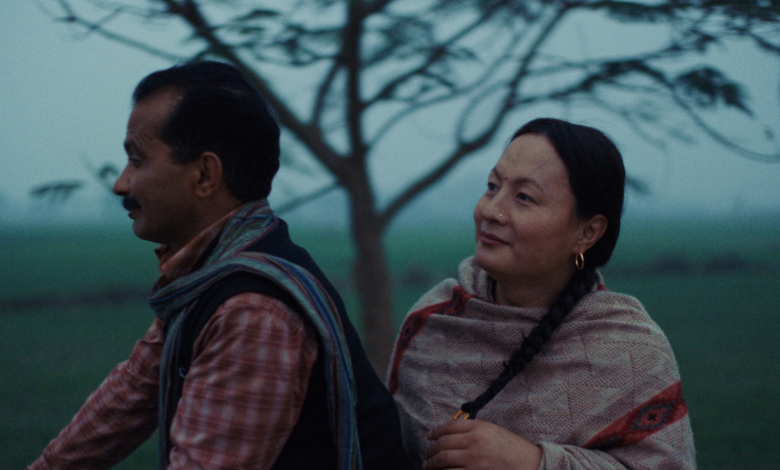
(Check out Lé Baltar’s Elephants in the Fog movie review. The film just had its premiere at the Cannes Film Festival. Seen it? Join the conversation with HtN on our Letterboxd Page.)
The first-ever Nepali feature film to premiere in the Un Certain Regard section of the Cannes Film Festival, Abinash Bikram Shah’s stunning directorial debut Elephants in the Fog sustains then subverts tired tropes readily attached to the trans experience, which should make it a welcome addition to the ever-expanding canon of trans cinema.
The wounding thriller takes place, for the most part, in a Nepalese village tucked away in the forest along the country’s southern border, a setting that Shah and cinematographer Noé Bach present to us with a sort of mystical, hazy allure via delicate wide-angle compositions, accompanied by an almost spectral soundscape. It is home to Kinnar women — South Asia’s so-called third-gender community, which includes transgender, nonbinary, and intersex people — who sacredly practice celibacy and chosen kinship, following the teachings of the community matriarch, Guru Mata (Umesha Pandey, in a performance that requires her to whisper-talk), while living at the mercy of wild elephants shunned by routine patrols at nightfall. Among them is the headstrong trans woman Pirati (commanding first-timer Puspa Thing Lama), who looks after her trans daughters Joon (Sahab Din Miya), Chameli (Jasmin Bishwokarma), and Apsara (Aliz Ghimire). Like the rest of the community, these women refugees find care and tenderness in each other, a bond that is thicker than blood. Treated as spiritual figures, they are also invited into houses to bless and celebrate life milestones, such as weddings and pregnancies, typically involving signature claps in which their fingers don’t touch.
But despite the sanctuary this side of the world offers them, shame and repression are still very much present, forcing some of them to lead double lives, therefore betraying their sacred vows. Pirati secrets a relationship with Drum Master (Aashant Sharma), who lives in the border city, where anonymity amidst the urban din and heavy traffic allows for desire to flourish — a brief respite from the heightened attention of living in the cloistered village. Former sex worker Apsara, meanwhile, dreams of becoming a model in Kathmandu, leveraging her body and seductiveness, while entangled in an illicit relationship with a douchebag of a man, MJ (Sanjay Gupta).
Such bifurcated lives snap into focus, as Apsara, after a heated exchange with Pirati, disappears without so much as a trace, save for her blonde wig discovered in the woods. It leaves Pirati guilty and sends her searching, only to be met with the police and the community’s indifference, if not outright neglect. With Shah’s deeply empathetic first feature comes a statement about what happens when one finally wrestles with the incongruous realities they find themselves in. When all of a sudden, the worlds they attempt to keep so desperately separate brutally bleed into each other.
Subterfuge as a form of psychological self-preservation and protection against physical danger has been a recurring theme, or at the very least feature, in trans cinema. The Matrix franchise has quite literalized this sense of double life through the red-pill/blue-pill dichotomy, while the likes of Isabel Sandoval, from Señorita to Moonglow, intimates it with a tempestuous and impressionistic spirit, without falling into the clutches of the coming-out trope. Here, Shah harnesses secrets as a way for his characters to dream beyond what the world affords them, while trying to honor their roots — a reflection on how freedom and self-actualization often come at a cost, especially for people who are already disenfranchised. Even as she is forced to choose between the man she loves and the community that nurtured her, there is a sense that Pirati views motherhood as a radical force that should expand, instead of limit, her capacity to love. Except she’s the only one who sees this with a clear set of eyes.
To an extent, Elephants in the Fog is stripped of stereotypical plotlines that notoriously haunt cinematic depictions of the trans experience, such as criminalization or the trans body undergoing medico-surgical transition (as seen in Jacques Audiard’s demeaning and downright awful Emilia Pérez, and even in Jonathan Demme’s The Silence of the Lambs). But in the same breath, the bulk of the movie leans on other trans tropes, specifically the suggestion of death and rapid disintegration of relationships, romantic or otherwise. As much as Pirati refuses to entertain the insinuation that Apsara is assaulted and left to die in the forest, which the villagers refuse to cross fearing that they might disturb the spirits, she knows it’s more likely to happen than her daughter vanishing without a word to pursue her dream in the big city. Hence the decision to take justice into her own hands, which ends up with an impulsively bloody encounter, as her psyche and that of her family grow increasingly destabilized.
There is a kind of discomfort, as a woman of trans experience, in seeing (mostly cis, white, and male) filmmakers relentlessly fixate on trans suffering and trauma. Not because they don’t happen in real life, but because such depictions seem to suggest that it is the default as far as the trans experience is concerned, that even onscreen it is almost impossible to simply let trans people be — the trans person as Everyperson, to slightly paraphrase Sandoval. Or, indeed, imagine alternatives for them.
But what separates the Nepali director’s work from other trans movies is that, even if the damage is already done, it offers its protagonist the will to fight and to no longer hold back, refusing to neatly portray her as a passive recipient of derision and danger, at which point Elephants in the Fog hauntingly underscores its titular symbolism, drawing a parallel between the Kinnar women and the ostracized mammal. From this mutual othering emerges a kind of empathy, one that is complex and never feels artificial. This empathy is likewise not achieved by making easily likable or linear characters. Instead, the narrative gravitates toward the contradictions that make and unmake them, proposing that there is nothing more deeply human than coming to terms with one’s fallibility.
Indeed, Shah fashions a story of loss and liberation that is unsparing in its honesty and striking in its aesthetic, just as Puspa Thing Lama anchors her performance with the rawness and resolve of someone who has lived (and is most likely still living) the experience, heightened by her compelling gaze, whether in grief or in joy, and especially in the final moving encounter with the gentle giant.
— Lé Baltar (@baltarle)