






BEEN HERE STAY HERE
Check out Anders Ljung’s Been Here Stay Here movie review, it hits theaters Friday, May 15. Seen it? Join the conversation with HtN on our Letterboxd Page.)
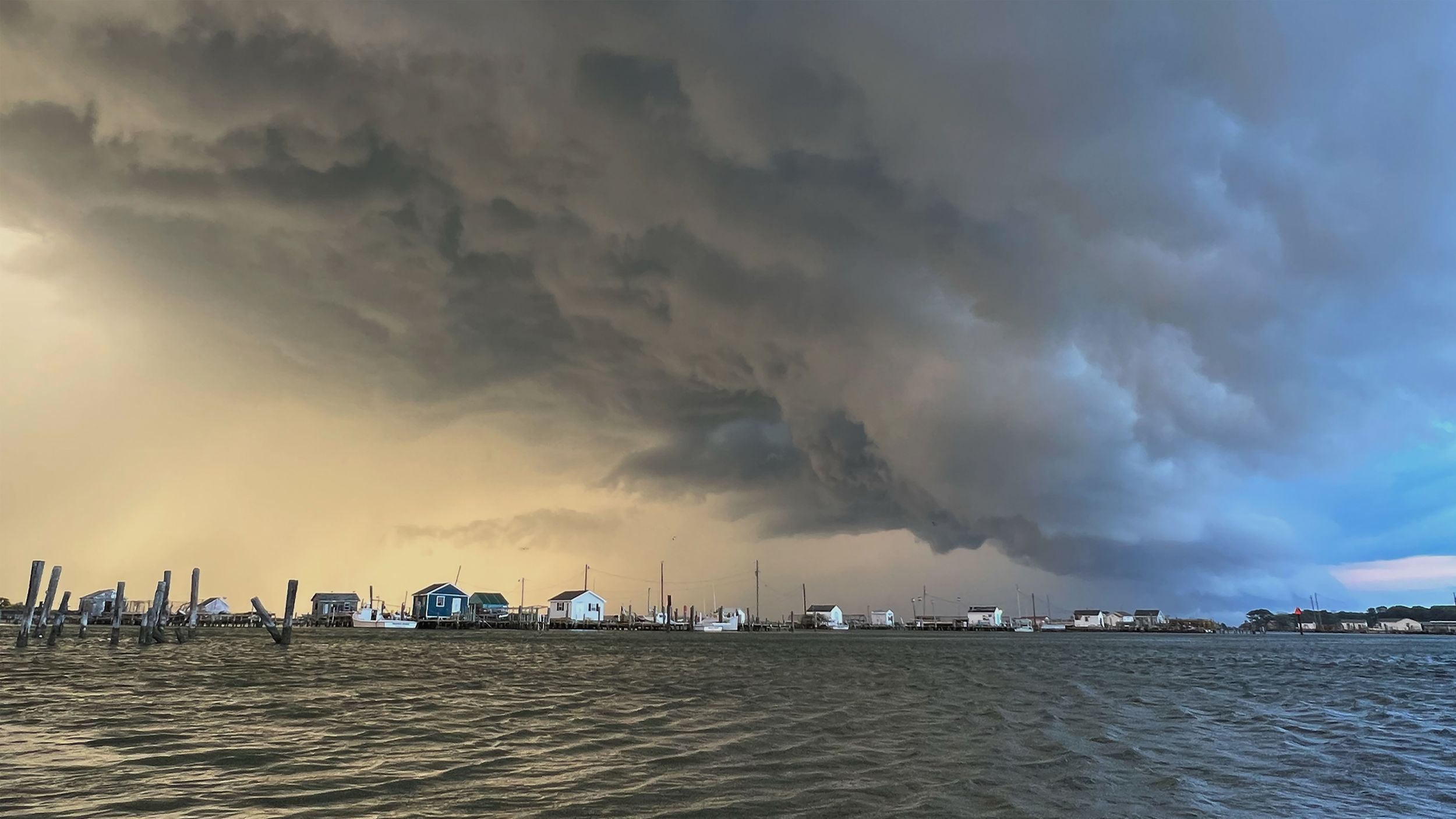
David Usui’s Been Here Stay Here arrives with the quiet confidence of a filmmaker who understands that observation can often be more devastating than confrontation. Set on Tangier Island, the isolated Chesapeake Bay fishing community slowly disappearing beneath rising sea levels, the documentary avoids the urgency and spectacle that often define contemporary climate cinema. Instead, Usui constructs something far more patient and emotionally complex: a portrait of a culture confronting erosion not through political rhetoric, but through the rituals of everyday life.
The film follows several residents across generations, including Mayor James “Ooker” Eskridge, young islander Cameron Evans, and child resident Jacob Parks, each embodying different relationships to Tangier’s uncertain future. Yet Been Here Stay Here is not interested in reducing its subjects to symbols within a climate debate. Usui’s camera lingers on church gatherings, conversations between neighbors, fishing boats crossing still waters, and the rhythms of labor that define the island’s identity. The result is a documentary more concerned with preservation than persuasion, understanding that the tragedy of climate change is not only environmental destruction, but the disappearance of memory, dialect, routine, and belonging.
The project also marks a compelling evolution for Usui as a filmmaker. Prior to this feature, his work largely existed within the editorial and documentary journalism sphere, particularly through his time at VICE, where immersive and behind-the-scenes storytelling became central to his style. That background remains visible throughout Been Here Stay Here. Usui approaches Tangier Island with the instincts of a documentarian trained to observe before interpreting, allowing the community’s contradictions and vulnerabilities to emerge naturally rather than through heavy-handed framing. Yet unlike the urgency that often characterized VICE-era reportage, this film feels deliberately slowed down, as though Usui has traded immediacy for contemplation.
That transition from editorial nonfiction into cinematic documentary proves essential to the film’s emotional power. Been Here Stay Here premiered within the festival circuit as part of a growing wave of environmentally focused nonfiction cinema, though its approach separates it from more overtly activist works. Rather than positioning Tangier Island as a warning sign alone, Usui frames it as a living archive, a place whose residents remain emotionally tethered to home even as the water rises around them. The film’s strength lies in this refusal to simplify either the politics or the people.
Much of the documentary’s impact emerges through its visual language. Tangier is filmed with a romanticism that initially feels almost dangerous. The concern becomes whether Usui’s patience and atmospheric approach will ultimately prevent the film from reaching emotional clarity, particularly given the insular nature of the community itself.
Yet as the documentary progresses, that very romanticism transforms into the film’s central achievement.
The aesthetic gradually stops functioning as distance and instead becomes a form of mourning. The lingering shots of water, fog, and collapsing shoreline begin to operate less as visual admiration and more as evidence of disappearance unfolding in real time. Usui understands that watching something vanish is rarely explosive. More often, it is slow, repetitive, and eerily quiet. By refusing sensationalism, he allows the audience to experience erosion in the same rhythm as the residents themselves.
This shift also deepens the film’s portrayal of Tangier’s residents. Rather than extracting dramatic confessions or forcing ideological confrontation, Usui becomes increasingly attentive to the transparency embedded within ordinary interactions. Conversations about staying, leaving, faith, and family emerge casually, almost accidentally, revealing a community attempting to keep both its geography and identity afloat simultaneously. Climate change exists here not merely as an international crisis, but as an intimate destabilization of culture itself.
That duality becomes the documentary’s defining insight. Been Here Stay Here recognizes that the destruction of place is also the destruction of language, ritual, labor, and inherited memory. Tangier Island is not framed simply as land disappearing into water, but as a way of understanding life gradually slipping out of reach.
In an era where nonfiction filmmaking often pushes toward immediate argumentation, Usui commits fully to patience. He trusts atmosphere, duration, and observation to communicate what exposition cannot. That confidence is especially impressive considering the relative youth of his filmmaking career. Many emerging documentarians struggle to resist overexplaining their subjects, particularly within politically charged material, yet Usui consistently allows silence and contradiction to shape the emotional texture of the film.
By the conclusion, Been Here Stay Here becomes less about predicting Tangier Island’s future and more about documenting the fragile act of remaining present while disappearance unfolds around you. It is a film about climate change, certainly, but also about attachment, memory, and the deeply human instinct to preserve identity against forces larger than ourselves.
In its final moments, the documentary leaves behind neither outrage nor easy solutions. Instead, it offers something quieter and perhaps more lasting: the ache of witnessing a community determined to love its home until the very end. Through its grounded tone, remarkable patience, and deeply empathetic lens, Been Here Stay Here establishes David Usui as a filmmaker capable of transforming observation into something profoundly elegiac.
– Anders Ljung