
(The Tribeca Festival is back and celebrates its 25th year! Taking place June 3 – 14 in various screening rooms around NYC, HtN has tons of coverage coming your way like this Time Warp movie review from Chris Reed! Seen it? Join the conversation with HtN on our Letterboxd Page.)
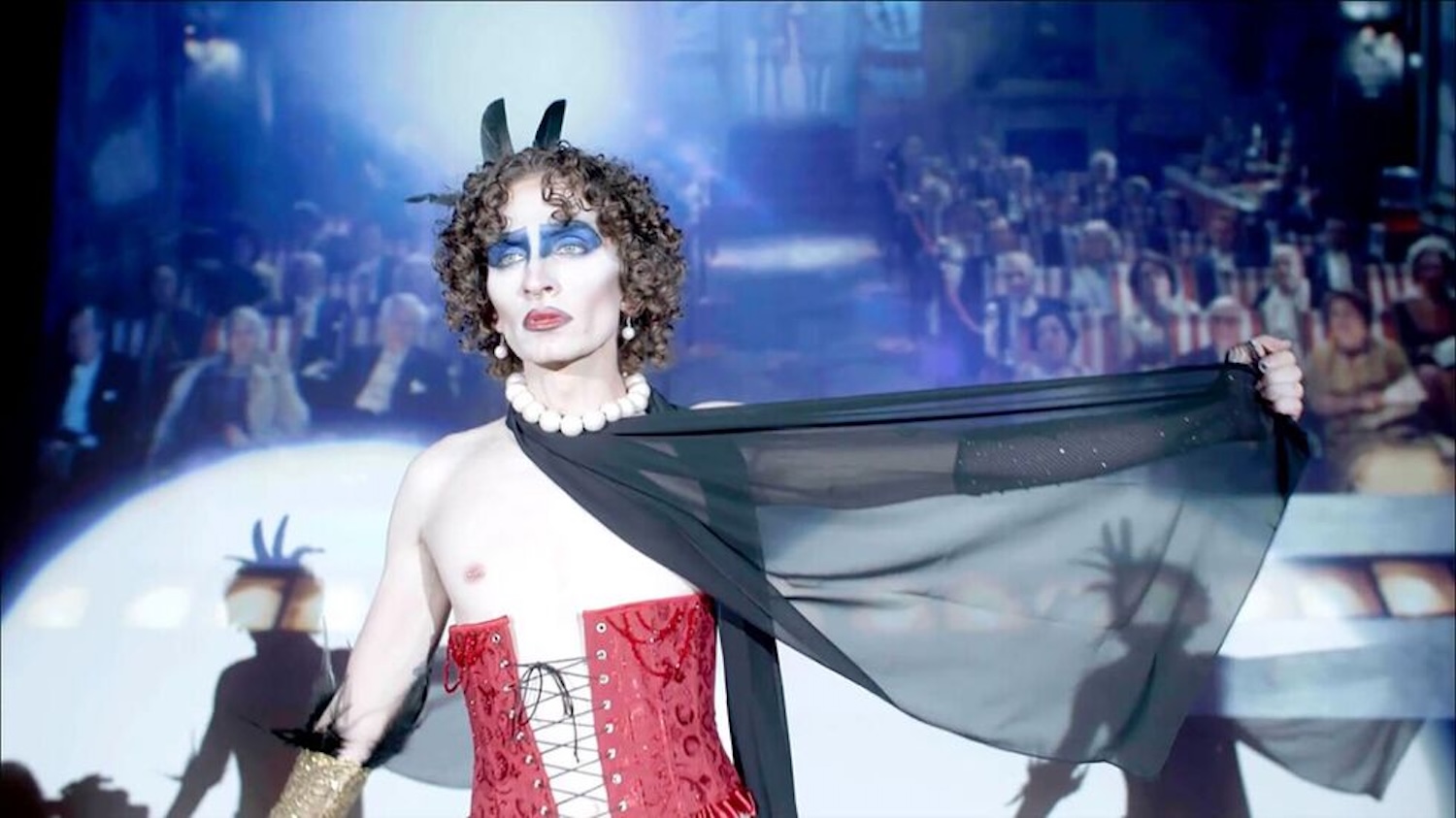
In her new documentary, Time Warp, director Allison Berg (The Dog) fashions a loving tribute to, as her characters within the film describe it, “queer joy.” A portrait of a group of actors preparing to perform as the shadow cast for screenings of The Rocky Horror Picture Show, the movie offers many different profiles in courage. For the location is Rock Springs, Wyoming, which is not the friendliest to anyone outside the straight mainstream.
Wyoming, in fact, as we are reminded here, is the state where Matthew Shepard, a young gay man, was murdered in 1998. It’s also heavily pro-Trump, and therefore not obviously open to “queer joy.” And yet the human species is full of surprises, as is this loving, lovely (but nevertheless a little long) tribute to misfits claiming their space.
If you haven’t ever seen it, Rocky Horror is a 1975 adaptation of the 1973 stage musical The Rocky Horror Show, written (book and score) by Richard O’Brien (who also played Riff Raff, the butler) and directed by Jim Sharman (who also directed the original theatrical production). The movie stars Barry Bostwick, Tim Curry, Charles Gray, rock star Meat Loaf, O’Brien (reprising his role), and Susan Sarandon, among many very game participants. It’s about Frank-N-Furter (Curry), a “sweet transvestite” alien scientist from “Transsexual, Transylvania” who seduces both members of a newlywed couple, Brad and Janet (Bostwick and Sarandon), while creating his ideal version of a muscular sex object (“Rocky Horror” of the title).
Somewhere along the way, after the movie initially performed poorly at the box office, audiences began yelling out lines during screenings, often in response to—or in anticipation of—what was being said in the film, turning Rocky Horror into a cult phenomenon. Sometime after that, folks began dressing up as the onscreen characters and lip-syncing and pantomiming along with the plot. That is what the “shadow cast” does.
Growing up, I was very much a fan of Rocky Horror, heading down to my local theater on the weekends to enjoy myself with my best friend and hopefully get in for free thanks to my (rather simple) costume of a blue bathrobe (I was Brad). It was only later, in college, that I discovered that most places by then had their own shadow casts (we had just yelled out the alternate lines on our own and then had come up with new ones). While I prefer the improvisation that happened without a shadow cast, I’ve always been fascinated by the people who put on that extra performance. Now that’s devotion to an idea.
Time Warp (named after one of the songs in Rocky Horror), shows that Rock Springs might be more open to change than we (or the protagonists in the movie) thought was possible. Kenny, the director of the theater company putting on the show, is himself surprised by the support he receives (not that there isn’t danger, as well). There’s even a former cop who joins the cast, not afraid to wear fishnets and heels. Everyone gets their cinematic due in the film, offered enough screen time for their individual narratives to shine. The result is terrific fun (again, if a tad long) and exuberant in its exultation. As they sing in the musical, “Let’s do the Time Warp again.”
– Christopher Llewellyn Reed (@ChrisReedFilm)