





HOW TO FEED A DICTATOR
(The Tribeca Festival is back and celebrates its 25th year! Taking place June 3 – 14 in various screening rooms around NYC, HtN has tons of coverage coming your way like this How to Feed a Dictator movie review from Chris Reed! Seen it? Join the conversation with HtN on our Letterboxd Page.)
In How to Feed a Dictator, director Andrew Neel (Goat) uses the device of exploring the eating habits of autocrats to examine larger issues of humanity’s propensity towards violence. Though no one in their right mind would choose to live in constant fear of the present and future, our past record as a species shows that even democratic systems can be vulnerable to forces of oppression. Food is the hook here, with the through line terror, and the sinker post-traumatic stress.
Based on Witold Szablowski’s 2020 nonfiction book of the same title, the documentary focuses on five despots in particular: Cambodia’s Pol Pot, Chile’s Augusto Pinochet, Iraq’s Saddam Hussein, North Korea’s Kim Jong-il, and Uganda’s Idi Amin (the book covers Albania’s Enver Hoxha and Cuba’s Fidel Castro instead of Kim and Pinochet). These were horrible people; there are no two ways about it. Murderers all, they committed atrocities ostensibly in the name of security, but really just to feed their own egos.
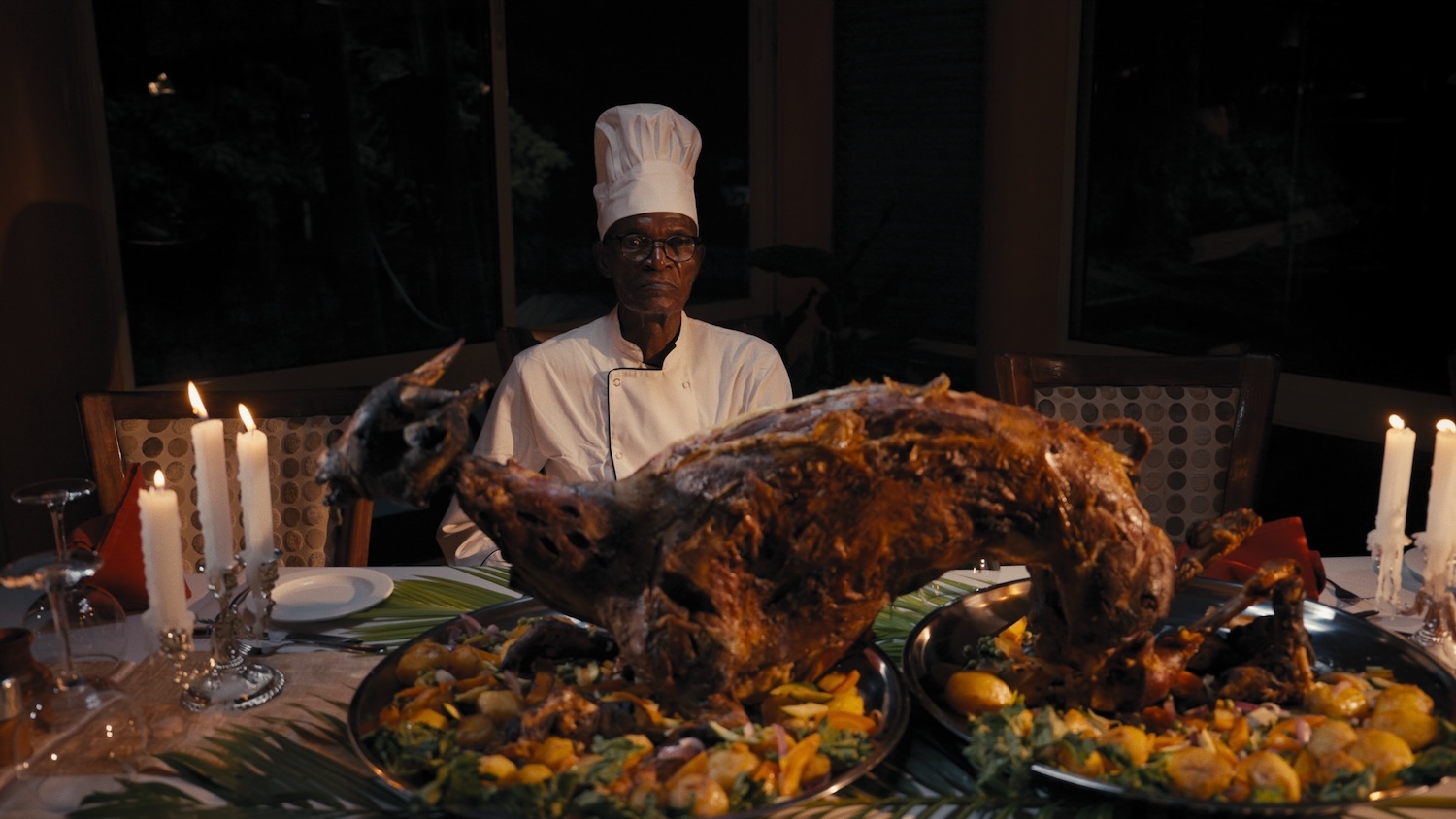
Speaking of eating, Neel makes sure to include ample food porn. Get those taste buds ready, because your mouth will water. Your brain, however, will recoil (I hope). If not, you’re either a psychopath or delusional.
The primary interview subjects are the folks who cooked for the aforementioned fearful five. A few rationalize their actions but still venerate their former masters. One of them, far less so, since he was more or less forced into it; this would be Otonde Odera, in Uganda. His tale is the most direct in its gruesome details of what he saw (including cannibalism).
Keo Samoun, in Cambodia, was but a child when drafted for service. It’s easy to therefore understand how she would struggle to recognize Pol Pot’s true nature. Nevertheless, she proves more capable of reflection than the Chilean Coco Pacheco, who still to this day loves Pinochet. Hussein’s chef also sees his dead boss as a hero, but he is no fool, preferring to remain anonymous, with his image blacked out. The Italian Ermanno Furlaniis, hired to make Pizza for Kim, was a purely mercenary soul, but his account at least shows that he knew what kind of man he was working for, even if he was happy to take the money and count it.
How to Feed a Dictator remains fascinating throughout, with insight into each country’s history—as well into the larger context of dictators everywhere—provided by the likes of journalist Riccardo Orrizio and academics Ruth Ben-Ghiat and Bruce Bueno de Mesquita. The movie is also not at all shy about making comparisons between those profiled to the return of fascism around the world today. The more we starve tyrants, the better off we’ll be.
– Christopher Llewellyn Reed (@ChrisReedFilm)