


A Conversation with Gaylen Ross, Carol King & Ben Shenkman (SAPIRO V. FORD: THE JEW WHO SUED HENRY FORD)
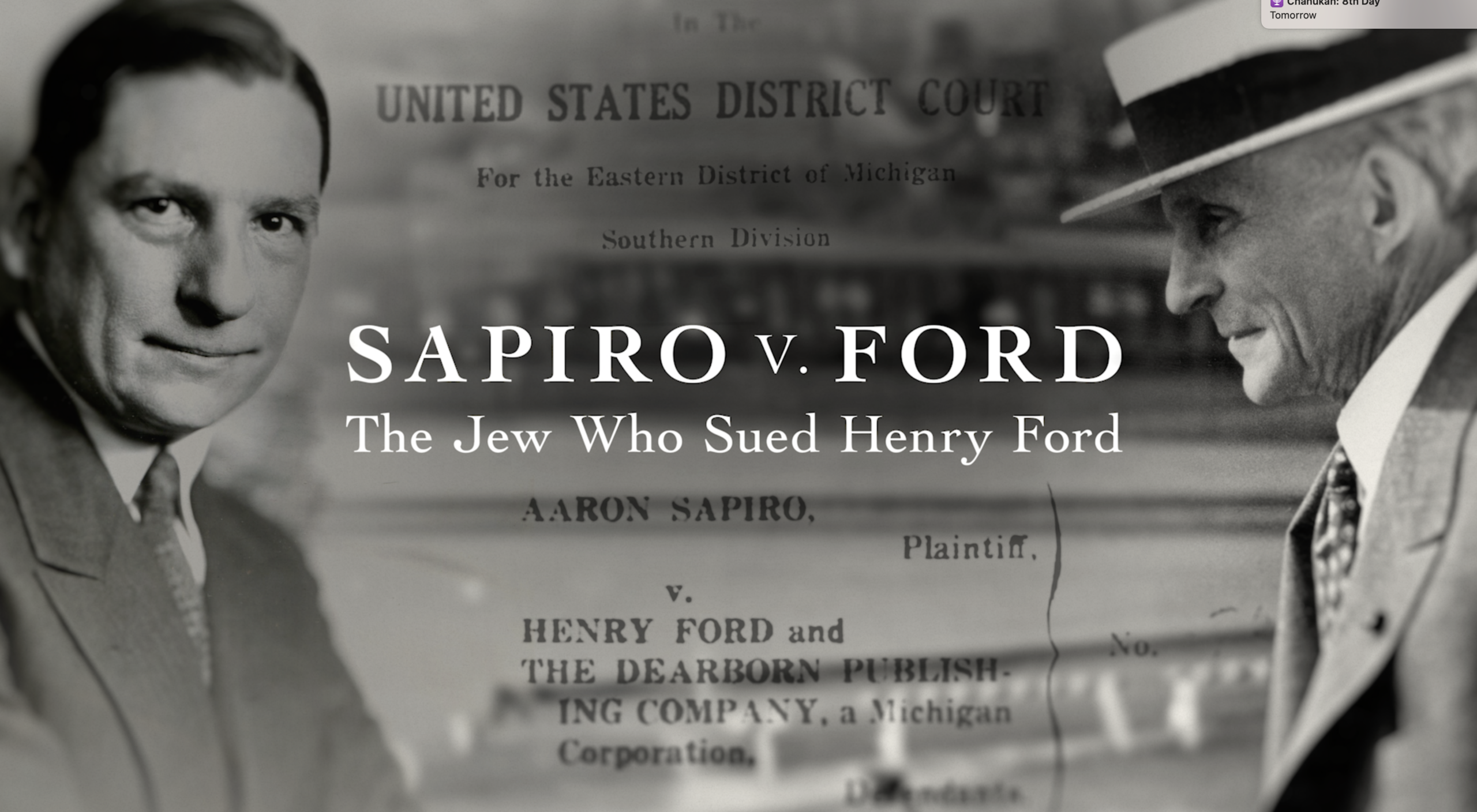
Henry Ford was a titan of 20th century American industry. He not only created an automobile increasingly affordable for millions of people but also ushered in the assembly line which revolutionized mass production. At the same time, he was strictly against labor unions and any workers’ organizations. Most damnably as one of the richest men in America, Ford was the loudest antisemite with the furthest reach and biggest impact in the early 1920s through his nationally distributed newspaper, the Dearborn Independent, subtitled The Ford International Weekly. Its national circulation reached a peak of around 900,000 subscribers, right under The New York Times, while many more were sold on newsstands.
Included in his newspaper was “The International Jew,” a column accusing Jews of causing World War I and controlling banking, labor unions, Hollywood films, Bolshevism, popular music, and even baseball. This weekly diatribe claimed the existence of an “international Jewish conspiracy to take over the world.” The source of the accusation was The Protocols of the Elders of Zion, a long-discredited work of propaganda created by antisemitic czarist Russians in 1902.
Ford’s newspaper initially attacked Jews in general, not by name, with inflammatory article headlines such as “Jewish Control of the American Press,” “Too Much Jew in Baseball,” “Jewish Jazz – Moron Music,” “Jewish Imperialism,” and “Angles of Jewish Influence in American Life.”
Under the libel laws of the 1920s, such scurrilous attacks were not open to lawsuits, but then the column began naming names, which was open to prosecution. Henry Ford’s newspaper made a fatal mistake when it published an article titled “Jewish Exploitation of Farmers’ Organization. II. The Story of the Sapiro Boys. All Little Pals Together – To Save the American Farmer!”
The article began: “A band of Jews – bankers, lawyers, money lenders, advertising agencies, fruit packers, professional office managers and bookkeeping experts – is on the back of the American farmer. Working occasionally in the open, usually behind a screen of well-paid gentile fronts, this organization has developed with such amazing rapidity within the past five years that its operations today extend from the Atlantic to the Pacific and from the interior of Canada to the Mexican border. If it is allowed to continue for another five years, not a grain grower, not a vegetable producer, not an orchardist, save one class in one limited area, will be able to escape paying tribute to it.”
One of the specified lawyers, Aaron Sapiro, a well-respected, successful farming cooperative organizer in the US and Canada, decided to take Ford to court for publishing 21 articles full of false accusations which damaged his reputation.
Aaron Sapiro’s journey toward becoming “the Jew who sued Henry Ford” is the basis of writer-director Gaylen Ross’s fascinating and timely documentary Sapiro v. Ford, a film which almost never got made.
After previewing the documentary for the Austin Jewish Film Festival, I had the pleasure of interviewing veteran documentary filmmaker Gaylen Ross, producer Carol King, and actor Ben Shenkman, all of whom detailed exactly how this invaluable film was finally created.
It all began with documentarian Michael Rose. From 2003 to 2005 Rose wrote and directed the fascinating PBS series Great Cars. Its 53 episodes examined the history of a wide array of classic American and international automobiles.
Rose was uniquely qualified for such an undertaking. Hired directly out of the UCLA School of Theater, Film, and Television graduate program, he worked for General Motors creating public service announcements and industrial films. In the early 1990s Rose moved on to write, produce, and direct the History Channel series, Automobiles. Then came the more expansive PBS series.
One episode of Great Cars focused on Henry Ford’s revolutionary Model T. An automotive historian told the filmmaker about a lawsuit initiated by a Jewish lawyer against the antisemitic Ford.
Rose was surprised that scarcely anyone, including himself, had ever heard of Aaron Sapiro and this lawsuit. Carol King, Rose’s widow, said that he became determined to create a documentary about this unknown episode in American history.
Michael Rose was rightly admired for his documentaries, while Carol King was amazing in her own right as a member of the National Abortion Rights Action League Board and the national board of the National Organization for Women, president of the Michigan chapter of NOW, and organizer of various Michigan political campaigns.
All her organizational skills made her invaluable to Michael. King explained how she was able to facilitate Michael’s filmmaking by setting up an office, hiring people, and organizing all the requisites of productions after they had moved to California in 1996.
Rose conducted research into Sapiro whenever he found time. He amassed a huge amount of material from which he made a 10-minute trailer to attract investors, but unfortunately, he became ill and died in 2020. The Sapiro project might very well have died with him but for filmmaker Gaylen Ross, who appreciated the importance of Sapiro’s crusade.
A sample of materials collected in the film SAPIRO V. FORD: THE JEW WHO SUED HENRY FORD
Gaylen Ross’s professional career grew out of a love of literature, facilitating her becoming managing editor of the esteemed literary journal Antaeus and Ecco Press for several years. Her initial foray into film was as “Francine” in George Romero’s classic horror film, Dawn of the Dead (1978). Several more film roles followed, but then she moved to the other side of the camera in 1989 to begin her storied career as a documentary filmmaker. That first film, Out of Solidarity, examined the lives of members of the Polish anti-totalitarian workers’ union, which initiated the eventual collapse of that country’s Communist regime.
Ross’s subsequent films dealt with fraudulent stockbrokers, Manhattan diamond merchants of W. 47th Street, Russian mail order brides, noted Broadway musical performer Laurie Beechman, Hungarian lawyer Reszo Kasztner, actress Caris Corfman, a Chinese woman’s campaign for fellow AIDS patients, and boxer Godfrey Nyakana. Gaylen Ross’s documentaries often enjoyed premieres at top international film festivals such as Berlin, Toronto, and the Hamptons.
Long an admirer of her films, Michael Rose had told Gaylen about his Sapiro project and sent her the fund-raising trailer to get her perspective. She agreed that it was a gripping story that should be told.
After learning of Michael’s death, Gaylen naturally reached out to Carol to offer condolences. During their long conversation, Gaylen expressed regret about the Sapiro-Ford documentary never being completed. Carol concurred but admitted that she was not a filmmaker herself. Gaylen replied that if Carol agreed, they could work together on making a documentary.
Gaylen Ross explained her reason for the offer: “I wanted to know more about the dynamic between Sapiro and Ford, and how this all happened in this collision of values and lives and people who never, never should have met. You have a Jewish lawyer, who came out of dire poverty and brought himself up by the clichéd but true “bootstraps.” And then you have Ford on the other side, this mega millionaire, billionaire, actually, in the 1920s, and how they came together.”
The story certainly fit Gaylen’s interests: “My films have reflected wrongdoings” The Sapiro project was closest to her award-winning documentary Killing Kasztner (2008), “where there was a major rescue of thousands of Jews, 1,600 on a train, and possibly tens of thousands more.” In that revealing documentary Ross uncovered the erased story of a Hungarian lawyer, who negotiated with Adolf Eichmann, one of the major organizers of the Holocaust, and saved those lives.
Likewise, nearly all historical mentions of Ford’s antisemitism fail to even discuss Aaron Sapiro and his lawsuit. Gaylen became determined to move Sapiro from the footnote into the main text of history.
Carol King explained her own reason to go ahead with the project with Gaylen: “This is somebody that Michael trusted and thought he could work with in getting ideas, so I was so grateful, because this meant so much to Michael, and the thought that I could complete it was a gift.”
Michael and Carol had amassed a wealth of research materials: newspaper and magazine articles, editorial cartoons, film footage, photographs, speeches, and interviews, resulting in the ten-minute fundraising trailer.
Ross certainly credits Michael as “originating director,” but the film Sapiro v. Ford would have to be conceptualized and constructed from scratch. First off, Gaylen strongly felt that the emphasis should not be on “the trial of Henry Ford, [but on] the Jew who sued Henry Ford.” She was intent on shifting the focus onto Sapiro, the hero. There was already a scholarly book which emphasized the actual trial – Henry Ford’s War on Jews and the Legal Battle Against Hate Speech (2012) by Victoria Saker Woeste.
Work on the structure of the film got underway in 2022. Gaylen described the two main aspects of its structure as the actual words of Sapiro himself, to be spoken conversationally by an actor, complementing the arc of the story presented through still photographs, moving images, headlines, newspaper and magazine articles, editorial cartoons, and interviews with historians. Attention would move back and forth between aspects of the lives of Henry Ford and Aaron Sapiro until they finally merge at the trial.
Gaylen talked about the importance of understanding the essential aspect of this David and Goliath story, with Sapiro “growing up and having been taken to an orphanage by his mother because she couldn’t afford to raise these children, to becoming a rabbi, to leaving the rabbinical school, to being a lawyer, to having a vision of what he wanted to do with farmers.”
Ross was amazed at the amount of material Michael and Carol had gathered: “That was really the source of the script, essentially. But then I created the script, and then it would go back to Carol for review and collaboration.”
What could be done with Sapiro’s own words contained in speeches and interviews? Gaylen insisted that “one of the most important things that I absolutely wanted was that no one speak for Sapiro. He had an amazing use of language, and he described himself better than anybody else. I didn’t want historians or scholars to talk about what Sapiro thought or what Sapiro felt.”
Carol added: “Neither one of us wanted reenactments. I mentioned to Gaylen at one point that Michael thought that this might be a great one-man show for theater, much like Hal Holbrook doing Mark Twain. And the minute I said that, Gaylen said, ‘Let’s get an actor!’”
The entire project was blessed with the addition of veteran actor Ben Shenkman, whom Carol described as “the right choice, the only choice.” With an M.F.A. from NYU’s Graduate Acting Program at the Tisch School of the Arts, over thirty years’ experience with a variety of roles in theater, film, and television, and a fine voice, Shenkman would portray Aaron Sapiro telling his own story.
Gaylen explained the reason that Shenkman would wear his own clothing, not a suit from the 1920s: “I’m not doing a historical drama with actors in costumes. I wanted the Aaron Sapiro character to feel like a contemporary so that the audience couldn’t place him in a time zone, and then somehow remove themselves from what he was saying, and I thought a costume would do that. And it paid off, I think, because people started responding to Ben as if he were speaking to them in the present moment.”
Ben Shenkman explained how he became involved with this film:
“Willie Reale [co-executive producer of the series Billions, in which Shenkman portrayed Ira Schirmer for 39 episodes] gave Gaylen my name as a suggestion, and so, they reached out, and they described the project and asked if I’d like to meet with them. I assumed it would be something like a voiceover, the typical thing that you would do for a documentary, but then they explained that they wanted me essentially to portray Sapiro. It was clear they weren’t going to do a reenactment. They had the research they had done that included all this verbatim material from Sapiro himself, from the interviews and speeches, and it was clear that was going to be a very speakable, engaging account of the character given by himself. So that was clearly an opportunity to try to animate what he had said.”
Gaylen Ross described working with Shenkman: “I had directed theater before I was doing documentaries. You have to take care of actors, especially when somebody is as experienced as Ben. It’s not that you just stay out of their way, but you listen to what they are saying to you, and what they need.”
Ben Shenkman countered: “A director is not in my way to begin with, so there’s no obligation to be out of my way. I felt very connected with her while I was doing it and that was a welcome connection. My desire was not for her to erase herself.
She didn’t do a lot of direction, but there were times when she asked me to try something else. But mostly, I did feel very free with it, and most of her direction involved just the desire to explore something, not to register a certain result.”
In addition to his calm demeanor, Gaylen was very pleased with the way that Ben decided to speak in the film: “We were not going to go after Ben recreating Sapiro delivering his speeches where there’s a thousand, 2,000, people in an arena, or an auditorium, or a church. He wanted to make it as relatable as possible. What I see happening in the film is that people start getting pulled in. So, when we get to the trial, they’re really with him.”
Shenkman’s scenes were shot in the lower level of Manhattan’s West Bank Café, where they have a performance space. He describes it: “I was in an otherwise dark room with light on me, which blackened out my awareness of anything else and made it a kind of very meditative and thoughtful kind of headspace to be in.”
Working off a teleprompter, Shenkman spoke Sapiro’s words in a very natural, conversational way. Using a teleprompter in that way was a first for the actor, but he praised its usefulness while providing insight into actors and dialogue: “If I’d had to learn all of that, not only would it have been much more difficult – just the act of memorizing it – but to find spontaneity in something that you’ve learned is an even bigger task than the learning of it, because first there’s the learning of it – there’s a lot of text to learn – and then the second is to rediscover it, to know it so well that it can just come out of you, as if it’s unlearned.”
He added, “So, the opportunity to play something that I was familiar with, and I understood the importance of all the language, and I understood who he was, and none of the story and the content was unfamiliar to me. But to go word to word to word, sentence to sentence, thought to thought to thought, off the teleprompter rather than from my own memory was, I think, a very essential ingredient in why it was able to then play as conversationally as it did, and for the thoughts to flow as spontaneously and convincingly, as I think they do.”
Ben identified two things that he considered relevant for his portrayal of Sapiro: “One was the idea of him as a modern-day interview subject giving, essentially, an extemporaneous and personal account of these events that had happened to him. I compared it to Eyes on the Prize [the landmark documentary series on America’s civil rights movement], in which you’re watching these people who are just absolute heroes. And they’re giving an account in this sort of talking head interview format of things that they did. And just their simple, pleasant, conversational accounts of what happened are gripping. It does not require them reliving in any emotionally immediate way, even, the incredible drama of what they went through.”
“And then [secondly] the whole aspect of him having organized the farmers in Saskatchewan and giving the speech at the church. I remember thinking that if I can, if we can sell the idea of him in this interview format, in a way, reliving the speech, as one might, if someone were very passionate about a speech they had given years ago, that they might actually reanimate the speech a little bit, even if they’re kind of saying, ‘This is what I said’ to a third person. If we can make that live for the audience, then the thing that Ford comes after him for will have value and preciousness to the audience, in a more specific way than just understanding this was a kind of a Jewish victim of an antisemite. This is someone who did something very special.”
Other people were chosen to speak in the film. Further insight into Ford, antisemitism, and America in the 1920s was gained through interviews with James Loeffler, Yair Rosenberg, Jonathan Sarna, Stewart Wells, Nettie Wiebe, and Victoria Saker Woeste.
Michael Rose had already conducted some interviews with historians Hasia Diner and Abraham Foxman discussing antisemitism, but when those interviews were conducted, the focus was on the reemergence of strident antisemitism in Europe. By the time the film was finally being made, antisemitism had exploded once again in America. Gaylen and Carol recognized the opportunity to emphasize the present-day relevance of Sapiro’s struggle. Consequently, recent scenes of American neo-Nazis, the Charlottesville rally of 2018, and other White-supremacist protests were mixed with images from a century ago. Even some clips of anti-Muslim demonstrations were added to remind us that Sapiro was speaking out against all forms of bigotry.
Since Sapiro’s work with helping farmers create cooperatives to pool their crops and sell them to the highest bidder was transnational, Gaylen and Carol went to Canada.
Carol explained: “We thought that interviewing farmers, who lived the experience, who had that history, made sense. And Gaylen found a group in Canada, as well as a couple of academics who were in close touch with farms and farmers.”
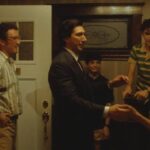
Ben Shenkman in SAPIRO V. FORD: THE JEW WHO SUED HENRY FORD (courtesy Michael Rose Productions)
Providing visuals depicting Canadian wheat farmers was an invaluable Evelyn Cherry silent film, By Their Own Strength. Michael Rose had secured a low-resolution, cropped version of the film, but Gaylen spent a lot of time and energy tracking down a better-looking print.
Adding to the uniqueness of Sapiro’s story and the use of Ben Shenkman portraying the activist lawyer are the fascinating graphics including animated newspaper headlines, political cartoons in motion, and inflammatory words exploding out of newspaper articles. Gaylen Ross gives all credit to the motion graphics designer Garry Waller’s Momentist Studio.
Through his artistry, every newspaper headline became an active character. Gaylen explained, “We did a style for every single one. Sometimes we would have to go through 3 or 4 versions of each one.” Both Waller and Ross were intent on eschewing static headlines. Instead, the animated headlines moved the story right along far beyond the speed of a Model T.
Regarding funding for the project, Lyn Kupferman, a longtime friend of Michael Rose and Carol King, learned that Michael’s admirable project about Sapiro had been revived with Gaylen Ross. Lyn said the words that every creative person dreams of but rarely hears: “How much money do you need?”
Once all the material had been gathered and the structural script finalized, Gaylen Ross then set about editing the film, as she had done with many of her previous works.
Even though she and Carol “discussed every scene and how things were going,” editing is ultimately a lonely job, unlike the actual production. Ross explained: “You’re still sitting there by yourself, figuring out music, and archive, and placement, and what sound bites to use. There’s no going away for a few days and let the editor work.”
Sapiro v. Ford: The Jew Who Sued Henry Ford has already been highly praised in over 30 national and international film festivals, beginning with the Miami Jewish Film Festival in January 2026.
The overwhelming reception of the film has been naturally wonderful for Gaylen, Carol, and Ben. I asked each one what they ultimately thought about Sapiro and his importance, not just for Jews, but for all people who have suffered the pain and fury of bigotry.
Carol King said: ““Had Henry Ford continued to publish the paper, imagine what the 1930s would have been like in America. Sapiro didn’t have the victory [in the trial]. That would have been wonderful, but the fact that Henry Ford had to stop publishing and no longer had that megaphone, that’s probably the greatest thing that came out of the trial. Ford thought he was the wise man. He had presidential ambitions. He’d run for the Senate at one point, and so in more ways than one this was not a legal victory, but I think it had repercussions that resonated through the years.”
Gaylen Ross said: “What Sapiro says in the beginning of the film, he’s addressing something much broader than the attacks against the Jews. He’s talking about religious bigotry, he’s talking about racial discrimination, he’s talking about intolerance. Sapiro was going after a lot of different things that included the response to the attacks on the Jewish community and himself, but also the xenophobia that was across the country, and what was happening. Sapiro was really looking at this landscape in a broader way and his very strong statements about the value of democracy working together for what you can’t do by yourself. The most important thing for him in life was democracy.”
Ben Shenkman summed up his thoughts about Sapiro: “Like the audience, I knew nothing about him. And the fact that we know nothing about him is an important part of the story actually. It’s kind of the point, in some way. As soon as I began to read his text, I just found him compelling. I found him heroic. Both in the events that the text describes but again his way of telling about it, his account of himself, his way of articulating what happened to him, the sort of modesty of it, if that makes sense, I’ve found moving and inspiring. So, I just thought this deserves to be heard. This deserves to be excavated from having been erased from history for whatever reasons, or whatever circumstances led to that being the result. This is something that deserves some sunlight on it.”
Regarding the timeliness of the film for contemporary audiences, Shenkman wisely added, “The idea of a very, very, very rich person with a huge megaphone to spread lies? I mean, It’s pretty much on the nose.”
– Chale Nafus (@chale_nafus)