





PLAYING WITH FIRE: AN ECOSEXUAL EMERGENCY
(Check out Brandon Wilson’s Playing with Fire: An Ecosexual Emergency movie review. The film opens in NY October 9 before expanding nationally in November. Seen it? Join the conversation with HtN on our Letterboxd Page.)
When living in apocalyptic times, it is natural to expect artists to meet the moment with work that helps us all process the tides of the era. But this can in fact be quite difficult. The axiom goes that political fuckery leads to better music and art but I am not sure this is always true. The George W. Bush era did lead to a golden age of documentary (by necessity since legacy media largely failed to do its job), but I remember seeing films and plays that led me to think that sometimes the fury generated by catastrophes, rampant inequality, and regressive politics overwhelms the artist, leading them to a scattershot rather than focused attack, and causes the work they are making to suffer.
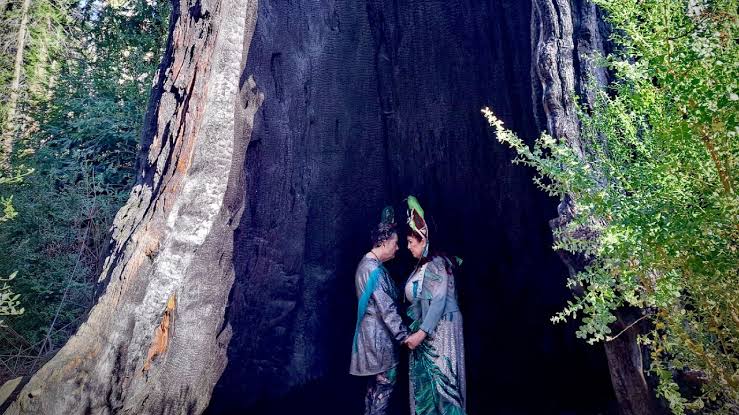
Having now lived through several eras like this, I can say that the best work of this kind isn’t just a protest against the status quo, it is also a promoting a vision of how things could be. Creativity works best when it is building, not just lashing out. A great example of this is the new documentary Playing with Fire: An Ecosexual Emergency, directed by Annie Sprinkle and Beth Stephens. The documentary has a winning charm because it is both deeply personal and also universal in its scope. And it is driven by the spirit of “ecosexuality,” a kind of sexualizing and queering of environmentalism (that the environmentalist mainstream is apparently not a fan of) that draws on indigenous traditions and queer theory and asks us to think of the earth not just as our mother, but as our lover.
Even if you walk away from this documentary with your skepticism toward ecosexuality largely intact, you will, if you remain open, come to appreciate its aims and the urgency for a new way of thinking about our environmental crisis. The directors begin the film in their beloved woodland town of Boulder Creek in Santa Cruz County, California. A one time logging town that has become a haven for those with a counterculture spirit, Sprinkle and Stephens interview many of their neighbors and denizens of the town, and they also include the animals of Boulder Creek, going so far as to make a narrator of sorts out of Albert, a free range white peacock who is a local celebrity. He belongs to no one, but the town belongs to Albert.
Tone is one of the biggest challenges in documentary and Sprinkle and Stephens do a fine job balancing the whimsical with the tragic. Fire threatens the town and claims the homes of some of their neighbors. The directors use this personal trauma to ask larger questions about the state of environmentalism in a time when far too many still dismiss climate science as a hoax and focus on those who are directly in the line of fire.
One of my favorite passages explores the practice in California and many other states of using the incarcerated as firefighters, and then exploring the roadblocks in their way to becoming firefighters after they are paroled (Governor Gavin Newsom just signed legislation to make it easier for the formerly incarcerated to make a living fighting fires the week of this being written). Sprinkle and Stephens also meditate on fire itself, consulting older traditions and environmental science which both regard fire as a necessity to clear old growth so new life can come. Destruction is a coin with two sides.
Directors Sprinkle and Stephens aren’t new to this subject matter. This is their third and likely final ecosexual documentary, the first being Goodbye Gauley Mountain: An Ecosexual Love Story (2014), about coal country mountaintop removal in Stephens’ home state of West Virginia, and then Water Makes Us Wet: An Ecosexual Adventure (2019). And while it would seem that an air themed documentary is in order, Annie Sprinkle, citing her age, has recently declared this will be her last film as co-director. Beth Stephens seems more open to continuing.
The duo make a formidable pair. Dr. Stephens, raised in Appalachia, is a longtime fine arts professor at UC Santa Cruz where she has twice served as department chair. Her work has been presented at galleries and museums around the world. Annie Sprinkle is a living legend. And that’s not a phrase to be used inadvisedly. Getting her start in adult films during its 1970s heyday, Sprinkle has been a sex worker, a filmmaker, a performance artist, and a decriminalization advocate, She earned her PhD in human sexuality 30 years ago. In short, Stephens and Sprinkle themselves should be the subject of an epic documentary.
But in the meantime, their own collaborative body of work will preserve their scholarship and advocacy for generations to come. But more than that, their films address the central challenges of our moment with humor, imagination, grace, and humanity.
– Brandon D. Wilson (@GeniusBastard)