






((Check out Anders Ljung’s 76 Days Adrift movie review, it’s available on VOD via Apple TV now. Seen it? Join the conversation with HtN on our Letterboxd Page.)
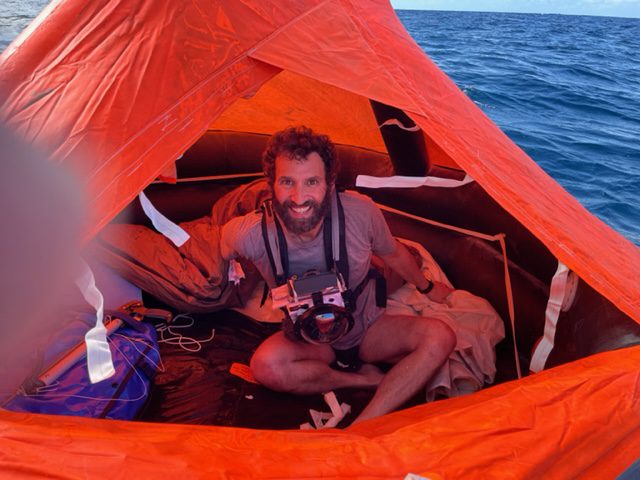
There is an inherent intimacy to a survival story told by the person who survived it. In 76 Days Adrift, director Joe Wein embraces that intimacy almost completely, allowing sailor Steven Callahan to become both the subject and guiding voice of his own extraordinary ordeal. The documentary recounts the 76 days Callahan spent drifting across the Atlantic Ocean in a small inflatable life raft after his sailboat sank in 1982. Rather than attempting to manufacture suspense around an outcome that has been public knowledge for decades, Wein constructs the film around the peculiarities of memory itself. Callahan explains, demonstrates, jokes, and reflects, turning an unimaginable experience into something unexpectedly conversational.
Callahan previously chronicled the experience in his 1986 memoir Adrift: Seventy-six Days Lost at Sea, which became an international bestseller and remains one of the defining modern accounts of survival at sea. The documentary inevitably exists in conversation with that book, but hearing Callahan narrate the story decades later introduces a different relationship with the material. Time has transformed terror into recollection. His voice carries the authority of someone who has repeated these stories but also the strange casualness that can develop when extraordinary events become part of one’s personal mythology.
In 1982, Callahan departed the Canary Islands aboard his 21-foot sailboat the Napoleon Solo. After the vessel was badly damaged and ultimately lost, he escaped into a life raft with limited supplies and few guarantees beyond his own ingenuity. What followed was a 1,800-mile journey across the Atlantic during which Callahan battled dehydration, equipment failures, injuries, sharks, and the exhausting repetition of simply staying alive. His survival depended upon catching fish, collecting rainwater, repairing equipment, and continuously improvising solutions from the small collection of materials available to him.
Wein initially approaches this history with something resembling an educational documentary. Callahan’s narration methodically guides us through the mechanics of survival, while photographs, archival material, diagrams, and recreations illustrate the increasingly elaborate systems keeping him alive. The structure can feel almost instructional. We learn alongside Callahan’s younger self, understanding not only what he did but why each decision mattered.
Yet 76 Days Adrift becomes considerably stranger, and more interesting, when that instructional quality begins colliding with the film’s sense of humor. The editing frequently takes on a slideshow-like rhythm, rapidly cycling through images and visual information while Callahan describes another increasingly absurd predicament. Sharp cuts compress the chaos of survival into miniature comic sequences. There is something inherently funny about watching one solution immediately create another problem, and Wein is surprisingly willing to let that absurdity exist alongside the danger.
The score amplifies this tonal contradiction. At its most atmospheric, the music complements the surreal quality of the archival and found-footage imagery, emphasizing the almost dreamlike impossibility of one person floating through an enormous, indifferent ocean. Elsewhere, however, the score becomes playfully animated. During some of Callahan’s clumsier or more chaotic recollections, it adopts an almost slapstick quality, occasionally approaching the exaggerated musical logic of a Looney Tunes cartoon. Movements, mistakes, and sudden complications receive musical punctuation that transforms portions of the survival narrative into something resembling physical comedy.
It is an unusual choice for a film about an experience in which death was a constant possibility, but it also prevents 76 Days Adrift from becoming oppressively reverential toward its subject. Callahan is not presented as an untouchable survivalist hero. He is resourceful and extraordinarily determined, but also fallible, frustrated, and occasionally ridiculous. His narration helps sustain that distinction. Because Callahan himself can recognize the absurdity of his circumstances, the documentary is able to laugh without necessarily diminishing their seriousness.
That balance is strengthened by Wein’s editing. The film moves quickly between Callahan in the present, historical material, recreated imagery, and the visual remnants of his journey. The ocean becomes simultaneously threatening and strangely mundane. Days blur together. Fish become companions and food. Improvised objects acquire enormous importance. The repetition communicates something that conventional dramatization might struggle to capture: survival is often less a succession of heroic acts than an exhausting accumulation of tiny decisions.
There is another fascinating cinematic connection behind the project. Callahan’s expertise eventually brought him into the production of Ang Lee’s Life of Pi, on which he served as a marine and survival consultant. Lee now returns the favor as an executive producer of 76 Days Adrift. It is a fitting association. Both films are concerned with the psychological transformation that occurs when a person is isolated at sea, although Wein’s documentary strips away the metaphysical spectacle of Lee’s film in favor of the physical reality that helped inform it.
What ultimately distinguishes 76 Days Adrift is not simply the extremity of Callahan’s survival but the peculiar way he has learned to tell it. Wein understands that the most compelling access point to a story this famous is Callahan himself. His narration shifts between instructor, comedian, historian, and survivor, while the editing and score continually reshape the emotional register around him. The result is a documentary that can resemble a survival lesson one moment, an archival dream the next, and an unexpectedly funny slideshow immediately afterward. More than four decades after Callahan disappeared into the Atlantic, 76 Days Adrift finds its intimacy not in recreating exactly what those 76 days looked like, but in observing how one man has learned to remember them.\
– Anders Ljung