





LADIES AND GENTLEMEN, BRIAN MULRONEY
(The Toronto International Film Festival (or TIFF) runs September 10-20 and HtN has boots on the ground covering all the best indie films they have to offer. Check out Clara Cuccaro’s Ladies and Gentlemen, Brian Mulroney movie review from the fest! Seen it? Join the conversation with HtN on our Letterboxd Page.)
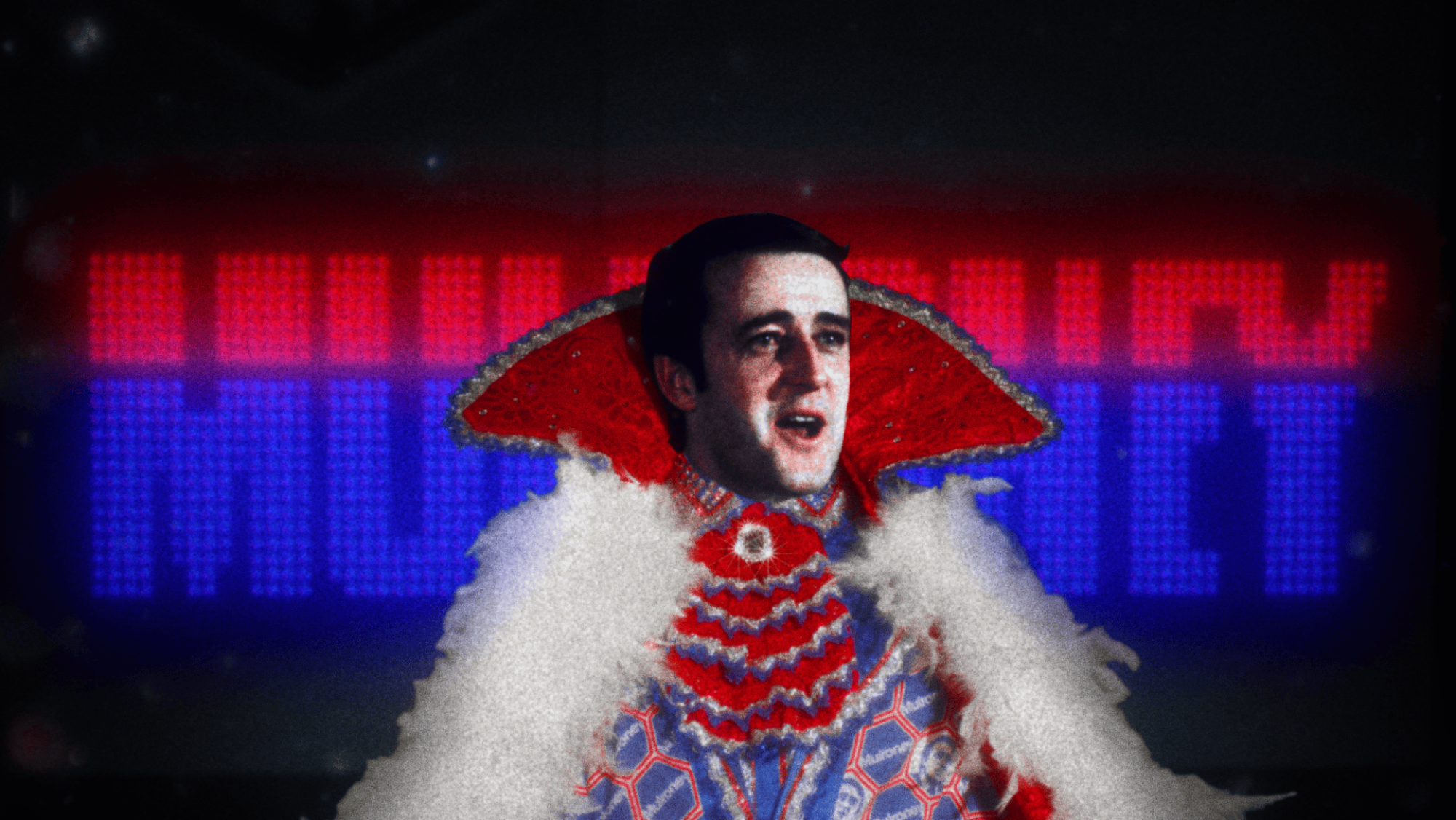
Matthew Rankin’s latest documentary, Ladies and Gentlemen, Brian Mulroney, asks a simple question: What if documentaries about politicians were fun? In this absurd, completely creative work of non-fiction, Rankin goes off script from the traditional biopic, assembling a kaleidoscopic portrait of the former Canadian prime minister from archival footage, staged recreations, animation, and a healthy dose of irreverence. It’s wild like an acid trip, with bright colors and a bedazzled Liberace suit, but also methodical and well researched like an academic thesis by a student on drugs.
Produced by the National Film Board of Canada as a four-part documentary series, Rankin eventually whittled the film down to 105-minute work of non-fiction. Told through a series of chapters that function like television episodes, Rankin begins with a collage of Canadian archival footage: there’s dynamite in the Rockies, wheat fields in Prairies, and red and blue cottages in the Maritimes. This montage of postwar Canada eventually cuts to the Progressive Conservative Party leadership convention in 1976, where everything will change. Joe Clark, not Mulroney, wins the nomination for the Tories. During his speech, Rankin cuts to archival footage of people smoking and sleeping, premeditating their indifference towards the 36 year-old man from Alberta, while the ‘Boy from Baie-Comeau,’ prepares for the future. This film is about the latter’s political accession, but in true Rankin fashion, Mulroney’s rise will be persuasive and anything but linear.
While Ladies and Gentlemen, Brian Mulroney is fabulously edited together with impressive visual gags, I was personally struck by the film’s motion graphics. Rankin’s team consists of Adrian Replanski, Galen Johnson, and Rob Feulner Quiñones. Their illustrations include Mulroney’s Liberace suit and the fictional Iron Ore Company of Canada (IOC) Airlines (Mulroney was famously the president of IOC before running for office). These graphics are bold in color, collage-like, and Monty Python-esque, showcasing the director’s gonzo spirit, but also perhaps a devoted compassion for the irreverent minds that came before him.
When Rankin isn’t remixing archival footage, he’s creating outlandish dramatizations that are as hilarious as they are novel like the fictional Museum of John Diefenbaker. For those of us like myself, who weren’t familiar with the landscape of Canadian politics, Diefenbaker was the last Conservative politician to serve as prime minister before Mulroney. When Clark’s popularity begins to waver, a cut-out version of Mulroney visits this fortress-like museum where the halls are lined with portraits of Gandhi and Prince Charles and quotes by Wayne Gretzky. It’s here that he finds the strength to follow in his predecessor’s footsteps. First he needs Clark to lose, then he needs to win over Quebec, a province that famously is not kind to Anglified outsiders.
When I was sitting in a press conference at TIFF, I overheard a group of Canadian critics wondering if Rankin’s newest film would resonate with American audiences. This review is proof that it does. I found myself in a Mulroney-infused wormhole after the film concluded, somewhat confused by the coalition government north of the border, but the testimonials and anecdotes on Wikipedia were not as interesting as Rankin’s documentary. No wonder he wanted to jazz things up.