


THE SPIRAL
(The 2026 Venice Film Festival ran September 2-12 on the island of the Lido di Venezia (Venice Lido) in Italy. HtN has coverage coming in like M.J. O’Toole’s The Spiral movie review. Seen it? Join the conversation with HtN on our Letterboxd Page.)
Family is complicated, especially when you carry the burden of your parents’ choices throughout your life. But it can’t get as complicated as the legacy of the Colonna family. What befalls them in director Paolo Strippoli’s The Spiral is a different kind of nightmare, one where most of them (except for one) aren’t aware that there have been darker forces at play contributing to the years of misery they endure. In his fourth feature, Strippoli (The Holy Boy) gives us a peek into Italian high society through the eyes of a well-to-do family who many would consider blessed on the surface, but over decades face dark circumstances out of their control because of one woman’s choices. This psychological and supernatural horror, anchored by a powerhouse performance from Jasmine Trinca as the vain and tortured matriarch, whose secrets and decisions drag her family through hell. The story unfolds through a confession she makes to her estranged daughter about the truth behind her family history. This unsettling, emotionally charged, and visually well-crafted stunner, which Strippoli co-wrote with Salvatore de Chirico, will make heads spin (like the title) when people see that the devil really is in the details.
The Spiral opens with middle-aged Anna (Trinca) paying an unexpected visit to her estranged adult daughter Alice (Romana Maggiora Vergano), a costume designer, at her Rome flat during a very stormy day. Alice seems more unsettled than surprised at her mother showing up at her place unannounced, given they haven’t been in touch for some time. With a mysterious black suitcase in tow, Anna sits Alice down to explain why she’s there: to tell her daughter the truth about what was really behind the unfortunate events that unfolded in her life since childhood. Her story begins with a somewhat ominous warning, “She is real.” At the start, we, the viewer, are in the same position as Alice, wondering who “she” is and what her frantic mother came all this way unannounced to tell her. Why now? Along with his co-writer Salvatore de Chirico, Strippoli expertly leaves the right amount of breadcrumbs from the beginning to hook and keep you anticipating what will happen until the moment your jaw drops.
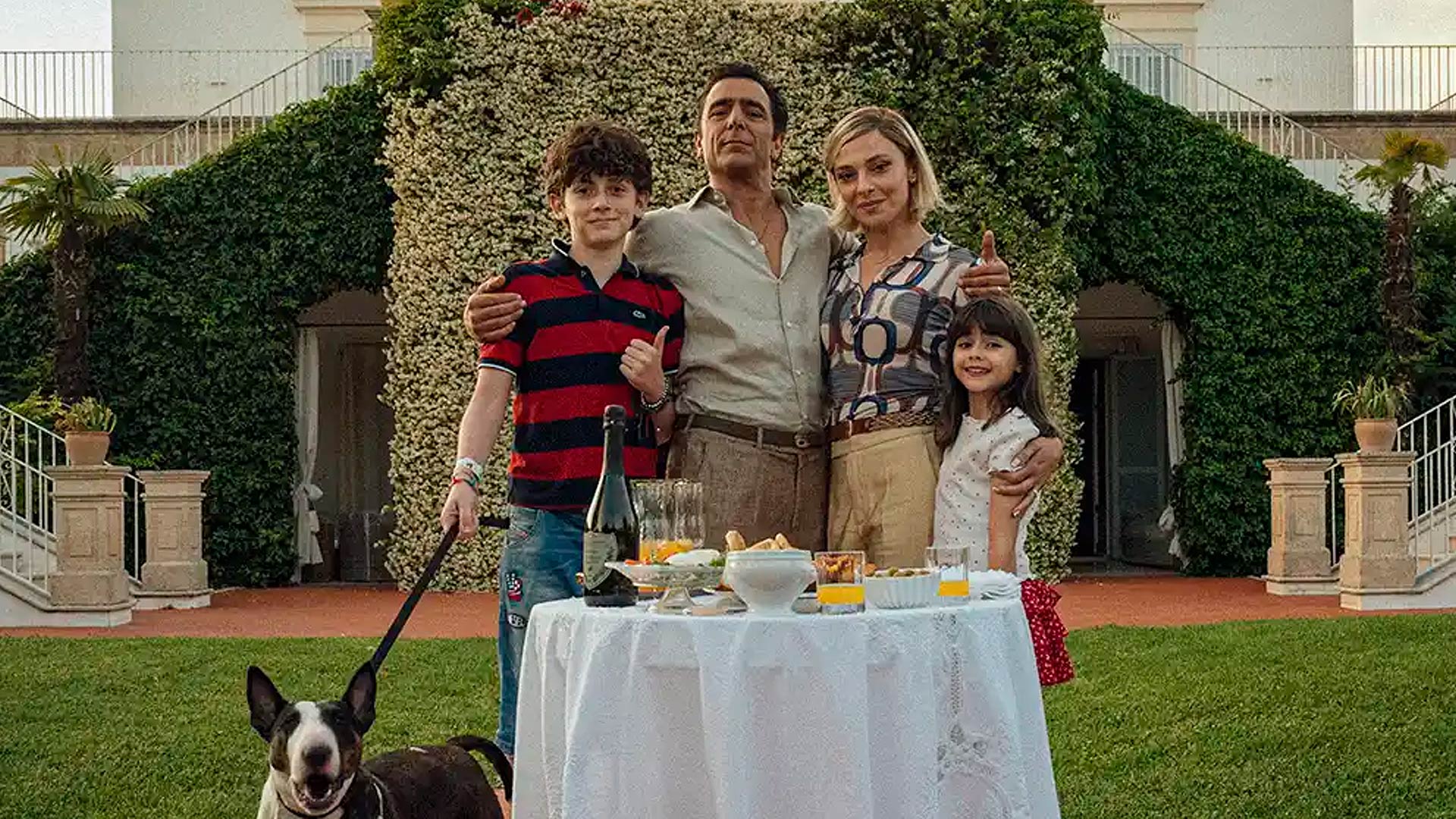
We soon turn the clock back from a stormy and overcast 2026 Rome to the sunny green pastures in 1999 Bari, where a younger and bleach-blonde Anna commands the staff in the gorgeous new home she shares with her husband Walter (Adriano Giannini), the machismo patriarch, along with a then 7-year-old Alice (Gabriella Telegrafo) and 13-year-old son Tobia (Alessandro Carbonara). Both parents try to live their dreams through their children, with Anna pushing Alice into a career as a child actor and Walter personally training Tobia to be a European football prodigy. This seemingly perfect family, trying to measure up to status in a conservative high society, seems to have everything one would want for their family. But Strippoli establishes his atmosphere of dread well enough that you reasonably expect something to go wrong. Everything begins to change for the Colonnas when a horrific accident during their garden party puts Alice’s at risk of amputation. Seeking space in a hospital church, a distressed Anna is chatted up by an ominous stranger (a fabulous and eerie Valeria Bruni Tedeschi), who somehow knows her children’s names and their situation. For the record, if someone smoking a cigarette in a church isn’t a clear enough red flag, I don’t know what else is. This stranger offers Anna a deal to save Alice’s future, in exchange for the health of another child, a scenario she describes in stark, bleak detail. Out of desperation and fear, Anna accepts whatever this stranger proposes. To her shock, things begin to look up in ways no one else anticipated. But as soon as Alice recovers, Tobia begins to eat uncontrollably, gain weight, and become depressed. Coincidence? The moment Anna sees this is as much a slap in the face to her as it is to the viewer. What kind of Faustian bargain has she made here?
Over the years, the family endures a string of hardships: obesity, bullying, brushes with death, financial hardship, fractured relationships, and eventually loss. As the family’s dynamics shift, it becomes difficult to pin all the blame on Anna’s deal with the devil. Instead, it exposes the real cracks beneath the family’s surface, particularly the pressure the parents place on their children to fulfill the dreams they couldn’t achieve themselves. Despite his flaws as a father, alpha-male Walter is someone who breaks rather than bends, directing more disappointment inward than at his children when life tests him. Meanwhile, amid the chaos at home and trying to be a loving sister to her troubled brother, Alice comes into her own, discovering her sexuality through time spent with other girls in her circle. The film moves fluidly between past events and Anna recounting her story to Alice in the present, building toward the daughter finally confronting her mother about always needing things her way and how she treated her children, rarely truly seeing them for who they are. Given everything Anna recounts, it’s easy to sympathize with Alice’s suspicion that her mother might be losing her grip on reality. Fittingly, as Anna’s story deepens, Rome’s weather grows more turbulent – verging on apocalyptic. When another near-tragedy strikes in the past, the devil-like stranger pushes Anna toward another agonizing decision, one that culminates in a jaw-dropping revelation in the present, finally explaining the true reason behind her visit to her estranged daughter. Strippoli never grants his audience any relief. Everything from the past to the present is steeped in threat, especially with those you should feel safest with.
Part family drama, part coming-of-age story, and part supernatural horror, Strippoli excels as a nightmare storyteller with The Spiral. Already established in Italian cinema, this will hopefully launch him worldwide as an exciting breakout voice in horror. Jasmine Trinca’s breathtaking performance recalls Nicole Kidman’s in The Others, where she too played a wife and mother caught between denial and excruciating realization. Another highlight is Valeria Bruni Tedeschi’s phenomenally creepy and unexpectedly funny performance as a cheeky demon who may have control over a lot more than just Anna’s life. It begs to be rewatched. Even though there is a fair share of unsettling imagery that will surely haunt audiences, Strippoli’s ambition transforms it into an intoxicating, all-consuming stunner that will get under your skin and seep into your bones.
– M.J. O’Toole (@mj_otoole93)