



A Conversation with Kent Jones (LATE FAME)

Arthur Schnitzler wrote Late Fame in the 1890s and never published it. The manuscript sat in his archive for more than a century before it surfaced, which makes it fitting material for a movie about an artist rediscovered decades too late. Samy Burch, who wrote May December, adapted the novella and moved the story from 1890s Vienna to downtown New York. Kent Jones directs the film. He was a film critic who directed the documentary Hitchcock/Truffaut and ran the New York Film Festival from 2013 to 2019 before turning to narrative features with Diane in 2018. Late Fame is his second.
Willem Dafoe plays Ed Saxberger, a poet who published a book in his youth, put the pen down, and spent the next forty years working at the post office. A young writer named Meyers (Edmund Donovan) turns up at his door one evening, and before long Saxberger is the guest of honor in a circle of twentysomethings who call themselves the Enthusiasm Society and have decided he is a forgotten genius worth reclaiming. Greta Lee plays Gloria, an actress and singer older than the rest of the group, closer to Saxberger in temperament, and the one person in the room who seems to be living the life the others are only performing. Jones shot in SoHo and the West Village, where the cobblestones and loading docks still sound the way they did fifty years ago.
The movie premiered at Venice last fall, played the New York Film Festival soon after, and is in theaters through Magnolia starting August 7.
Hammer to Nail: I would love to talk about these opening moments. We see an average day in the life of Ed Saxberger, quickly and effectively situating us as to where he is currently in his life as well as our setting. He arrives home from a day at the post office when he sees his neighbor, Paulie (Tony Torn), in an eccentric outfit smoking a cigarette. And then we have our first interaction between Saxberger and Meyers. Can you talk about what was important to you in helming this introduction?
Kent Jones: It was important to situate the opening credits in images and sounds from Ed’s past, the moment he got to New York and was part of that scene, and then move into this other part of his life. You aren’t quite sure how the two connect, but it becomes apparent as you watch the film. I wanted the credits to be precise about that world, the stuff that was, as people used to say, DIY, but that was the nature of the art. Mars, the band that did “Helen Fordsdale,” I don’t think any of them knew how to play an instrument. They were art students, which was a typical thing back then, but they made something so energized. To move from that into this other rhythm, and to keep the music carrying that New York, guitar-based feeling, I wanted something that echoed the kind of guitar playing Tom Verlaine did, and Don Fleming knew immediately what I meant. But it’s a different rhythm and a different moment in his life, and then, boom, there’s Meyers. I just wanted to set it up that way.
HTN: That definitely comes through. I love the scene where Ed first goes to the Enthusiasm Society. We meet Carmichael (Arthur Langlie), Sherfey (Graham Campbell) and Brussard Clay Singer), who’s quick to proclaim that he’s an essayist, not a critic, and Winn (Luca Padovan), who writes everything. They fawn over Saxberger’s work even though they’ve not read it, and the era he comes from. Brussard is quick to psychoanalyze the influencer cohort of the society. The sequence ends with the start of their idea for a throwback show, no phones allowed, all shot on a film camera. So much is told through Willem’s mannerisms here. Can you talk about your thinking with this sequence?
KJ: One detail that follows after Brussard makes his proclamation about the influencers is that he gets a text from one of the influencers, The woman he’s obviously had an affair with, and goes back, and you can guess what the conversation is. As opposed to Diane, I wanted to shoot this movie handheld, for the most part, and to have two cameras going as much as possible in every scene. The reason was that I wanted to be responsive to everything happening between the people. Those guys and I talked everything over, and that group is an amazing bunch of people. Graham Campbell is doing a Ryan Murphy thing now. Clay Singer, who plays Brussard, just got through doing the immersive version of Phantom of the Opera. They’re great, and they got on the wavelength immediately. For Willem’s character, he’s suddenly thrust into this thing. He gets the whole schtick when they realize who they are talking to and say “Oh, Saxberger!!” On the other hand he’s charmed and lured by the siren song of, you’re a forgotten genius and we’re reclaiming you. Even if in his heart of hearts he knows the rest of them, not Meyers, may or may not have read the poetry at that point, he’s charged by the energy of the group.
HTN: The sequence at Meyers’ apartment is so awesome. Again, it’s the subtleties of Willem’s performance that speak volumes. I love Meyers talking about how his parents bought him this place as an investment. He says that it’s practically cheaper than the dorms. He initially comes off as embarrassed saying “it’s ostentatious,” but you can tell deep down he loves the vibe, with the music playing in the background and his all-white outfit. He presents Ed with the invitation, which genuinely excites Saxberger. He muses about how technology is rotting the brain. The sequence ends with Meyers pressuring him to make a memoir, probing him about his process like I’m doing to you right now. Saxberger says, “I like to let things settle.” Hilariously, Meyers responds, “interesting choice of words.” Can you just talk about helming it and also finding that location?
KJ: All the interiors were in Jersey, in Jersey City. It was an artist’s place; she had her apartment in the back and used the ground floor as an Airbnb. On the white on white, I have to bring up one of my key collaborators, my wife, Carissa Kelly, the costume designer. When she told Edmund she thought it should be white on white, his first thought was, “really?” Then he got it on, saw himself on camera, and said, yeah, it’s the right idea. I don’t know that Meyers is really pressuring Ed so much as it’s part of the whole thing, “my agent wants to talk to you, about you,” I’m not into satire personally.

A scene from LATE FAME
I like laughing at it and watching it, and there’s obviously a satirical element here, but I found something very touching about Meyers. Working that out with Edmund. He said to me, “I think Meyers should be a little odd, what do you think?” I said, “yeah, that’s the idea. He’s someone who can just speak that way…I read it in Charing Cross Road in one sitting, I’m writing this epic poem blah blah” imagining himself as a new Diaghilev. There’s something ridiculous about it and something touching about it. It’s touching to me that the group isn’t really a group, that they kind of are and kind of aren’t. Some members appear and disappear. That becomes the key scene between the two of them, and the center of it is where Meyers breaks into this insane laugh, or where he talks himself in a circle about politics and art and then just drops it and says, “what about you?” It was a lot of fun to do that scene.
HTN: Another scene that seemed fun was the meeting with the agent played by Jake Lacy. It’s a real highlight for me, and Jake is just perfectly cast in this role. The whole thing about Saxberger being a rediscovery, and how precious that is, it feels like a turning point in the movie. Again, can you just talk about crafting it?
KJ: It was more insane on paper, and I whittled it down to what it became. The key to the moment is that Willem is thinking, “I don’t know what I’m doing here, but I’m here anyway.” The alluring beauty of the forgotten genius, we’re here to bring you back to the prominence you deserved and that was so unfairly kept out of reach, it buoys him up, and then he gradually floats back down to earth. That scene is a turning point, and where it really turns is the moment Gloria says, you must have been beautiful when you were young. The idea that he’s going to write another poem is never going to happen, but it’s the act of wanting to write one and feeling like he can, and then, when pen goes to paper, it doesn’t happen, because the muscle isn’t there. All he can do is listen to the poets that energized him when he was young. For him to be there against his better judgment but there anyway, and then to be told he’s a valuable property, it’s a bit of an exaggeration, but for an agent it’s not that far off.
HTN: I worked at United Talent Agency, so I know it’s not that far off the mark.
KJ: You worked at UTA? I’m repped by Houston Costa and Jeremy Barber there.
HTN: That’s awesome! I had a nice boss…but I knew people who remind me of Jake Lacy’s character. It’s a great place, actually. Anyway, can we talk about Greta’s performance at the bar? It’s just utterly marvelous, and an extended musical number. Just talk about working with her on that scene and how it came from the page to the screen …Who is also repped by Houston…and Edmond is!
KJ: It’s a real Houston project. He gets a special thanks at the end, because financing a film like this is not easy, as you know, and he helped in the final crunch. Interestingly, someone else was originally cast in Edmund’s role. Houston asked if I’d meet with Edmund just generally, and I did, and I thought, this guy’s great. I was originally thinking of him for another role, but when the original actor, who was never quite right to begin with, didn’t work out, I said, I’m calling Edmund now, and that was about thirty seconds later. With Greta, Houston sent me to see Past Lives without mentioning he repped her. He just said, “it’s a really good movie, it won at Sundance.” I said, “that’s not a guarantee,” but he was right. After I saw it I told him I thought it was great, and that the actress blew me away, and he said, “oh, I rep Greta.”
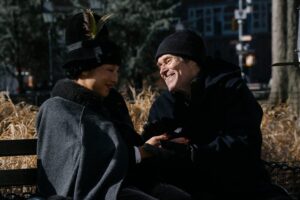
Greta Lee and Willem Dafoe in LATE FAME
Then I saw her in Russian Doll, grounded in comedy, even better. I could talk about working with Greta for hours.“Surabaya Johnny” wasn’t on the page. What was on the page was a striptease, and it just didn’t feel like the right thing to do in a new burlesque place. I said I wanted her to sing something, and told her I was thinking of “Surabaya Johnny,” because I love Brecht and Weill and it seemed right for her character. She said, “Say no more, and you’d better get the rights, because you can’t unsay it now, I have to do it.” For the costume, that incredible green thing she wears, Carissa found it after I showed her and Greta a bit of Sternberg’s Shanghai Express to get a general sense, and we found the right wig. Beyond that, the way she sings it, performs it, relates to the audience. We decided to record it live, not post-synced. She sings it beautifully, but not too beautifully. She’s doing it in character, which is a subtle thing she does throughout the movie, playing a character who’s playing a character, almost every minute, except in the scene where he goes to her house. Boy, she is formidable.
HTN: You almost think for a second that Saxberger is going to be inspired to write another poem.
KJ: There’s a special quality to Weill’s melodies and to Brecht’s lyrics. It tells part of her story too, in a very oblique way.
HTN: Absolutely. Well, Ed is, in a way, flattered back to life. Flattery is really a native language of this industry, of festivals and press junkets like the one you’re on right now. How do you personally tell the difference between an admirer and an Enthusiasm Society member? I’m sure you brought a lot of personal experience to this movie in that regard.
KJ: That’s a tough one, but a very good question. People say the camera doesn’t lie, and neither does body language, gestural language, behavior in the moment. So when you’re listening to someone who’s saying what they think you want to hear, or what they think should be said within the confines of the moment, or not, it’s all there. It’s like when I interviewed David Fincher for Hitchcock/Truffaut. He was talking about how, if you think as a director that you can hide your ambitions, your weirdnesses, you’re nuts, you just can’t, so don’t try. I think that goes for human behavior too, in the situation you’re describing.
HTN: Well, I think I have time for one more question and I’m about to be applying for accreditation at the New York Film Festival, so I think they might like this…
KJ: Haha, Sorry, can’t help you there.
HTN: The film played at the New York Film Festival in Alice Tully Hall. I’m just wondering, generally, what was it like walking into that building as a filmmaker being judged rather than the person doing the judging?
KJ: Not as weird as it would have been if I’d made it the year after I left. We did a screening of Diane there, and I had a conversation with Eugene Hernandez, back in 2018 for that. I did Hitchcock/Truffaut there once, but that’s different from the festival itself and Alice Tully Hall. It wasn’t weird, really. I was walking the same walk I was very familiar with, and then I was up on the balcony, where I sometimes sat with friends. At least I don’t still have the instinct to start asking questions. It was cool. A great screening. I really enjoyed that.
– Jack Schenker (@YUNGOCUPOTIS)