

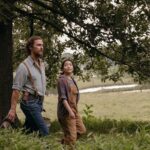


A Conversation with Karen Allen: Berkshire International Film Festival Tribute Honoree
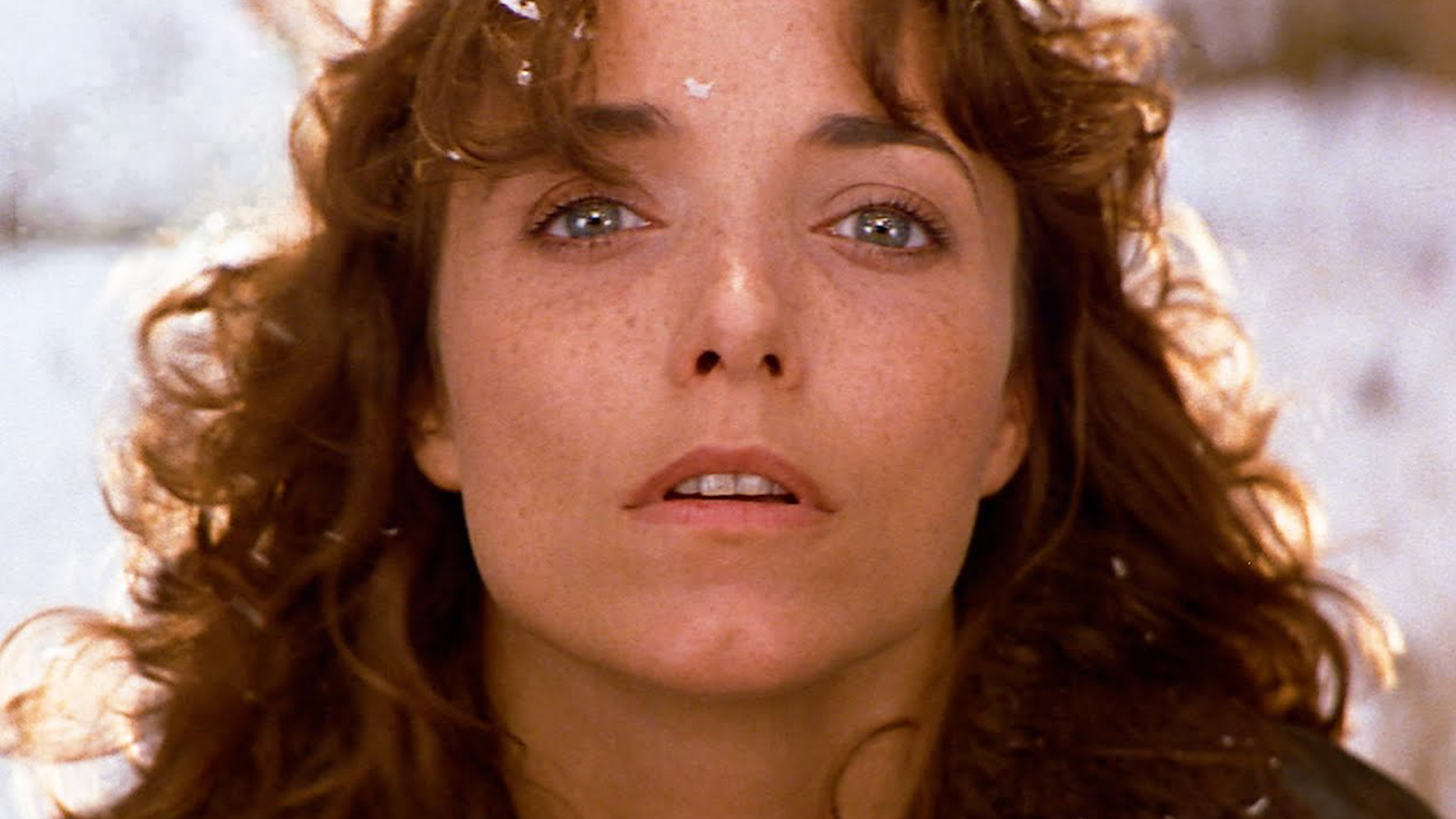
The Berkshire International Film Festival returns for its 20th anniversary celebration from May 28 – 31, showcasing 31 documentaries – including two world premieres – alongside 29 narrative features, 29 short films, and a free animated shorts program for children. Since the festival’s founding in 2006, one of its most devoted champions has been legendary actress Karen Allen. Known by most folks for her iconic role as Marian Ravenwood in the Indiana Jones films, Allen has remained deeply involved with the festival over the years as a juror and on the board of directors.
A longtime resident of the Berkshires, Allen has also become an important part of the region’s artistic community – as a neighbor, theatre collaborator, and textile designer through her Great Barrington studio and clothing label, Karen Allen Fiber Arts. This year, the festival will honor her with a Q&A moderated by production designer Kristi Zea, accompanied by a special screening of Starman, the 1984 John Carpenter film in which she starred opposite Jeff Bridges. I spoke with the warm, funny, and endlessly thoughtful Allen about her creative life, reflecting on her career, and what gives her hope for the future of storytelling.
*This interview has been edited for length and clarity.
Hammer To Nail: The tribute on the 20th anniversary of the festival speaks so beautifully not just of your legendary career in cinema but also of your role in the Berkshires community. What has being part of BIFF given you, personally and creatively over the years?
Karen Allen: Well, I kind of got involved with it very, very early on. Kelley Vickery, who is the artistic director of [BIFF], has run and built it over the years. When I first came onto the board, we were a very small group of people. I’ve had on-the-ground experience working in film and knowing a lot of directors, actors, producers, and other people. So that was the kind of expertise I could offer to them. It’s such a complicated thing to run a film festival, and there’s a huge amount of preparation for a very short period of time where the festival actually takes place. But the amount of work that goes into making it happen is quite extraordinary. So I have been there to help in whatever way I could. I’ve done some work going with Kelley to festivals to look for films we would like to invite to the festival. I’ve also helped her choose honorees. For a long time, I have kind of been the overseer of the jury. We even have this beautiful thing called the Filmmaker Summit, which I think really distinguishes the festival from a lot of other ones. We invite experts from different fields of filmmaking to come and speak to these young filmmakers for two days. Some of the filmmakers who meet at the summit develop friendships that go on for years and years. So it’s very satisfying to help create something like that. The festival has grown a lot. Our board now has 20 to 25 people. There’s a lot of work we do trying to figure out how to make the festival. We want it to grow, but not get too big.
HtN: Whether as an actor or even a knitwear designer with your own brand and studio, what role have the Berkshires and the community you’ve fostered played in sustaining your artistic life?
KA: I think it’s just my kind of community, first of all. Politically, it feels like a good place to be. I live in a kind of an enclave where people are very well-informed and very involved in what’s going on in the world. It leans towards a sort of liberal and supportive community way of thinking. There’s not a lot of polarity. I don’t wanna be faced every day with people who have nothing but arguing in their hearts about what’s important in the world. And I love nature. I think after living in New York for something like 40 years, there was this real longing. I spent most of my summers in the countryside with my grandparents growing up, and I always found it a very nurturing place to be. I think the Berkshires has this sort of more open feeling. Because there are so many artists that live here, it just feels like the right environment for me.
HtN: With the festival showing Starman in your honor, how does it feel for you to look back on this project 40-something years later?
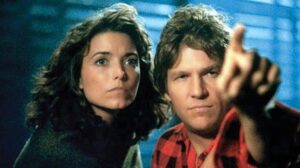
Karen Allen & Jeff Bridges in STARMAN
KA: Well, it was a really special film for me. I loved working with Jeff Bridges. We’ve stayed friends ever since, and it was just a wonderful collaboration. John Carpenter was wonderful to work with, too. It’s a strange kind of movie to make ’cause it was a little bit of a road movie. I turned it down the first few times John asked me to do it because the premise actually scared me. Like, this woman loses her husband to an accident. She wakes up in the middle of the night, and there’s this baby on the floor that turns into a man who looks just like her husband, but he’s actually an alien. I was like, “I don’t know if I can do that” [laughs]. Well, what it took was Jeff Bridges. He had not been cast yet when John asked me to do it. And when he was cast, it just all fell into place because he’s so deeply committed to that character and so fully embraced this being. It made it all so much easier than I thought it was going to be because I just took him at face value , and we were able to find a way to become these characters that on the page would make you think, “How do you pull that off?”
HtN: What was the dynamic on set like with Carpenter at the helm?
KA: John had, at that point, a really great crew around him that he worked with on film after film after film. Sometimes when you work with directors, depending on the location and stuff, there can be a whole new crew. So they were very involved in trying to get a language set with their crew and get to know them. That part was so smooth. Sometimes he and his cinematographer (Donald M. Morgan), the sound guys, and everyone, they could literally just give a little hand gesture to each other, and they hardly needed to speak sometimes to figure out how they were gonna shoot something. It was a fun, easy, and exhausting film to make because we were always on the road. We’d be at a Holiday Inn for a day or two, then pack again and head to the next Holiday Inn.
HtN: For a science film of its time, at its heart, it’s really about grief, connection, and rediscovering life after loss. What did you connect to emotionally when you first read the script?
KA: I think I connected very much with Jenny and with this idea that she starts out being very fearful of who this person is, even though he’s like in her husband’s body. She knows it’s not her husband. Little by little along the way, the fear starts to die back, and she starts to see the beauty in who he is, and really wants to save him. In and of itself, just that little journey is something so interesting to portray. Then she literally falls in love with him.
[Spoiler alert for those who haven’t seen Starman]
KA: She wants him to take her with him, but instead, he leaves her with a child. Jeff and I talked about how we would like to see a sequel made to this. People come up to me all the time and say, “Where’s their child?”
HtN: Hey, they made two sequels to Tron already, so who knows what could happen?
KA: Yeah, who knows? [Laughs]
HtN: Another of your performances that really stood out to me was your role in Colewell. The film conveys the grief of losing not a person, but a way of life. Did that resonate personally with you?
KA: It resonated deeply with me. There’s always that kind of question that one asks as they get older: How do you keep trying to figure out how you still fit in with all the things in life that you’ve been passionate about? As you get older, the question has more resonance and profundity to it. Tom Quinn [the director] just appeared in my life. He had written this and then decided he wanted me to do it. He sent this script to my agents three times, and they wouldn’t send it to me because it was gonna be such a low-budget film. Then he finally found my store, sent an email with the script attached, and the email was so elegant and lovely. I read the script, and then I got back in touch with him. He came here, we sat down, had lunch together, and talked. I thought, “This is somebody I would really like to work with.” Some of what he wrote was stuff he went through. It’s funny in a sort of way, but I was kinda playing him as well, and he’s a young man. I was also going through a lot of stuff in my life when we were working on that. There was a lot of loss in my own life. I lost my mother and my father and then my sister, who died not long after. I felt like it was one of those sort of moments where art and life were crashing into each other. I think that the loss that I felt within that character is that everything is being taken away from her, in a sense. It was right on the surface for me when we shot the film, which doesn’t always happen in a film.
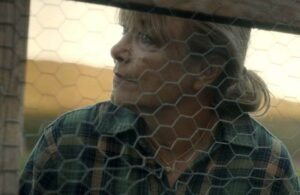
Karen Allen in COLEWELL
HtN: What do you think that film captured about small-town America that is often overlooked or misunderstood?
KA: The sense of corporate injustice in smaller towns. This case was based on a lot of other cases. This has happened to thousands of towns: just people making decisions for these kinds of economically practical reasons, and not considering that there are human beings involved. The little town I lived in here in Massachusetts before I moved, we had a little post office just like the one in Colewell. Mostly one person ran it, and we got to know that person intimately. It became the place in this little town of Monterey where everybody crossed paths. I got to know a lot of the town just by going to the post office. Whether something was going on, there was some issue, somebody had passed away, or something had happened in the town, that’s where it all happened. Most of the time, these post offices weren’t failing; they just weren’t making [the corporations] any money. They would just become irrelevant, and I guess that’s the central theme: how a certain way of thinking can devastate communities. That’s the sad reality of it.
HtN: After decades in the arts, is there anything that excites you the most about storytelling today?
KA: I guess that I still get so excited about it, you know? I did a film in Dublin last summer, and while I was there, I went to the Gate Theatre and then the Abbey. The play at the Gate that just bowled me over. I just loved it so much. I direct a lot in the theater, particularly up here. I bought a written copy of that play and brought it back. The artistic director [of the Berkshire Theatre Group] read it and was equally in love with it, so we’re gonna do it this summer. I think that there are still such good writers out there writing things that can be so moving. I feel the same way about a film. There are usually a few films every year that not only I love, but I kind of champion. I’ll constantly say to my friends, “You haven’t seen this film? You have to come over and watch this film!” I like soulful stories. I like stories that have something to say. I want them to rock my world. I’m just so happy that there are people still out there writing these kinds of things. That talent really inspires me, and the work of other actors and filmmakers also inspires me.
HtN: When you think about legacy now, what feels most meaningful to you?
KA: I’m an odd sort of actor in the sense that I’m not really into the glamour aspects of being an actor. I’m very down-to-earth, and what interests me is kind of authenticity. I don’t think it’s particularly valued, maybe more in the theater than in the world of film. I feel like I’ve sort of stood my ground in my career. I’ve done the things that I really wanted to do and love to do. My grandmother, whom I absolutely adored, lived out in the middle of the country and led a really simple life. She used to always tell me when I was a kid, “You must aspire to what you admire.” When she first said it to me, I had no idea what she was talking about.
But as I got older, I thought, “Oh, that really is profound.” When you really admire something in your heart, it gives you something to want to move towards. People often say to me, “Oh, you left Hollywood.” No, I never left Hollywood. I never lived in Los Angeles. I never lived in Hollywood. I’ve never really felt like I was a part of that community. I did things that were successful in Hollywood just kind of by chance, but I love the idea of just moving towards things that you love and things that move you is enough. It all kind of comes down to hard work and loving what you do. If you love what you do, you will put up with all the crap that surrounds it and continue. I’m just gonna stay awake, alive, and see what happens.
– M.J. O’Toole (@mj_otoole93)