





A Conversation with Boots Riley from the SIFF ’26 premiere of I LOVE BOOSTERS
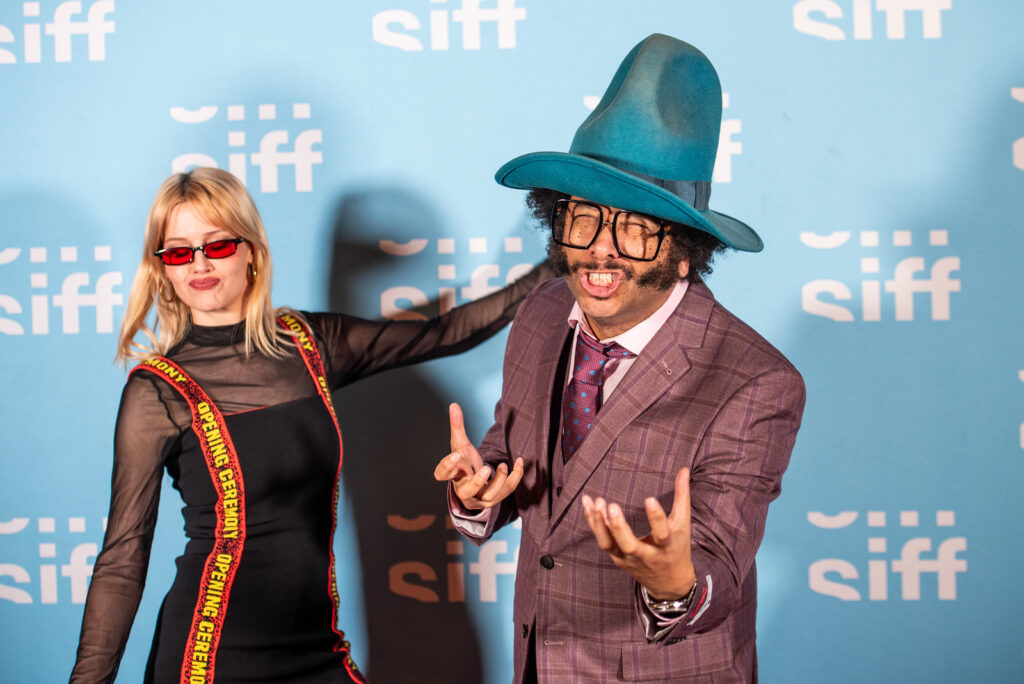
The 2026 Seattle International Film Festival opened with a bang as a sold-out crowd filled the historic Paramount Theater to see Boots Riley’s second feature film, I Love Boosters. In honor of the film’s high fashion theme, Riley wore a comically large turquoise hat and a snazzy mauve suit. He briefly introduced the film, saying that they almost didn’t get it finished, and we would see why when it was over. I believe he was referring to not only the high concept sci-fi material, but also the ambitious use of practical effects to bring his singular vison to light. Check out my review for this explosive film, and please go see it in theaters when it opens on May 22nd. This one demands the big screen treatment.
The following is a transcript of the Q&A hosted by SIFF after the screening. It has been lightly edited for clarity.
SIFF: Boots, thank you so much for being here on opening night for the Seattle International Film Festival. We’re so grateful to be able to start our festival with I Love Boosters.
Boots Riley: Thank you
SIFF: I’d love to just have you start by talking a little bit about where this movie began. I know you have a song of the same title from back in 2006. Did you always imagine it would become a movie?
BR.: I didn’t always imagine it would become a movie. But what I wanna do before we continue with this… I wanna say thank you to Seattle International Film Festival for having us. And – this is very important – to acknowledge the volunteers and the cinema workers. I know there is a cinema workers union and they’re in the middle of negotiating their contract with SIFF and I want to encourage SIFF to give them a fair contract.
[Crowd erupts in cheers and applause]
BR: I wrote a song 20 years ago called “I Love Boosters”, and it’s based on a lifetime of experiences of… I don’t know, like, trying to stay fly while you’re broke. And as a matter of fact, there’s somebody else that has a song about that who’s here. I think Macklemore (“Thrift Shop”) is here. And another rapper that’s here was also in the movie. He plays Li Pan. Alan Z is here.
I think about characters. I start with characters. I didn’t start thinking about the world that’s around them and what I actually think about that world… So, I have to be honest with myself about what I think about the world that shapes us and why that is meaningful in a personal way. And then that kind of brings up characters. And this was a group of women that I wanted to write about again. [My original pitch was] “It’s gonna be about a bunch of boosters that find a teleporter” because what I’m always trying to do, even before writing this… I’m always hyping the contradiction. And that’s what I realized I do with song lyrics… it’s like poetry. It’s like taking an idea that that’s right here, this line really connects to this idea, to this idea, to this idea, to this, to this, to that.
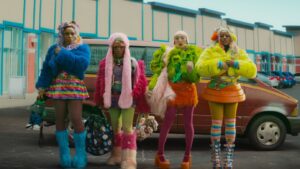
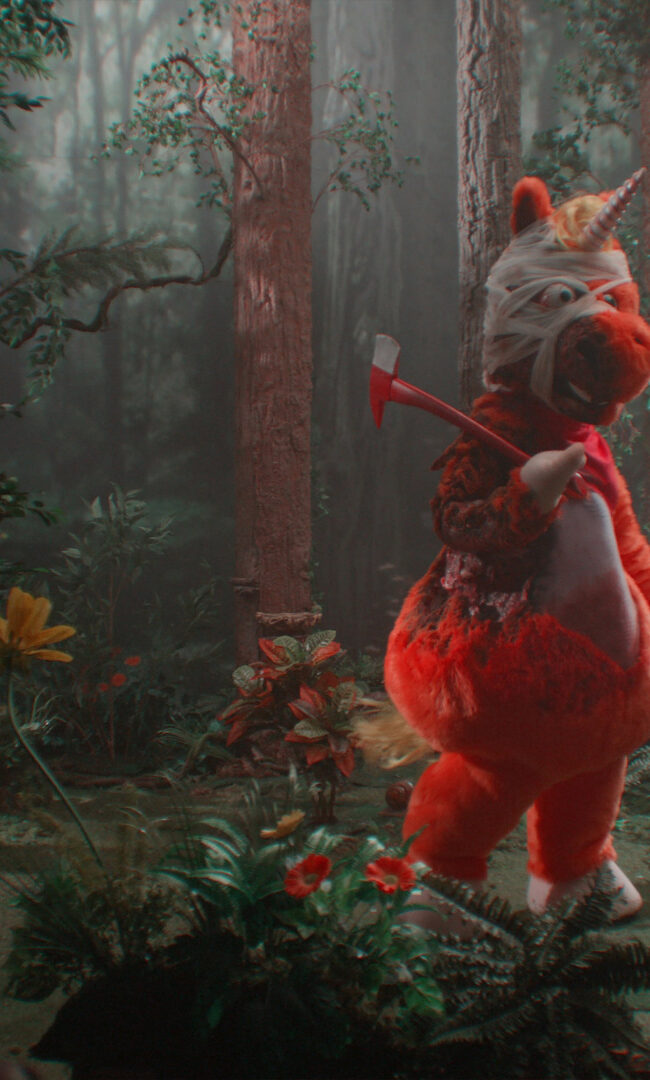
A still from I LOVE BOOSTERS
You take all that theory and get rid of it, and you put those two things together and it’s like, “WHOA! That’s a bar!” you know? What I’m doing is I’m just pointing out ironies and contradictions. And I’m doing that visually, cinematically, story-wise… And so, when I first said, “I’ll do the teleporter idea, the contradiction [with retail clothing] was taking the different points of production and distribution and putting them together geographically with… someone who makes the clothes and someone who sells them. And I just got bored of that idea after I started writing it. And then I went off and finished writing [his TV series] I’m a Virgo. I finish writing these two other scripts that are going to be the next movies after this. And then I got back to this. And I was thinking about science-fiction and…how science-fiction has changed our notions of even existence…
So, here’s an example: There is only right now. There’s not really a quote unquote time. There’s right now. Everything before is just a memory of things we see, things that are written down about what happened before. But that doesn’t exist. And the future is just our imagination. Now that’s empirically provable scientific fact. However, when I say it I sound like a hippie. And the reason I sound like a hippie is because of science fiction. It’s because we think of time as this thing that’s still there because we’ve seen all these things for over a century where it’s like, “if only we had the technology that could get us there…maybe sometime in 1000 years there will be that technology” or something like that. But there won’t be, because it doesn’t exist. And, like, I’m not against mythology and people believing bullshit. You know, whatever. Sometimes it’s useful. But I was like, “OK, well, what if I [incorporate] a philosophy that I use, just without [giving] the terminology. I use the philosophy of Dialectical Materialism in figuring out all sorts of stuff, both directly in my life and in my writing. So, I was like “what if I put that into it into a machine?” Then I got excited and finished the script.
[Crowd erupts in laugher and applause]
SIFF: I have to ask you about this collaboration with Keke Palmer. I feel like she is so slept on as an actress. I was so excited to see you had her in this lead role, and on top of that she is singing on tracks in the film. What was that collaboration like? Where did that begin? And how did these discussions evolve?
BR: Since the songs came up, I should mention that the song that you heard at the end [credits] as well as two of the other [tracks] in the film that Keke Palmer sings, are primarily by my daughter.
[Audience collectively awwwwwwws]
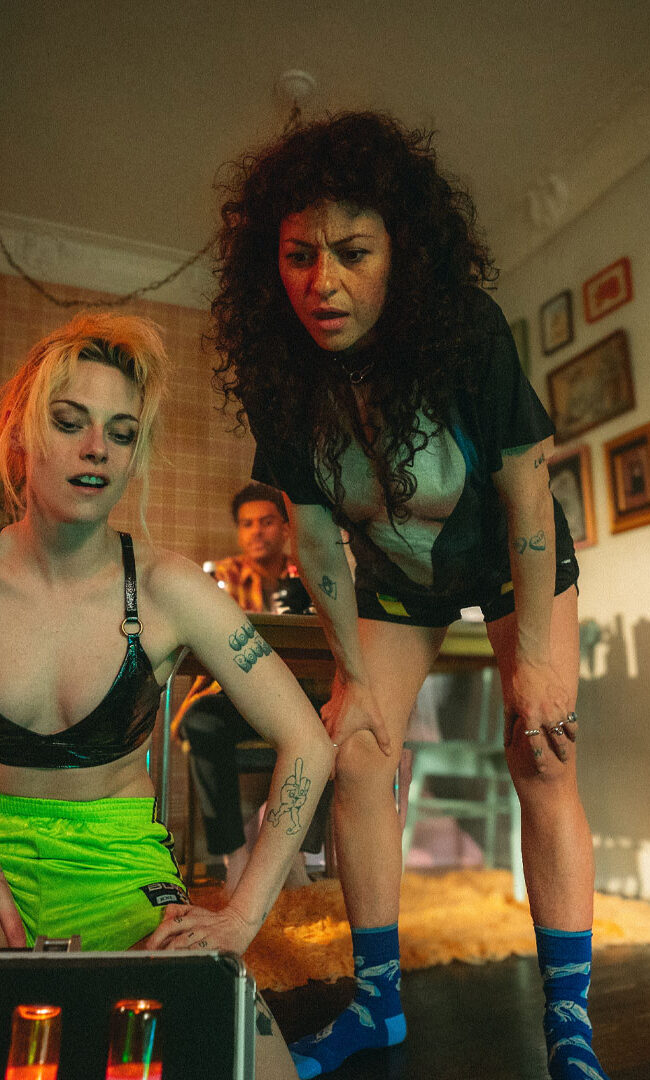
BR.: And I was on set, and I was playing [for] Keke, my daughter‘s demo for “Cassandra”, and she was crying, and she was like, “We gotta put this in the movie.” I thought maybe [it was] too slow or something… I met with Keke and… I think of what people know about her is… it’s kind of a character, right? And a lot of [directors], they want a certain cadence from her because it works. And she’s a comedic genius. But we started talking about some of the things [for that character] that were [based on] how she really relates and communicates when she’s not “on” and being the character that she’s creating. I’m saying this because she says this. And the whole idea was to get to things in a different way. And she said to me, “You know, everyone always says this to me. But then when they wanna make the money, then they’re like, ‘Do that Keke Palmer shit’.” And I mean… she is doing… I mean all of it is her, right? But it’s really cool because she is so smart and she reads a lot of stuff… I didn’t know [that] before meeting her… Just her philosophy of how she operates in the industry.
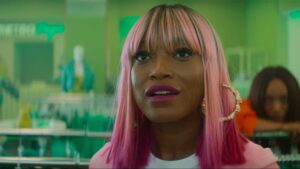
Keke Palmer in I LOVE BOOSTERS
One time I was like, “Well, you’ve been acting since you were a kid.” We were on set doing the spinny legs part, and she was on a wire and all this kind of stuff. And it was taking so long and we were tired. And I was like, “You’ve been doing this for so long… Are you even excited to be doing movies? Cause you’ve seen it so much.” And she was like, “Well, I get excited about this thing that we all make together. And the movie to me it’s just a record of all the people working together to make this thing happen.” And I was like, “Damn. I should’ve said that.” So, yeah it’s really good. And here’s the thing… We didn’t have enough money to do the things that we wanted to do. We did them anyway. And one of the ways that we did it was by cutting methodology, which ended up making things more graphic. Like, okay we don’t have enough money to [build] all these sets, [shoot] all these locations. We’ll get one long wall for the montage. And here’s the red store, and here’s the brown store… And we’re gonna just move the camera down. So, those are some of the things that that we did [because of budgetary constraints]. And it made us be more graphic in what we’re looking at. So it did things for us in that way. But the other thing that we did was we probably didn’t do more than three takes and so that took a lot of… [pre-production] talking for weeks with the actors about the characters… to know them and figuring out what to say. And also just picking amazing actors.
SIFF: We just have to shout out, Taylour Paige, Naomi Acki, Lakeith Stanfield…
[Applause]
BR: Yeah, they’re all really great. I think there’s some people that are well known in this cast, and there are a few revelations that will [make] people be like, “Who is that?!” Like Poppy Liu. Amazing comedic genius. And I think her family is here too.
[Audience cheers]
BR.: Is she from Seattle or is she from Minnesota or something? I don’t know. But yeah. So that’s really a huge part of the job is picking amazing actors and figuring out who’s gonna work. Who’s gonna up each other’s game. That sort of thing. And work well together. But as far as also talking about the way things look… I do want to say… I have to say this. We missed about a foot on each side of the screen [the Paramount screen cropped the film]. So, you’re gonna have to see the movie again [in the theater].
SIFF: This is a movie that lends itself to a rewatch, so I think everybody will be happy to see it again. We can’t leave here without touching on some of the special effects components of the movie. The fleshy skin suits, the transporter, the big ball of clothes… And it all feels so practical. What was your process in coming up with that and collaborating with your team?
BR: So, coming from music, you start realizing…especially with rappers… You’d be like, “This person is the rawest rapper! Blah blah blah.” And most people are like, “Okay, that’s cool. What does the beat sound like?” And so, for me… I’ve always gone into it wanting it to be visceral because of that sort of approach to the music. You can’t just know that someone is feeling a thing. I want us to feel something cinematically. The cause, a visceral reaction that’s similar to what the characters are feeling. And so that mean, for me… textures. That means a different rhythm… that you think it’s gonna do this and then it does this other thing. Colors, textures… If you do CGI, it all gets smooth out. CGI just smooths everything out. With CGI, you could have a skyscraper stand-up, walk over and take a shit and it wouldn’t be amazing. And that should really be amazing. And so… I think there’s things about life we don’t understand.
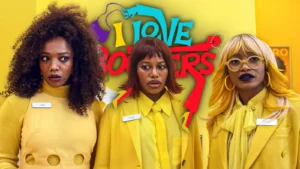
A Still from I LOVE BOOSTERS
So, the idea is always to use miniatures. The idea is always to use stop motion, which my friends Ri Crawford and David Louer [collectively known as] Mystery Meat, who worked on Sorry to Bother You and I’m a Virgo…They also worked on this. They’re from Oakland. And the folks who did the miniatures… Chris Warren [Blind Beagle VFX] and family. Their grandfather won an Academy Award in 1963 for The Time Machine. Their father won an Academy Award for Terminator 2. They were, like, skater punks who their father roped in and they started working on… They did [the] London [set] for Bram Stoker‘s Dracula… That sort of stuff. And now they’re just crazy dudes. At first we were just gonna do the inside of the mall as a miniature… and the ball, of course. And the rest of it was gonna be, like, on the street in San Francisco with some stop motion and things like that. But as I told you, we didn’t have money to do all of that. And as we were talking about it… things were getting whittled down to… “Maybe we’ll just be inside the car. And it’ll be funny because we’re just inside the car.” And then Chris was like, “We got buildings. We could just put them on a ramp.” And, so it just expanded. And then [we were] like, “Well, fuck. Let’s just keep ramping that up.” It’s all practical, in-camera stuff. The other thing… about the practical stuff is [that] you know what it looks like. You’ve seen it [before you start filming]. That’s what it looks like. It’s not like, “Oh, we got some people… they’re gonna make it look good.” And then, you know… it doesn’t.
[Crowd laughs]
SIFF: The last thing I wanna ask you about… I think that there’s an interesting crossover between fashion and film. They both are kind of [at] the intersection of arts and commerce. And I’m just wondering, with all the perspective that you have, how do you navigate that?
BR: How do I navigate… art…?
SIFF: Just the inherent contradiction of…a cross-section of art and commerce.
BR: Yeah, I mean… you can’t have life without conflict and contradiction. So, I don’t try to avoid a contradiction. I’m trying to get to where everyone’s at, right? I’m trying to… get people to look at things or listen to things… people who are plugged into mainstream outlets. So even when we were doing music… We had a communist hip-hop group and we would try to get it on the radio and a couple times we did, before people found out what was in there.
[Audience laughter]
BR.: Cuz here’s the thing… I’m not trying to figure out how to get “the better capitalist” to be running the world. I’m not gonna be like, “Oh, this capitalist is better. Let’s see what they do right.” And as I just talked about, I’m a communist…
[Audience cheers]
BR: I want the people to democratically control the wealth that we create…
[Audience cheers]
BR: And that is something that can happen. And I’ve shaped my life toward helping… trying to help make a movement… The only way for that to happen… is not gonna be one at a time, you know… We just whisper to each other. And it’s not even gonna come from us having a huge demonstration with10 million people. What we need is a mass militant radical labor movement…
[Audience cheers]
Withholding the labor as a tactic and strategy… to first, get policy changes. Show some victories and grow even bigger. But no revolutions have ever happened without those sorts of movements happening first, because the idea is to get the working class to be involved in class struggle. And so… I can’t do that. I had it figured out with music. I was like, “I could spend 20 years trying to make a network of independent venues that somehow don’t touch capitalism. And then make some music with a band to [play] those venues. Or I could get my stuff on EMI records, [or] on Warner Brothers, and get to people… Because the most important thing is to get people involved in campaigns, organizations, and parties in order to make that movement that we need. So, I don’t see it as a contradiction because I don’t see any other way to do it.
[Audience cheers]
SIFF: Thank you all so much for sticking around after the movie. It will be releasing on May 22… You should go see it.
BR: Here’s the thing… I want to say [this] before you end. One: I know this is on Neon, which is, you know, the hot shit independent distributor studio right now. But we don’t have it covered [financially]. With Sorry to Bother You, we started on a few hundred screens and [expanded to] a few hundred [more] each week. And at one point, we got it as high as 1000 screens. And that was only for a week. And then it went down… we had it in theatres from July to the middle of October… This movie… [on] May 22, [it] will be on about 2500 screens. And that is a huge opportunity. But it is also a huge danger because we either make it right then, or it’s off of the screens, and everybody’s gonna be complaining on Twitter, like, “What happened?” But that’s what will happen if we don’t knock it out that first weekend. That first day if possible. So, what I need you to do… I need your help… If you like this movie, I need you to post on whatever social media you’re on… so much that your family calls you up and asks if you’re okay. I need you to tell people about it in real life… I don’t care whether [it’s to] your friends, family, or just random people… at a bar or whatever. And I need you to come back on May 22 with 10 friends, dressed in matching monochrome…Whatever you think is the fashion version of yourself. And you know, also call the theater. Make sure they actually have it there. Because it actually works. And lastly, I need to take a picture with ya’ll.
I’ve been doing these weird sorts of pictures with [audiences]. They’re not well thought out. I just kind of figure it out right then what we’re gonna do… So… I do know that I wanna get everybody [in the theater in the picture]. OK here we go if your name starts with the letter A through I: I’m gonna need you to point at me and drop your jaw. If your name starts with the letter J through R, I’m gonna need you to put your hands at the side of your head. And if your name starts with the letters S through Z, I need you to stand up on your chair like you’re trying to get a better look, but look toward the person that you came with. So, we need to do that right now.
[Boots hands his phone to the SIFF rep and everyone does as instructed]
– Jessica Baxter (@TheBaxter)