





(Check out Savina Petkova’s All of a Sudden movie review. The film just had its premiere at the Cannes Film Festival. Seen it? Join the conversation with HtN on our Letterboxd Page.)
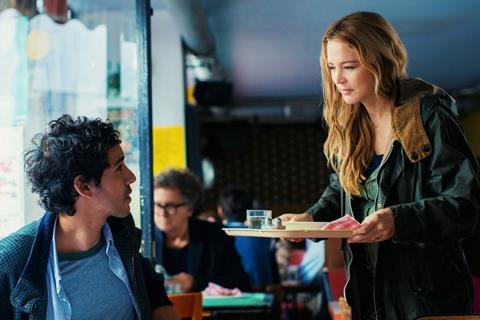
There are films that make you believe art is worth making and films that convince you life is worth living. Ryusuke Hamaguchi’s All of a Sudden, part of this year’s Cannes Official Competition, is both. Even though the stakes are high for the Japanese director whose 2021 film Drive My Car won Best Screenplay at the Croisette and later the Oscar for International Film, his gentle touch sculpts a marvel of a film with a beating heart. For the first time, Hamaguchi works in France and Japan, in both languages and with actors from both nationalities. In the lead, we have the remarkable Virginie Efira as Marie-Lou, director of a care home with an anthropology background, who, in the film’s first shot, is dozing off in the garden. Her life is work and her work is life, we learn very soon, through conversations with her colleague Olivier (Jean-Charles Clichet) – she fills in for others on her day off and even takes up a room in the care home, to be on call.
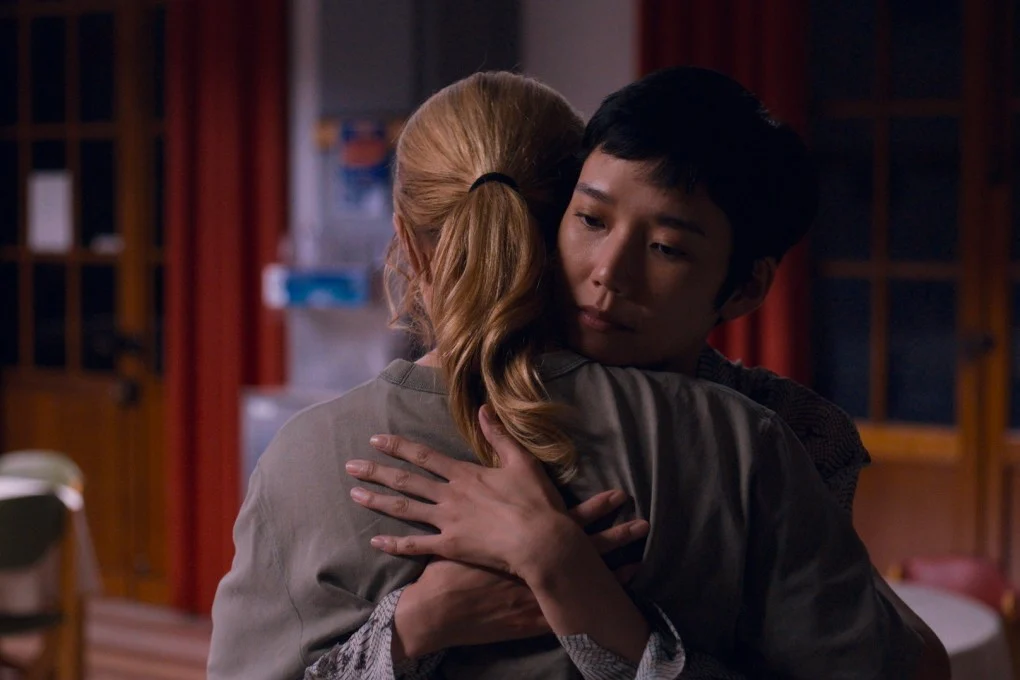
There’s more to Marie-Lou than her workaholic altruism, but it takes an unexpected encounter—as per usual in a Hamaguchi film—to peel off the layers of self, solidified into a person. In comes Mari Morisaki (Tao Okamoto), a Japanese theater director touring with her play, main actor (Kyozo Nagatsuka) and his autistic grandson Tomoki (Kodai Kurosaki). The latter seems to be the link between those two women—as Marie-Lou’s carer instincts kick in as soon as she sees a lone Tomoki running along with the tram she’s riding—but their relationship grows in unexpected directions, thanks to and despite their shared notions of care. All of a Sudden plays out as a string of insightful, and sometimes charged dialogues between the two women with homonymous names.
The film is loosely based on a book of correspondence between philosopher Makiko Miyano and anthropologist Maho Isono (When Life Suddenly Takes a Turn), brought to Hamaguchi’s attention in 2020. Taking a work of nonfiction with personal reflections on illness, death, and care, and fictionalizing it is already a challenge, but making a film that’s truthful, respectful, and open to the viewer is an even taller task. In those terms, the script, co-written with Léa Le Dimna, deserves exceptional praise for its considerate pace, circling around what Mari and Marie-Lou are willing to reveal and share, and expanding alongside their mutual trust. Both Efira and Okamoto switch between French and Japanese in an exchange that’s as dynamic as it is intimate – watching them feels like falling in love.
What the characters talk about is as important as how they talk about it – theater, art, disabilities, palliative care, death, and capitalism emerge as the focal points in the film, but while this mix could have easily drowned the dialogues in despair, All of a Sudden is rich with affection, well-aware of how broken the world is. A central role in the film is dedicated to Humanitude, a caregiving technique gaining popularity in France with the emphasis on human connection for people with cognitive disabilities. Its ethos is a perfect fit for Hamagichi’s reverential cinema, where characters are not afraid to touch each other and transform together. That said, the director’s latest film is as far from an auteur echo-chamber as it can be – the whole team was trained in Humanitude before coming on set and the shoot took place in institutions practicing the technique, with a lot of residents included as extras or non-speaking roles.
All of a Sudden unfolds with the serendipity of Hamaguchi’s Asako I & II or Wheel of Fortune and Fantasy and the philosophical breadth of Happy Hour. Of course, the luminous performances of Efira and Okamoto as a dual protagonist are the ones that stay with you long after the credits roll. It’s clear how deeply each of them has submerged themselves into those characters who seem at once familiar and unknowable. Marie-Lou and Mari often joke about not knowing anything about each other even as they spend days and nights inseparable. The effect of being present for those long takes and dense conversations is revelatory; even as a viewer, you want to learn more without knowing all.
– Savina Petkova (@SavinaPetkova)