


A Conversation with Sam Green (THE OLDEST PERSON IN THE WORLD)
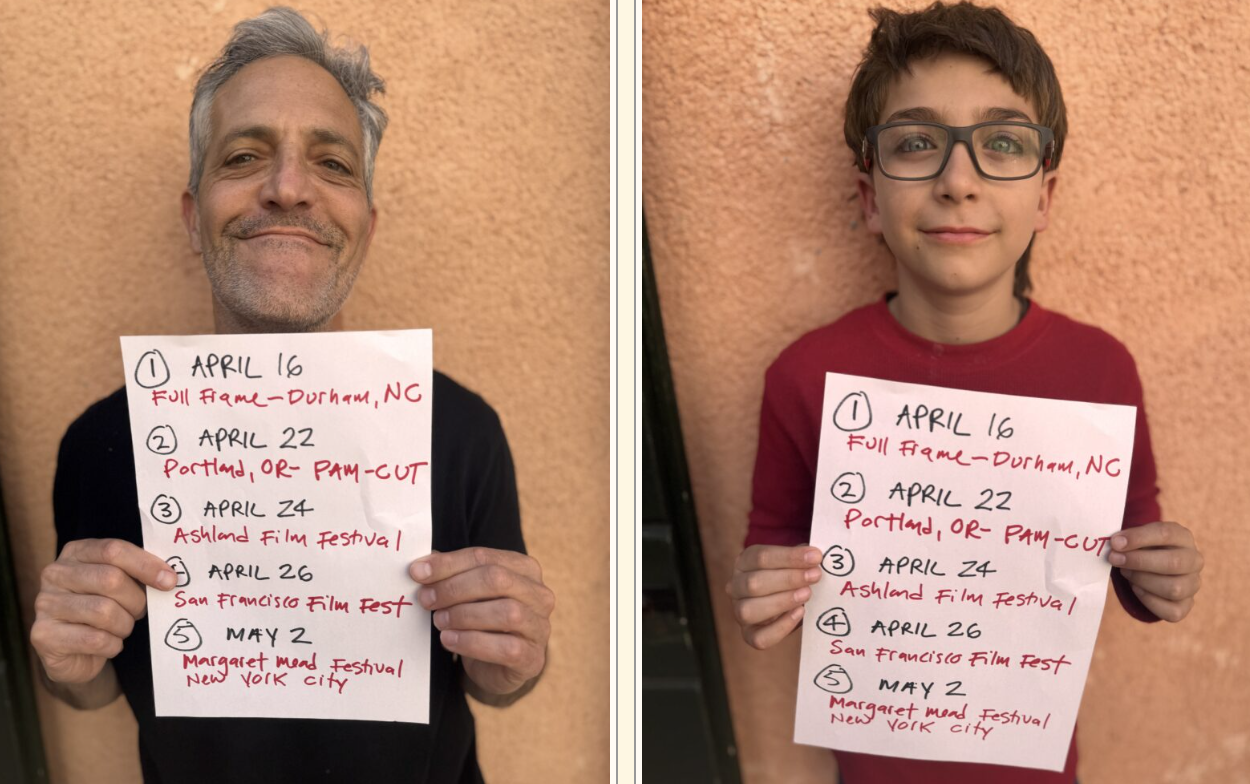
“Enjoy it those of you who are alive. The world is fantastic.” — (at the time) oldest person Maria Branyas Morera [via social media]
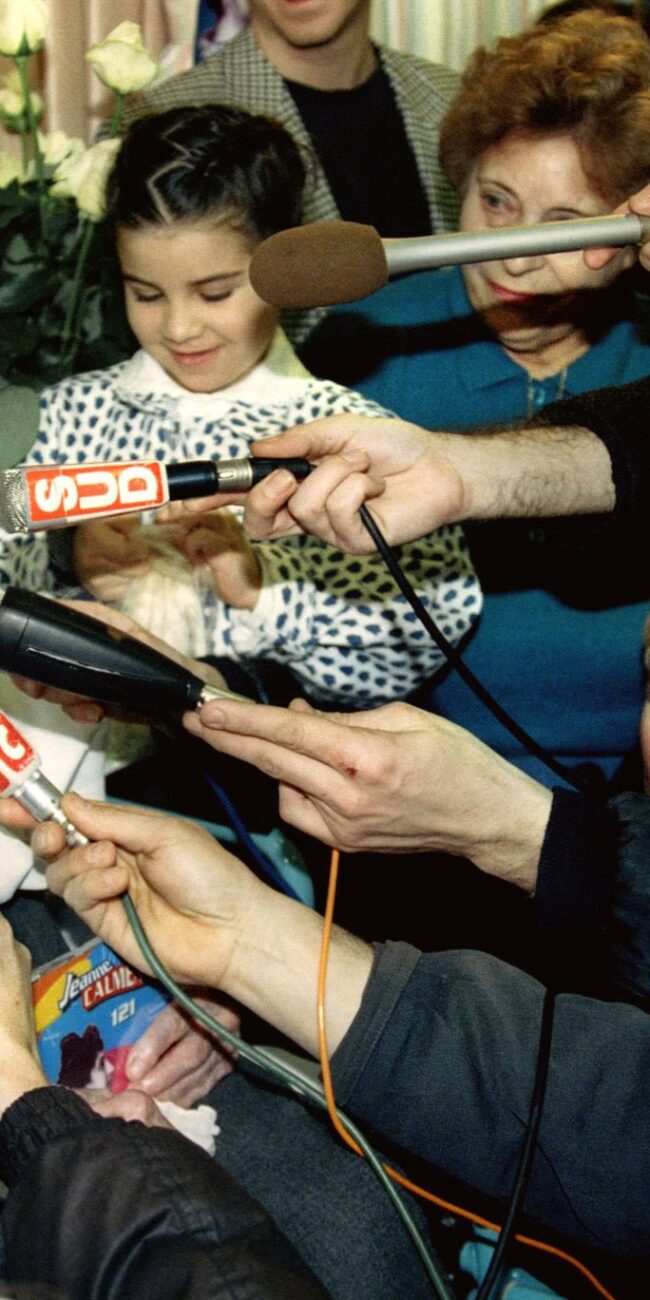
A decade in the making—from July 2015 to July 2025—or a lifetime. Several lifetimes, admittedly! Individually and independently, years calculated over a hundred times six (or seven) of a few supercentenarians in particular: Violet Mosse Brown, Susannah Mushatt Jones, Emma Morano, Maria Branyas Morera, Kane Tanaka, Sister André [née Lucile Randon]. Even Jeanne Calment (in archival footage). [Or perhaps Ethel Caterham (current record-holder at one-hundred-seventeen years, already older than the eldest verified man to ever live and a mere five-and-a-quarter years from the oldest person of all time).] Is it meaningful that twelve of the top two-hundred men and women to have ever lived in recorded history are alive right now? Filmmaker Sam Green, in a break from the “live” format of 32 Sounds and A Thousand Thoughts, has crafted and released herein his most personal film in The Oldest Person in the World. Released! Not “finished” since, in theory, the framework of this documentary will be revisited every decade with an embellishment of additions. By Green? Remains to be seen, ideally.
Anything of notable merit occurred during the intervening decade? A calamitous presidency. A pandemic. A worldwide period of stay-at-home-for-the-sake-of-yourselves-and-others. Another fraught election. For Green, in particular, the birth of a child. A diagnosis of multiple myeloma. Life and death material.
Meanwhile, a bit of background for the sake of those unaware: Sam Green was born in Detroit in the mid-1960s and he attended the University of Michigan in nearby Ann Arbor (down the road from his birthplace). He received his masters from UC Berkeley in the early-1990s and, thereafter, taught in the undergraduate Media Studies Department at USF as well as courses on documentary film history at the Academy of Art College in San Francisco. Earlier in his filmmaking career, he was arguably best-known for the remarkable Academy Award-nominated The Weather Underground (co-directed by Bill Siegel). These days, he can frequently be found at the sorts of impresario institutions with eclectic rosters of touring artists presenting a hybrid of unconventional “documentary screening” and raconteur performance, essentially a format of largely his own creation.
With The Oldest Person in the World, Green’s unconventional storytelling style is injected into a fixed form, not unlike [unwieldy metaphor ahead] a compressed mattress shipped to its inevitable destination, expanding to its proper dimensions once the wrapping is removed.
Hammer to Nail: Your voice is the first that we hear. You are the first person that we see. Was it certain from the beginning of this project that this would not follow the “live documentary” format? I wager each of these projects takes whatever form is befitting of the material.
Sam Green: I am a firm believer in the idea that the form of a film should come out of the subject and the material. When I made a film about sound (32 Sounds), it seemed to be the only way to ensure that the audience would have the kind of bespoke sonic experience I knew was necessary for the film to work. We would have to travel around [to screening venues] with headphones! When I made A Thousand Thoughts—with and about the Kronos Quartet—I knew that a regular music documentary about them would be boring. If it were a live film and they were there playing all of their music while the audience was sitting in the same room, feeling the music and beholding the quartet, that would be a completely different kind of experience.
With Oldest Person, there didn’t seem to be a compelling reason to make it a live film. On top of that, there were good reasons not to! It is a super-personal film and the idea of saying those words over and over again… I would not want to! Plus, with a live cinema piece, the downside is that you’re definitely limiting the audience. Most of the time, I don’t mind. Fewer people might see it but it is a much stronger experience. With TOP…, I want as wide an audience as possible. So those were some of the thoughts that went into the form. The fact that I will continue to film and put out new versions of the movie every ten years, for as long as I can. It is a never-ending project, which befits the subject matter. You can’t wrap your arms around the “oldest person” record for more than a moment and then the film will be out-of-date. In that sense, it is kind of like life. We can never fully capture and hold on to life and time. We take photos and try to fix things in time. Ultimately, it is a losing battle. It will all be dust and we will eventually all be forgotten. My hope is that this form reflects all of that.
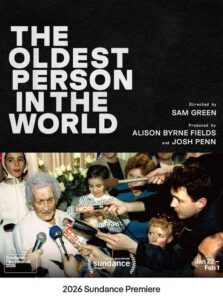 Anyone (although generally those born in the last century) could’ve developed an understandable fascination with the Guinness Book of World Records. For a half-century, their guides reflected the wonder of random exalted facts in a pre-internet world. Guinness still exists, of course, but their influence has waned in recent decades. Easy enough to determine who had the longest fingernails or who has run the fastest half-marathon elsewhere, seemingly? Reading these reference books as a child, these milestones seemed achievable. You, too, could appear in these pages! Over time, of course, you could no longer be the “youngest” to accomplish something. You could be the “oldest”—oldest person to publish a novel or oldest to skydive—yet the ultimate benchmark is the oldest person in the world. An achievement you could accomplish without trying!
HtN: There is a certain appeal to reference books for individuals of a certain age and peculiar interests. What do we lose as the influence of these publications diminish?
SG: I am not sure. Obviously, there is a real delight in leafing thru a copy of the Guinness Book of Records. The shortest street in the world? The longest taxi ride? The shortest correspondence between two people? One can have wonderful research journeys around the internet, with curiosity taking a person from one topic to something else tangentially related. There are many ways to engage with the world and I’m not necessarily nostalgic for print. Or, another way of putting it, I am open to change and the new.
HtN: It seemed likely that you, yourself, were going to figure somewhere into your telling of these oldest persons. At what point in the process did you determine that issues of a more personal nature would be folded-in? Presumably, those same considerations encouraged you to include your son in the film as well, ever-so-briefly the “youngest person in the world” (although perhaps you arrived at those decisions independently)?
SG: My first idea was to just film each oldest person and put together a sequential record of these portraits and that would be the film. One of the things I love most about documentary is that you set off into the world with an idea for a film—”I’m going to make this movie!”—and the world says, “Wait a minute! It’s not that movie, it’s this!” Something significantly different… and that is fantastic! I believe that the world is far more interesting and rich and complex than anything I can imagine, so I am always open. My films are much better because the world and fate and chance are collaborators.
At a certain point, I realized that my initial idea was not going to work. I think part of that was based on me feeling like all the oldest people would somehow be like Ruth Gordon in Harold and Maude, in that they would be these saucy women dispensing kernels of wisdom in a sly, teasing manner. I clearly didn’t have a sense of what 116 year olds are like. At that point, you’re tired! Not really in the space of thinking about life or deep thoughts.
I decided to include Atlas because I was clear from the beginning that this would be a movie about time. One of the things that the oldest person stirs up in me is lots of thoughts and feelings about time. Here I was, filming one 116 year old after another. In the film, it would seem as if no time at all would be passing. Atlas was born a year after I started and it occurred to me that if I filmed him growing, that would really show time passing. I say in the film that he could be like a yardstick, showing the passage of time. When you start a movie, you have no idea why you are doing what you are doing (or at least that is the case for me). It is just a compulsion. There is something deep there but you don’t understand what it is. It is only over time that you begin to glimpse things. With this film, at a certain point I started to see that this was not some academic interest in the sociological phenomenon of the “oldest person” that was driving me. It was more that I myself was asking questions that we all as at some point. Why does one person live to be 116 and another person take their own life at 40? Why does one person get a terrible disease and someone else has a long life and never spends a day in the hospital? Why does one man get struck by lightning seven times? How do we live in a world where no one of knows what is going to happen tomorrow? These were my questions and they were really what was behind the inquiry. Once I started to see that, those themes began to work their way in a more overt manner into the film.
HtN: Since the premiere of The Oldest Person in the World, it was discovered that supercentenarians have elevated ratios of CD4 CTLs in their blood, suggesting that immune adaptations at a later age might have a role in longevity. Granted, this continues to factor into our persistent desire to find a “reason why” when the precise reasons will continue to be elusive.
SG: I like the fact that it is still a mystery why some people live so long. I asked one of the leading gerontologists who studies supercentenarians: “What is the secret?” He said, “Choose your parents and your grandparents wisely.” It is largely genetic. Of course, on top of that is luck! Then, on top of that, is one’s lifestyle choices.
[Spoilers ahead! Stop here! After you’ve seen the film, return and read along.]
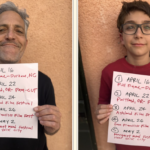
There are many qualities to recommend in a documentary. Like all of Sam Green’s work, every aspect of TOP… is remarkably interwoven. For the moment, it seems necessary to focus on merely one angle among many: film-editing. Consider this a masterclass in editing. The first sound in the film is Sam’s voice: “Start here.” The first image is Sam holding handmade signs of the date and occasion, a birthday party for the (then) oldest person in the world. Begin at the beginning. Followed by introductory narration and a montage of related (yet unrelated) images. Amongst that collage is an image of a younger Sam with another man of roughly the same age, without explanation. After that video footage, we return to the birthday party of Susannah Mushatt Jones, serendipitously occurring not far from where Sam and Kat Galasso and their son, Atlas, live. Past the midpoint of the film, in the thick of the COVID lockdown, Sam participates in a virtual discussion with the oldest siblings in the world. There is an emotional moment in their conversation when the eldest of the group talks about her brother, the first of the siblings to perish. Her daughter, off-screen, says, “It is hard to see your younger sibling pass before you.” There is a brief cut to Sam. Then a cut to another member of the family, wiping tears from their eyes. Pause. Cut to a nondescript area behind a shopping center in Maryland. In the voiceover, we learn that this is where Sam found his brother in the back of an automobile, deceased. We then see the footage again (from the earlier collage) of Sam and his brother, Dave. We later learn that this is the only moving-image material of his brother.
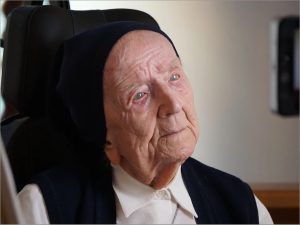
A still from THE OLDEST PERSON IN THE WORLD
HtN: In a draft of the review, I note that there is a brief sequence of you and your brother in a collage of images that opens the film. Later, when you participate in a virtual conversation with the oldest siblings in the world, the eldest describes her sense of loss in the passing of her brother. After her daughter describes how difficult it was for her to lose a sibling, there is a cut to an image of you, essentially in silence. This is a profoundly moving sequence and I can imagine that there was something of a struggle in how to effectively introduce Dave’s passing. How did you resolve the balance of telling the story of these “oldest” women with the personal stories of your brother, your father, your mother and your son (and Kat, intermittently)?
SG: For a long, long time, the film started with my mom and I in the cemetery visiting my younger brother’s grave. It started there. We had made that scene because it solved several problems in the editing. People kept asking about the connection between the oldest people and Atlas and Dave. They also were unsure why I was making the film. Starting at the cemetery with the loss of my brother solved a lot of that. But it created other problems. That was the lens thru which you watched the rest of the film. It is a heavy lens! There was no real lightness and the film could not breathe. It was only at the very end of the edit, with the insistence of my partner Kat (who is actually a great editor), that we reworked the film and made it so that you arrive at the death of my brother 2/3rds of the way thru the film. It is a reveal and this allows the film to be much lighter until that point. It was a huge change. It was really remarkable how changing the first scene made a completely different movie.
[These assorted words were written on the birth-anniversary of my own brother (who passed under similar circumstances).]
The Oldest Person in the World philosophically addresses the mysteries of life and death. It does not answer these questions since there are no answers. Why do some of us live for a century or more while others are here for only a moment? Which could, simply, connect to your own particular point of view: “God moves in mysterious ways” or for no discernable reason at all.
[If you or someone you know is experiencing a crisis, do not hesitate to contact the 988 Suicide & Crisis Lifeline.
– Jonathan Marlow (@aliasMarlow) [with sincere thanks to publicist Susan Norget and filmmaker Sam Green]