


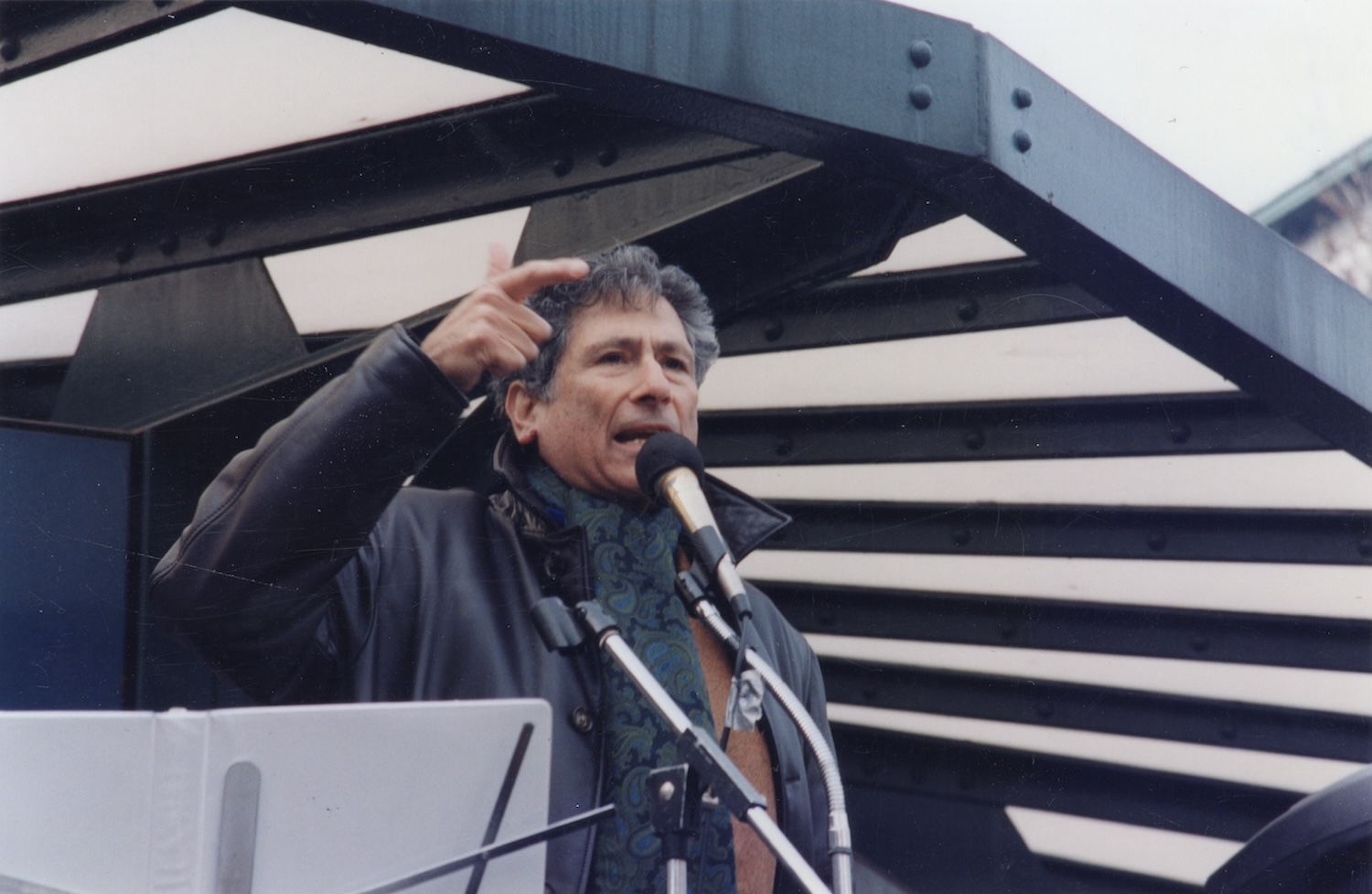
EDWARD SAID: BETWEEN WORLDS
(The Toronto International Film Festival (or TIFF) runs September 10-20 and HtN has boots on the ground covering all the best indie films they have to offer. Check out Chris Reeds’s Edward Said: Between Worlds movie review from the fest! Seen it? Join the conversation with HtN on our Letterboxd Page.)
It can unfortunately sometimes be risky to express sympathy for the plight of Palestinians, so wrapped up is their past, present, and future in the fate of Israel. Officially created in 1948, that country exists on land that at one point was owned and cultivated in part by populations now either exiled or condensed into Gaza and the West Bank. While he was alive, academic and activist Edward Said (1935-2003)—born in Jerusalem—was an outspoken defender of Palestinian rights. In director Maiken Baird’s gripping new documentary Edward Said: Between Worlds, we learn all about his life, work, and enduring passion for justice
Only a confirmed antisemite would refuse to acknowledge the reasons why the Jewish citizens of the world deserved a homeland, given the millennia of prejudice, abuse, and murder to which they had been subjected throughout their history. Throw in the 20th-century Nazi-driven Holocaust, and it only adds to the urgency of the question in the 1940s. It should be possible to acknowledge that reality while also feeling the pain of the Palestinians—none of whom had anything to do with the European persecution of Jews—as they suddenly found themselves strangers in their own home.
Certainly, Said saw no barriers to advocating for his compatriots. Born into a well-to-do Christian family—his father a successful businessman who invented the first Arabic typewriter and also served in the American armed services during WWI—Said witnessed the dispossession of Palestinian property as a boy. He first ended up in Egypt following the “Nakba” (or “catastrophe” – what Palestinians call the creation of the state of Israel) and then in the United States, where he was enrolled in the prep school Mount Hermon, located in Northfield, Massachusetts.. It was a very white place, and he was drawn to the literature of Joseph Conrad, Rudyard Kipling, and Albert Camus, feeling kinship with their outsider status. He would go on to Princeton, and then Harvard, and eventually become a professor at Columbia.
So far, so apolitical, until the Six-Day War in 1967, when a coalition of Arab states attacked Israel and lost, forced to give up territory as a result. He wrote a 1968 essay entitled “The Arab Portrayed,” in which he analyzed the images—often reductive—of Arabs in literature and culture. It was the first step in reclaiming his identity as a Palestinian and establishing himself as a public intellectual, a journey culminating in perhaps his most famous work, the 1978 book Orientalism.
Baird (Ghislaine Maxwell: Filthy Rich) features Said’s voice throughout, excerpting from the considerable archive of interviews he recorded in his lifetime (that’s the beauty of making a movie about a public figure). His sharp mind comes through, his powerful words and thoughts articulating the enduring plight of his people without devolving into antisemitic screeds. His problem was with the Israeli government’s treatment of Palestinians—committing the same crimes upon them that had historically been visited upon Jews—and not with Jews themselves. Interestingly, he found it easier to speak to Israelis than to American Zionists, the former more open to dialogue.
It’s a complicated film about a complex individual, who asks us to consider the question, “Who owns history?” There have been so many instances of erasure throughout human existence, many now forgotten because those who vanished were unable to tell their stories. Time will tell if Palestinians are among those lonely souls who disappeared. But as long as we remember voices like Said’s, there is hope. After all, his final work, an autobiography, was translated into Hebrew in 2002. No place is a monolith, and there are those who listen, no matter the noise around them. What kind of citizen of the world will you be?
– Christopher Llewellyn Reed (@ChrisReedFilm)