




(The 2026 Venice Film Festival runs September 2-12 on the island of the Lido di Venezia (Venice Lido) in Italy. HtN has coverage coming in like Lé Baltar’s One Minute To Midnight movie review. Seen it? Join the conversation with HtN on our Letterboxd Page.)
“I sensed your need for existential conversation,” says a restless, disgruntled female character to the self-absorbed protagonist of One Minute To Midnight, the French writer-director Nicolas Pariser’s in-competition work at Venice — a pensive talking picture about a man trying to find his bearings in a new world around him, which plays like it was shot and scripted on the fly, apropos for the film’s searching nature.
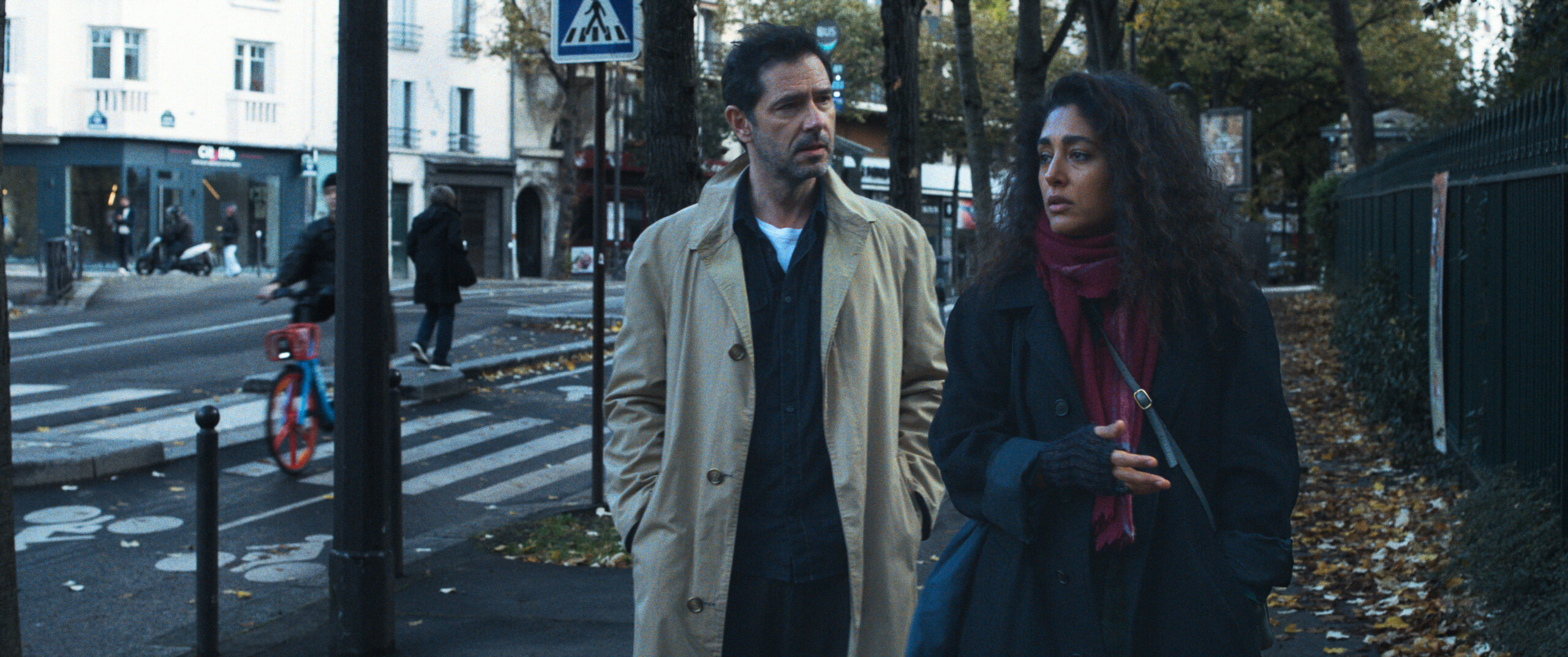
That woman, it turns out, is Tina (Golshifteh Farahani), the former paramour of Léo (Melvil Poupaud), a broke and frustrated writer in his late 40s, who is grappling with the impending end of his current relationship and the sudden demise of his estranged biological father, whose last will requires him to travel to Italy. But it isn’t until the film’s final 15 minutes that Léo arrives in Ferrara to take care of the inheritance; in the meantime, he meanders through the streets of Paris taking stock of his life and the big questions he’s managed to elude for so long.
Soon enough, Léo comes across ghosts from his past, especially women with whom he’d previously been involved largely through an out-of-print male-led magazine set up by his friend, publisher and producer François (Micha Lescot), in the 2000s. There, Léo and his other buddies, once described as “The Pack,” oversaw and hosted in-group parties for female interns a decade younger than them, including Tina and the socialist politician Armelle (Anaïs Demoustier). These men belonged to the cultural bourgeoisie of the early aughts, and were fond of calling themselves “part of the scene.” Whatever that means.
Their time in the magazine is now the subject of a television series François is set to shoot amid growing rape allegations leveled against one of the men named Luc, who remains an off-screen presence throughout. An hour into the movie, Léo visits the set, where he’ll witness a scene rehearsal in which the character based on him is being told off by François’ self-insert; that he’ll never make it as a publisher for he has no will to act on it, or to grab girls to kiss them. Even in fiction, Léo cannot seem to outrun his checkered past.
Pariser takes a quizzical approach to articulating harsh truths. In a gesture that gives the film a metatextual touch, the Alice and the Mayor director casts himself as a retired cinephile and critic turned Orthodox Jew, as if allowing himself to judge his own protagonist, even as he is averse to neatly painting Léo, patterned after the men of The Miser and The Bourgeois Gentleman, as a villain or suggesting that he’s on a path towards personal growth. Clearly Pariser is less interested in reconfiguring the existential dislocation swelling at the movie’s center into a sort of second coming of age than he is in staging a string of brief encounters in which the characters amble through a city on fire while conversing and complaining just about anything: love, career, desire, abuse, politics, morality.
What the movie lacks in physical action, it makes up for in copious dialogue. Pariser offers a thoughtful and almost spontaneous approach to talk in film, as though we’re watching these characters collect their thoughts in real-time. He knows what should be apparent in these conversations and what should remain implied, and they work because they rarely devolve into pontification, even in moments when the characters are about to square off verbally. Save perhaps for Léo’s scene with Gustave, the character Pariser plays.
The film’s questioning temperament extends to how the filmmaker writes the female characters as rather critical of the main man, whose presence, as in the TV show where a version of him appears, is merely a subplot in his own life. As a father, Léo never had much of a hand in raising his now-activist daughter Emma (Clara Pacini), whom he could only visit during vacation, as the cost of living in Paris forced him to move to eastern France. As a partner, he’s unsure whether the person he’s living with still feels any affection for him. Even being a son feels altogether foreign to him, especially now.
The sense of acerbity and criticality shared by the female characters may have another explanation. When lawyer Éléonore (Léonie Simaga), an outsider to the magazine who contemplates her own relationship with one of its founding members, asks Léo about whether a lot of young women were on staff or whether they were able to write for the paper as much as the men did, Pariser’s free-flowing picture decidedly snaps into focus, attuned to the weight of the #MeToo movement and the ways that men shield complicity through blind ignorance for self-preservation. Does Léo really not remember the “pathetic affairs” he’s had, or is he afraid of how vividly he’ll arrive at the truth once he finally confronts it? Such sharp questions leave him in equal shock and awe, and Poupaud’s visage powerfully conveys that uneasy feeling.
That the women are positioned as figures of discernment also strategically allows Pariser to counter his own biases and tendencies as a white male filmmaker directing a movie about the lived realities of women in the post-#MeToo era. And yet, this clever dramaturgical device works only insofar as it crystallizes the protagonist’s internal disquiet.
The film’s compelling rhetoric, suffused with secrecy and subtext, rarely takes the audience to anything visually curious, besides realizing the sexual tension between Léo and one of the women at one point. The camera more often hews to the tense objectivity of the medium shot, tapping into the typical instincts of a bunch of French talking pictures. The script suggests that the lives of these women do not orbit around this one self-involved man, but there’s nothing onscreen to show that part of them.
Likewise, we’re acutely aware that the political unrest in the background — curfews, public demonstrations, deployment of riot squads — is meant to evoke the reactionary reality of present-day France, but Pariser’s decision to eschew its particulars never fully materializes that tumult and danger. What’s happening on this side of Europe is urgent, One Minute To Midnight wants us to know, but only from a romanticized vista. Near the film’s end, Léo and Tina are arrested by riot police for no apparent reason, and just when we assume that the protagonist finally finds himself in a situation where it’s no longer possible to not get involved or ignore the signs of fascism, Pariser insists on an ellipsis and thwarts the story’s radical energy, only to service a schmaltzy endnote.
Though genuinely gripping at times, One Minute To Midnight feels way too breezy and pristine for a film about the knotty textures of trauma, abuse, and frenzied histories.
— Lé Baltar (@baltarle)