

A Conversation with Jan Holoubek (WILD WILD EAST)
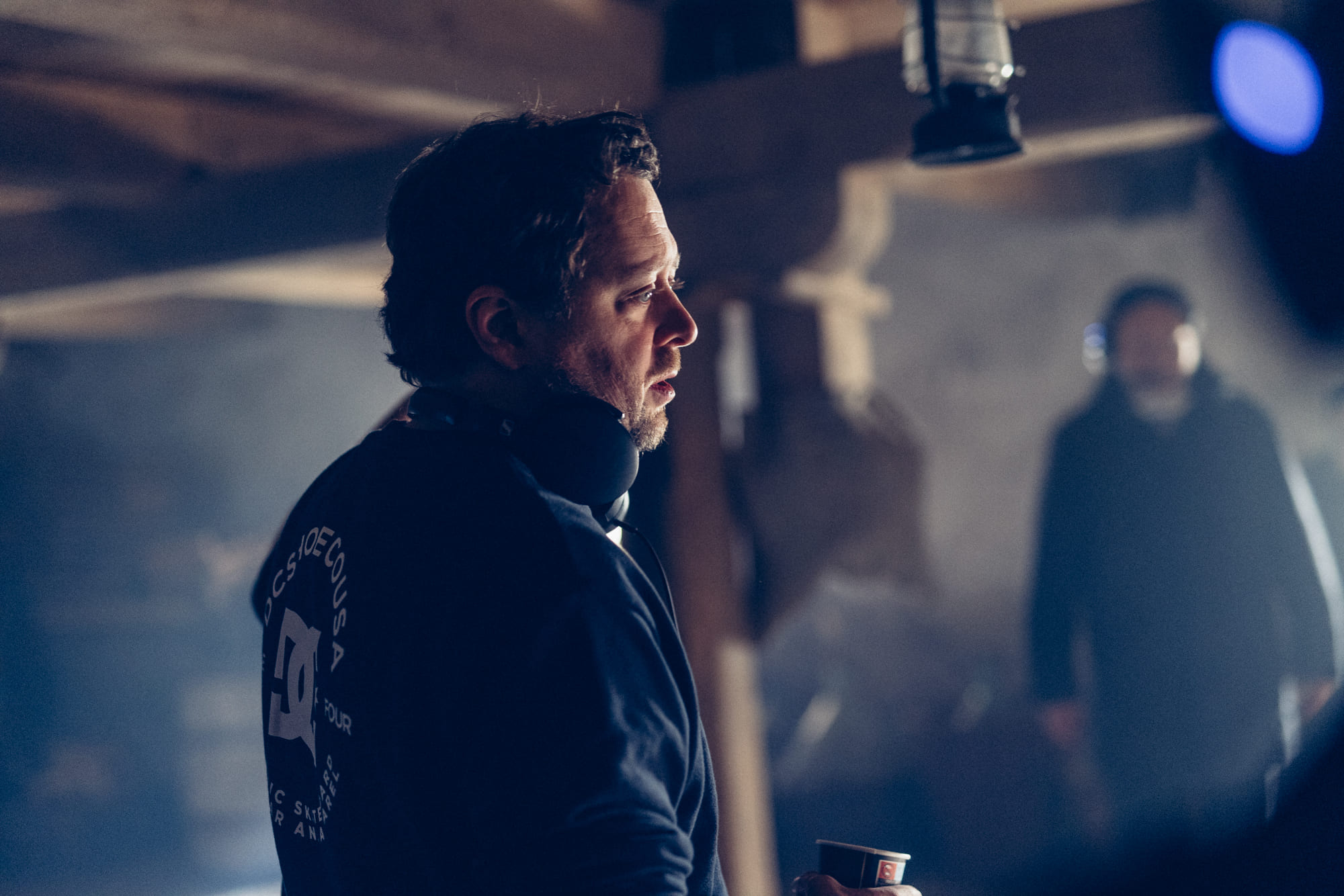
With his latest film, Wild Wild East, Polish director Jan Holoubek has combined the Western with a noirish thriller and thrown the mix into the middle of World War II. The year is 1943, and a mysterious stranger rides into town. He’s played by Itay Tiran in a tour-de-force turn as a Nazi official, Martin Wolff, hot on the trail of missing Jewish gold. Where it is and who will get to it first is the riddle that needs solving. Let the backstabbing begin! The movie just premiered at the 2026 Toronto International Film Festival (where I reviewed it). Just ahead of the fest, I spoke with Holoubek via Zoom. Here is that conversation, edited for length and clarity.
Hammer to Nail: So, your movie has the word “East” in the title, but in the press notes, you compare it to classic Westerns, talking about Sergio Leone, Clint Eastwood, and George Roy Hill, as well as Andrew Dominik. What originally made you want to apply the aesthetic of a Western, with a mysterious stranger riding into town, to a film about World War II and the Holocaust?
Jan Holubek: This idea was in the script; it was designed that way. I read it as a completed script from Aleksandra Takuska, and it was all there. And that’s what amazed me about it so much, this variety of genres that are there. This originality of the idea is what made me love it so much.
HtN: There are also elements of film noir. You have all these double crosses and incredible twists and turns. I feel like you lit it more like a film noir than anything else with that deep contrast. How did you work with your cinematographer to get that look?
JH: It’s our 8th production together with Bartek [Bartlomiej Kaczmarek]. And I used to be a DP [Director of Photography] as well before I became director, for 17 years up until my first production that I directed, which was 8 years ago. So, me and Bartek, we communicate often without words. We know exactly what kind of atmosphere we want to achieve. Of course, we talked about it, but again I will go back to the script: the atmosphere, the color, the kind of smell of this world was already hidden in the words of the script. And we just had to find the key to open it and show it.
But it’s not only me and my DP in this team; there is also a great set designer, Marek Warszewski, and costume designers and makeup artists. And they are all people that I work with constantly. I tell them the main direction, but then they come back with ideas and this world that you see finally on the screen is a mixture of all those creative ideas of those super-talented people. We don’t use references, though. We don’t say, “Let’s do it like in this movie or that kind of movie.” We would rather look for the inspirations among ourselves. That’s how we come to this result.
HtN: Speaking of that amazing creative team and your set designer, how much of what we see of the town that you shot in was the actual town, and how much were you dressing to achieve that look?
JH: The street of the town and the house of the Levis, that huge property, we shot in Latvia. We don’t have such places in Poland anymore, to be honest. But in Latvia, somehow, they kept it there. Actually, this town is under the protection of UNESCO. So that’s why it looks so real, like it is frozen in time somehow. To be honest, we didn’t have to do much in this town except the details that we had to change and add the snow, but a lot of things were there already.
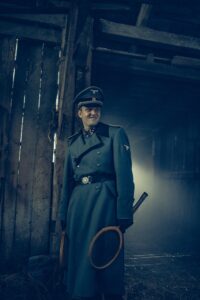
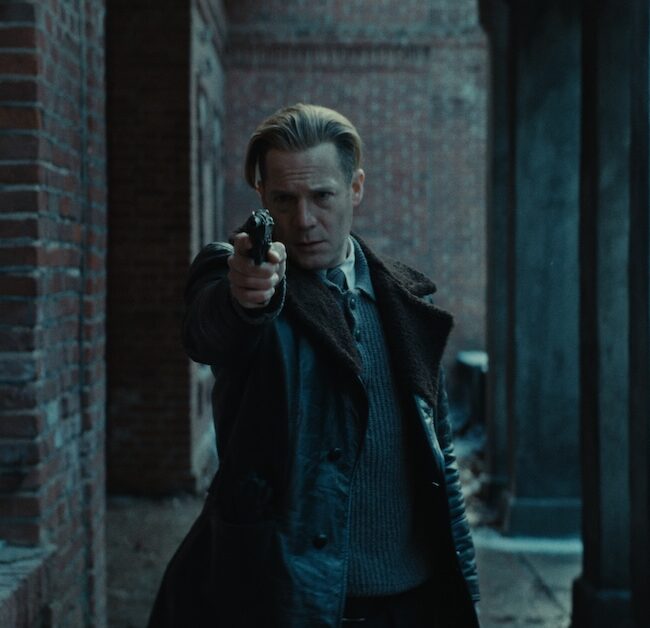
A Still from WILD WILD EAST
HtN: You just had to make sure you didn’t destroy a protected UNESCO site. (laughs) Let me ask you about your lead actor, Itay Tiran, whom I’ve never seen before. He’s done a lot of theater work mostly and he was a revelation to me. And really, your film is great, anyway, but with him at the center, it’s even better. How did you find him and then how did you pitch the movie to him? I know he’s Israeli and living partly in Berlin, so that explains the German, but his Polish to me sounds really good. Did he speak Polish already?
JH: So, originally. I was sure that this part was going to be taken by a German actor. That was our idea. We did casting for that part and for Kurt, actually—the other guy—in Berlin, and then a lot of really great German actors came; I mean, really great. And among them, there was one guy who was not German—that was Itay—and he just amused me with his talent, intelligence, and also the way he looks. I mean, he’s very, very handsome, and I wanted to have a handsome main character, like in a classical Western. And the fact that Itay is actually Jewish is something extra. I mean, I never thought that it would go this way. And he works in Vienna, in national theater, so he speaks German pretty perfectly. As for Polish, he was learning it for the movie. It was very difficult for him.
HtN: Well, it sounds to my ear like it blends really well with the other Polish actors. He did a great job.
JH: He did, So yes, we found him during auditions and Jan Bülow, who plays the Kurt character, he also came and they actually met together at the auditions. I had them both in front of the camera, and when they started to act scenes, I thought it was magic.
HtN: And what about the rest of your ensemble?
JH: All of these actors are very well-recognized in Poland. They’re really well-known. Robert Więckiewicz, who plays Kaim, is considered to be one of the best actors of his generation. The rest of the actors you see, these are all just great actors; it wasn’t difficult for me to cast them. I had this clear vision of who should be who in this movie. As you probably noticed, it’s a bit like a theater drama. There are just seven characters, so I knew that I had to have really good actors for that.
HtN: I have some questions about the gold at the heart of the story. I don’t want you to give away plot spoilers, but I am curious about your choice of what the gold turns out to be at the end, since earlier we’re led to believe that it is a family treasure, and then what we see is very different than what I expected. Is that just in Wolff’s imagination, because he’s gone through this horrific experience, or is it actually what the gold always was?
JH: It’s neither this nor that. It’s actually the gold that Germans are using to pay for the vodka. So yes, Wolff was looking for different gold than what he found at the end.
HtN: Speaking of that final scene, Wolff picks up, in the camp, a postcard sent from Palestine. It’s a very deliberate choice. I’m curious what that was meant to signify, to you. Are you making parallels with what is happening in our present-day world?
JH: Well, in a very basic way, this is a postcard, let’s say, that was sent from the attorney who disappeared, and they’re constantly saying that he went to exotic countries, so that would be Palestine, because he would probably go there and wait for the Levi family, but it’s also a kind of promised land. It was already a promised land at that time for European Jews. We did not put Palestine there because of the situation that is happening right now in Gaza. But on the other hand, if it works for you as a viewer and you have an extra thought about it, I don’t mind. I mean, that’s OK because we cannot avoid this thing in it. I mean, what is happening there now started in the camps.
HtN: True. You’re absolutely right. There Is a parallel.
JH: There is a connection, but I don’t want to make it deliberate or want everybody to have a thought about it.
HtN: You don’t want to oversell the comparison, but you’re right, there is a through line and genocides repeat. So, speaking of all that, I was very impressed by how you ground your movie, which is a really engaging thriller—I was hooked from the start—in the undeniable horrors of the Holocaust. You don’t leave that out. And I’m just wondering what staging that was like. I imagine it was difficult. It’s a very impressive, prolonged scene. Obviously, we’ve seen this onscreen in other movies, but you put it in your film, and I’m just curious about what that was like for you recreating such moments.
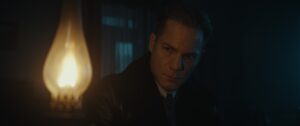
A still from WILD WILD EAST
JH: Well, it was very difficult for everyone. It was freezing. People were naked, as you saw. It was also emotionally very difficult for our main actor, who lost family during the Second World War in such a camp. So it was very difficult. We shot it in two days, the whole sequence, so we were short on time. Because, as you said, we’ve all seen it in movies before, I think the strength of the sequence is because you don’t suspect that you’re going to see it in this movie. If this was a movie where it is clear from the beginning that you’re watching a wartime kind of feature-documentary movie, you wouldn’t be so surprised.
I read a lot about the camps, and what surprised me—because every time we see it in the film, there are shouting Germans beating people as they leave the train and so on—was that they wanted to keep people calm until the very end, so they were pretending that everything was fine and nothing was going to happen. They were of course lying to them that it’s just for one night and they’re going to be put on another train or something like this. That’s why those people stayed in this line and were basically calm.
And that was so shocking to me, and that’s why this horror could work so smoothly because people were not panicking. If they started to panic, the next train that would come, and they were coming really often, those people would see already that there is something happening and the Germans could lose control. So that’s when I realized that I needed to do this sequence like that, and I think that’s something original in comparison to things I’ve seen before.
HtN: And I think you succeed. It is a really powerful gut punch at the end, and you do surprise us because we’ve been watching a very different kind of movie up until then. Well, Jan Holoubek, I want to thank you for chatting with me.
JH: Thank you very much!
– Christopher Llewellyn Reed (@ChrisReedFilm)