




THE REMOTES
(The 2026 Venice Film Festival ran September 2-12 on the island of the Lido di Venezia (Venice Lido) in Italy. HtN has coverage coming in like Lé Baltar’s The Remotes movie review. Seen it? Join the conversation with HtN on our Letterboxd Page.)
A slippery, elliptical ride of a film that unfolds largely under cover of darkness, The Remotes, which world premiered at TIFF, steers us into the many sinister ways in which a killer navigation app not only takes control of one’s muscle but also one’s memory — about how our lives and deepest desires can be automated and surrendered to the Frankensteined language of Big Tech.
Though viewers might point readily to David Cronenberg’s Crash as a source of inspiration, that feels rather nominal here, and it’s disingenuous to suggest that this narrative feature debut from Filipino experimentalist John Torres merely riffs on Crash to evoke the techno-fascist ethos of the 2020s. For one, it lacks the Cronenbergian notion of extreme carnality, which is crucial to the 1996 cult classic’s visceral distillation of its characters’ erotic attachment to machines. If anything, The Remotes tonally splits the difference between Lav Diaz’s Batang West Side and co-writer Dodo Dayao’s Violator — slow-burn, stylized, with a story that will likely be described as a head-scratcher. The director borrows from genre conventions before boldly bending them to his will, creating an eerie atmosphere and vivid mise-en-scène where the pleasure of surrender gives way to machinic existence. It’s a perfect midnight movie that’s been rattling around my head for days.
A prominent figure of the Philippine New Wave film movement, alongside such filmmakers as Diaz, Khavn, Roxlee, Raya Martin, and The Remotes co-producer Sherad Anthony Sanchez, all championed by the late critic Alexis Tioseco, Torres has for years developed a penchant for the archival and autobiographical, poetically repurposing found and personal footage into new images in motion that, despite their seeming impenetrability, at times mistaken as braggadocio, somehow always wear the director’s heart on his sleeve. Such efforts include Todo Todo Teros (2006), Refrains Happen Like Revolutions in a Song (2010), and Room in a Crowd (2023). In this beguiling, steadily spiraling latest, the multi-hyphenate Torres has changed that inventive, plunderoptic sensibility not a whit.
The Remotes draws from Torres’ 2019 hybrid short We Still Have to Close Our Eyes, a dystopian tale of human-controlling digital systems fashioned from behind-the-scenes footage of local film productions, including those directed by Diaz and Erik Matti. This full-fledged fictional project arguably offers the Los Otros co-founder his best shot at commercial distribution, given its glowing array of stars. Outside the main cast, the film features the likes of Elijah Canlas, Jorybell Agoto, Ruby Ruiz, Bituin Escalante, Nour Hooshmand, and more.
Fragmented into four vignettes and about as logical as the GPS directions to a looping dream, the film finds Alchris Galura in a subtly commanding lead performance as the grieving Segundo “Dong” Mijares, the protagonist sharing a surname with the similarly tortured detective of Batang West Side. About to migrate abroad a year after his wife’s death, Mijares finds himself ensnared by an investigation into seemingly bizarre road incidents. He has a hunch that a voice-guided navigation app used in a seminar to retrain reckless drivers is responsible for the series of crashes, which may or may not shed light on his wife’s passing.
To that end, he follows the enigmatic Cantero sisters, Eva and Gill, played by Julia Richards and Gabby Padilla, respectively. Eva has the voice of their dead mother and once lent that voice to the machine. Now she suspects it has gone rogue and taken on a life of its own. Gill, meanwhile, drifts in and out of delirious reveries. Together they run the seminar, while wrestling with the residues of grief still haunting their mother’s house Eva is trying to sell. Mijares enrolls in the seminar and is soon engulfed in a world of simulators and voice commands. He grows weary by the hour, but the needling nocturnal film around him does anything but spur him closer to the source of his disquiet, as Torres is more interested in raising new questions than in answering those preceding them. The director wants us to do the solving if only to remind us how futile and frustrating the endeavor can get. Torres and Dayao, who wrote the material together for over six years, reject a filmic grammar that defer to the tired panaceas of narrative conventions, allowing for a semiotically refracted picture.
Also among the prime suspects showing up in the film’s second canto is restless motorcyclist Donnie (Enchong Dee), who, from time to time, has sex with Eva, though they are not entirely in the mood for each other. Donnie chases the crash and cannot seem to switch off. In those moments where he’s on the road, reveling in the surrender and accelerating with reckless abandon, he feels most alive. But only to the extent that his body’s engine does not conk out. The other trainees speak of how the disembodied voice assumes different personas. At times it sounds like a clingy ex who can’t move on, at others it behaves like a silent ghost. But the common denominator is that it taps into primal feelings that drive all users into submission. The voice, then, becomes an unsettling life force they begin to crave.
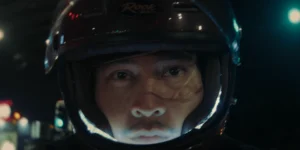
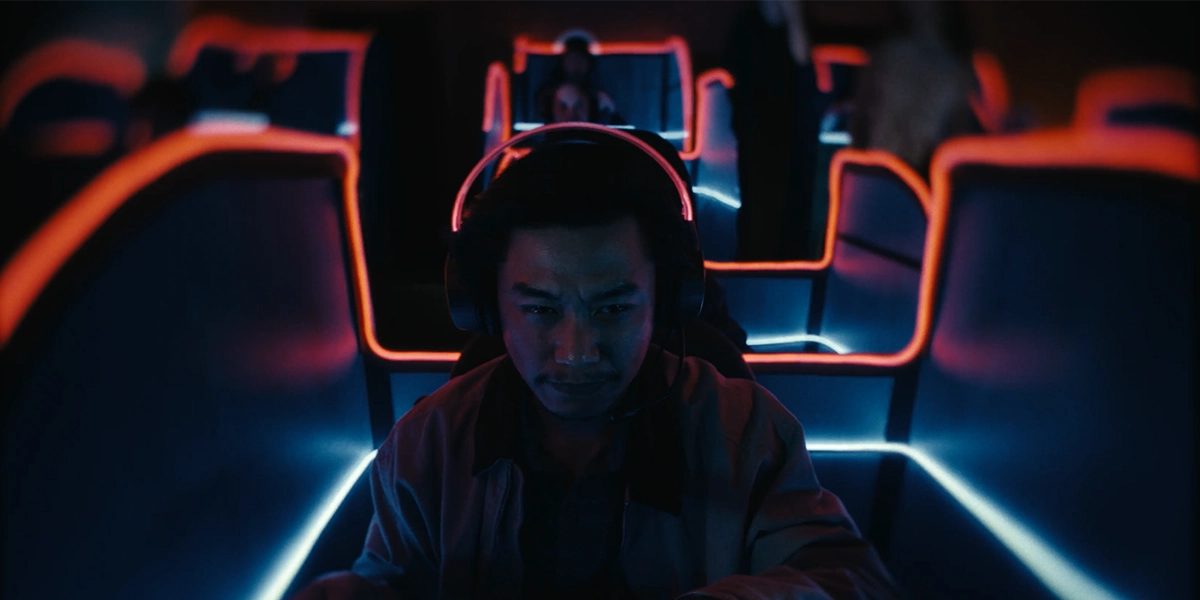
A still from THE REMOTES
This must be what AI-assisted therapy feels like — how it weaponizes this sort of personalized generalism by feeding on our pains, fears, desires, and memories. In this respect, Torres crystallizes the horrors of “grief tech” and the ways we lose track of ourselves when the loss is too much to bear. The more we give in to this machinic comfort, the more we dig our own digital graveyards, to such an extent that rejecting the algorithm is akin to reliving the tragedy as if it were the first time. The film suggests this is hardly conspiratorial, and never more so than in our present reality where artificial intelligence is implicated in the mechanics of modern genocide, revealing the imperial will built into surveillance through automation.
The Remotes is too slick a film to be fully nailed down. When things start to remotely resemble a plot, Torres insists on surreal digressions. In such moments the artistic effervescence of cinematographer Tristan Salas and production designer Remton Siega Zuasola is indisputable, offering vistas that convey a menacing mood and plenty of intrigue. Images flash across time and space through crosscutting. Practical effects generate gore. Then, out of nowhere, an underground concert disrupts the film’s pensive rhythm. There’s even an instance where the camera pulls off a 360-degree bird’s-eye view of the concrete roadways playing host to Donnie’s narcotized night drives.
Soon enough, the viewer grows used to the filmmaker’s notion of Manila’s outskirts as dark and sprawling but far from futuristic or alien. While the film hints at a techno-fascist world, as conjured by its deep shadows and neon lighting, it is bereft of elements you’d typically expect from sci-fi cinema. No holographic displays or pristine surfaces. Even the psyche-altering technology at its center isn’t particularly sophisticated. Its vision of the future is not remote from the Philippine milieu of past and present.
When Mijares entertains a new lead, he’s accused of seeing ghosts and is advised to drop the case as the Canteros have links to a high-ranking official the detective wouldn’t want to cross. It’s beyond their jurisdiction, his colleague and brother-in-law says. Accidents happen, and there’s nothing to fuss about. Torres foregrounds this indifference until it eventually echoes the chilling rhetoric normalized under the Rodrigo Duterte regime where calculated barbarism and sharpened surveillance were treated as simple facts of life, where reading too much into something could cost you your life. That political climate reached new extremes during the COVID-19 pandemic in the country, in one of the world’s longest and strictest lockdowns. While the world was on fire, digital systems worked its way into people’s lives: what we consume, how we move, what types of connections we make, how we grieve. Torres complicates that kind of mediation to imply that it takes away our agency and, ultimately, humanity by virtue of convenience — and how that could possibly be irreversible.
Political implications aside, this particular world-building can be explained by how The Remotes works less as a sci-fi movie, or indeed as a genre piece, than as an auteurial work employing a mosaic style. Much like the persona-shifting voice, it flirts with the edges of science fiction, noir, police procedural, ghost story, road movie, and romance. This is a Torres movie through and through, in that it’s hard to suggest it’s not besotted with its own schtick, sending us back to square one the moment we think we’ve got it all figured out. The effect is that of a jolting déjà vu, except we’re reliving a moment or memory that is not our own. To be sure, demands for coherence would be the most glaring criticism one could level at the film. But I’d wager that neat logic won’t yield a work this haunting. Such demands, more than we’d care to admit, restrict our idea of what makes cinema and therefore homogenize us as audience.
Torres’ sleight of hand is especially heightened through sound, which Mikko Quizon treats here as anything but ancillary. As the film wends onward, several character voiceovers recur and start to blend slickly into each other. Some lines are delivered as though the characters are speaking in tongues. At some point, the people with whom Mijares interacts suddenly speak in a singsongy tone as the narration insists it’s the voice of his dead wife. This is, of course, instructive of Torres’ diaristic method, inspired by various sources, from Kidlat Tahimik to Robert Bresson. Composer Don Josephus Raphael Eblahan, for his part, induces hypnosis with a score that is hyper-attuned to what not only sounds like spiritual emptiness but also like the death of memory; it feels borderline Kiyoshi Kurosawan. The unnerving soundscape ultimately renders it tough to decipher what is real and what is imagined, just as the clues to Mijares’ investigation start to slide into mere coincidence. Can one-way routes or a blouse sold to a seedy thrift store help illuminate ulterior motives? Is there really a crime, or is it just the work of his unraveling psyche? Perhaps an echo of a future far out of reach?
Much like his protagonist hallucinating evidence, Torres envisions The Remotes as the “real film” his late mother would ask him to make. It’s like her own digital afterlife forged through a language her son knows best — a gesture that doubles as the director’s journey back to himself. It’s altogether touching, dizzying, and polarizing. Then again, when has grief ever been a moment of clarity? For over two and a half hours, Torres becomes our Eva, the voice that guides us as our motor functions freeze and our minds drift into the ether. There has not been a more audacious Filipino motion picture this decade.
— Lé Baltar (@baltarle)