



A Conversation with Sébastien Laudenbach (VIVA CARMEN)
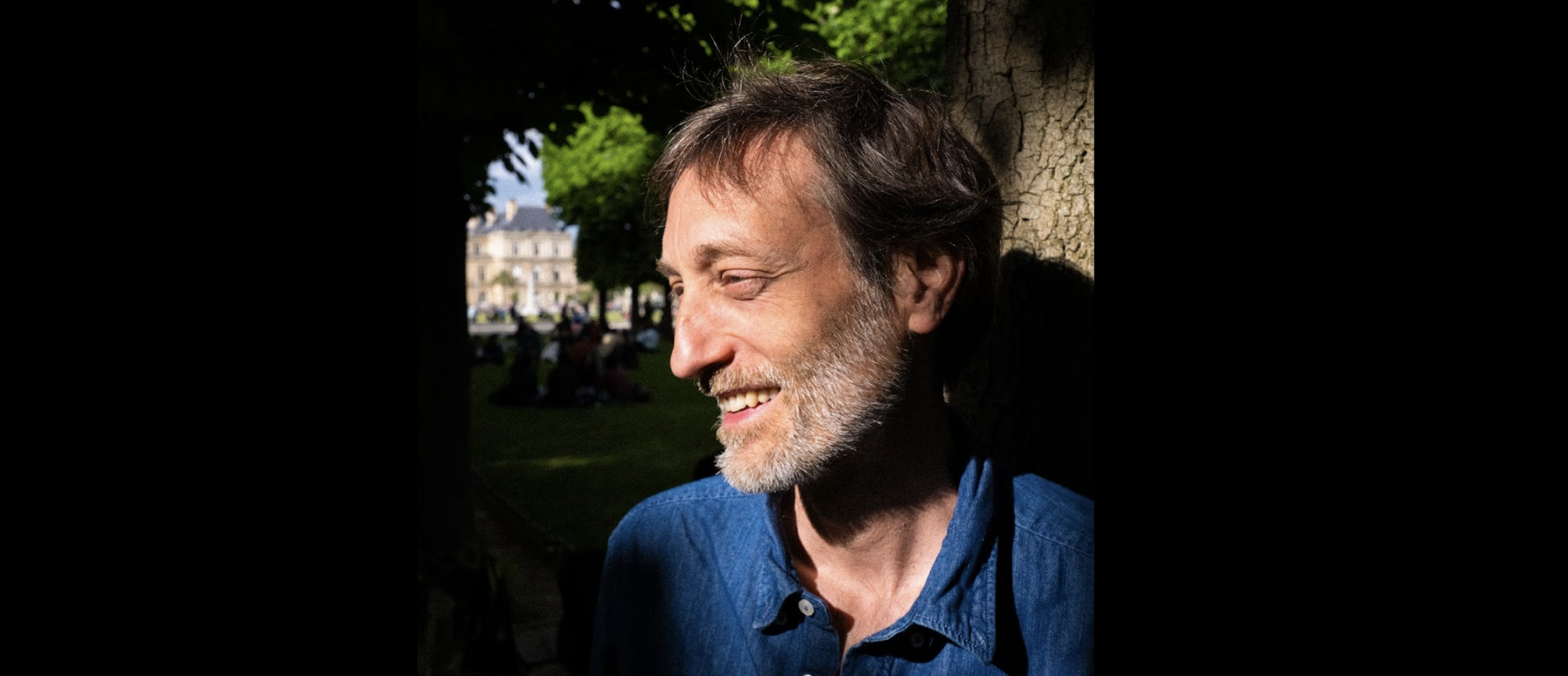
Mainstream feature animation has become an airless thing. Every frame is locked down, every surface polished, every emotional beat pre-chewed for the audience. Sébastien Laudenbach works in the opposite direction. His characters seem to have just been drawn, his colors drift outside the lines, and his films retain the openness of a sketch. The Girl Without Hands in 2016 and Chicken for Linda! in 2023, co-directed with Chiara Malta, established him as one of the most distinctive animators working today.
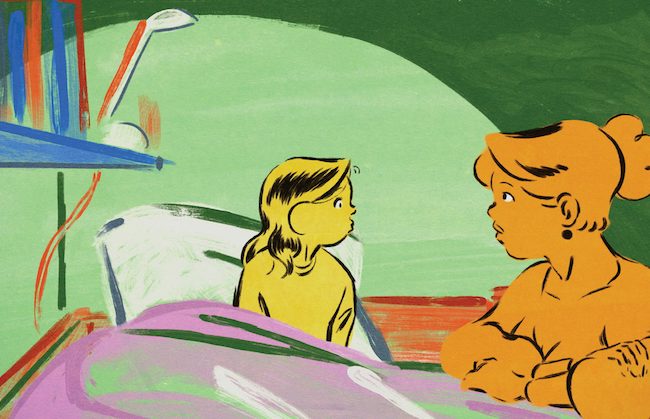
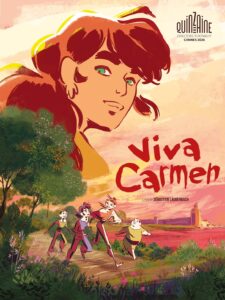
Viva Carmen, which premiered in Quinzaine des Cinéastes, adapts Bizet’s opera through the eyes of a tribe of Sevillian street kids led by the apprentice knife-grinder Salvador (voiced by Milo Machado-Graner of Anatomy of a Fall) and the fierce Belén. They learn that Carmen (Camélia Jordana) is fated to be murdered by the soldier José, and they set out to stop it. The film handles its source material with a startling lightness, condensing the opera into something a child can follow while keeping the weight of its central tragedy fully intact. I spoke with Laudenbach at Cannes about his collaborators, the music, and reimagining one of the most performed operas in the world.
Hammer to Nail: You said that you didn’t want to suggest, as American films do, that it is within children’s power to solve adult problems. Were there specific films you were defining yourself against?
Sébastien Laudenbach : I don’t have any specific film, but it’s true that when you have a kids’ gang, they succeed in every film. Like, I don’t know, Goonies or E.T. It’s quite rare to have a failure, especially for a film for kids. I don’t mean that my movie is only for kids, it’s for everybody, I guess, but it’s also for kids. It was important for me, and I think it’s interesting to tell kids that we can also fail. But what do we do with this failure after the failure? What’s next? What kind of civilization do you want to bring up? What kind of world do you want to make? If there is a message in my movie, it’s this one. I hope there is hope at the end of the movie. There is this sunlight at the end, even if Carmen died. There is this little Carmen, so maybe we can save her, the next Carmen and the next woman. We are living in a world where a lot of women are killed every day, and it’s impossible for our society to change that, to avoid that. So how can we bring up new thoughts and a new world to change that? That’s it.
HTN: Absolutely. I think all that comes through. Viva Carmen is the first of your features where you’re not the graphic designer. What did you have to unlearn working with Cyril Pedrosa’s line rather than your own?
SL: It’s not totally true, because on Chicken for Linda! I was the character designer but not the background designer. We worked with Chiara Malta, the co-director. We worked with a wonderful artist on the backgrounds. On Viva Carmen, I felt very lucky to work with Cyril, but also with Élodie Rémy for the colors and Éléa Gobbé-Mévellec for the character design. They are so talented and so generous.
We created a kind of gang together. They were like the three musketeers for me. They didn’t know each other, but we created a kind of family, actually. We admired the others’ work. Cyril was astonished by the colors proposed by Élodie. Éléa was like, oh wow, it’s so beautiful, the backgrounds. And Élodie was the same for Éléa’s work. It was so beautiful to see this osmosis. I think it was quite unique. So I felt very, very lucky. They helped me a lot. That’s the reason why I say that it’s not my movie, it’s our movie. In the story, there is this idea that with a gang, with a tribe, we can create something, because the kids are not family, the women on the hill are not family, and the house at the end is an open house. It’s also the same ending we did with Chiara in Chicken for Linda! Everybody together, we can change something. We can create a new kind of relationship and power.
HTN: Amine Bouhafa and your sister Isabelle Laudenbach composed the music, which almost functions as a character itself. Can you talk about your collaboration and what was most important to you?
SL: It was obviously very important because the movie is based on the opera. So from the early months, we decided to work with them together. Amine had worked with Folivari previously on The Summit of the Gods. My sister was working on a Carmen adaptation for a ciné concert. She played guitar in front of an old silent movie from the 20s. So we spoke together about our respective Carmens, with my sister, and I asked her to create something for the very early trailer. She created this very wonderful music, and the producers were convinced, and they were convinced that it was nice to work together and to bring her into the adventure, because she lives in Spain, she’s a flamenco guitarist and composer, and she knows me quite well. Amine is very talented for scores. He has done a lot of music for films. Bringing them together was very powerful. They created music inspired by the opera, so you can find a lot of patterns from Bizet’s opera.
If you know Carmen, there are a lot of patterns in two hours of music. If you know the opera quite well, it’s like a game, you can recognize a lot of things. And if you don’t know the opera, if you are a kid, for instance, maybe it’s a gate to discover the original opera. It’s not a musical, but we have a song that was composed and sung by Camélia. She’s so talented. She’s an actress, a singer, a composer, a producer, and she’s like Carmen for me. We contacted her very early, because Carmen is a very strong character, and it’s not easy to find the good Carmen, for the character design and also for the voice. We worked a lot, especially for the character design, to find our Carmen. Because when you speak about Carmen, you have something in mind. If you know the opera, if you don’t know the opera, you know Carmen. It’s a brand.
HTN: Absolutely. The opening tavern scene. You described the camera organizing the chaos of the men’s world, closed in on itself. How did you and your storyboard team translate that thesis into shot logic, and what was most important to you in that opening moment?
SL: It’s not an easy way to enter into a movie, because it’s chaotic, you don’t understand anything, and it’s dark as well. We worked a lot with the sound designer Carolina Santana and the mixer to create something chaotic but not too hard, not too strong. In the script, it was written that the beginning had to be a man’s world and the end a woman’s world. So it’s very simple. We are with the kids. The adults’ world is tall, they are noisy, and you don’t understand this world. I think this film is not for kids, but some kids could see it. They are kids, so they have to understand the world. The relationships between people, everything. I wanted to create that feeling of, oh wow, I’m little in a tall world, and I don’t understand anything, but I am also smart, I’m a thief, and I can take some things, some money. It was also a good way to present our two little kids, who are very cute and important to me for the story.
HTN: It’s a beautiful introductory sequence. I loved it so much.
SL: I worked with storyboard artists, but I did the whole pre-storyboard. It was very intuitive. I worked directly on the script making little sketches, and I would give them to my storyboard artist. One of these storyboard artists is Éléa Gobbé-Mévellec, who is the character designer. So when she did the storyboard, it was amazing, because it was like the movie, because the characters are on model and so are the backgrounds. It was like the movie, but in black and white without animation. It was amazing to see, because it was very true.
HTN: I’d love to see that as a graphic novel. If I’m not mistaken, you’ve never been to Seville, but Cyril and Élodie went without you and came back with two different kinds of records. One brought sketches and the other brought photographs. How did you build the city in your own head from those materials, and did the two kinds of references pull the film in different directions?
SL: I asked Cyril to create all the spaces. So he creates the graphic design, the color directions, the stroke style. But I also needed to have the real spaces in order to place my camera in mind. So it was very important for me to have Cyril’s references for the arena, for the corridor, for the streets, and for the last house, which is a real house in Seville. He made a sketch of this house, and when we created this sequence, I asked him to start with these sketches to create the real background. So it was very important.
I don’t know Seville, but I know Spain. We talked about the light and we created these sharp shadows in order to have this strong contrast between light and shadow. The color is a kind of character as well. Everything is at the same level. For me, voice talents, actors, animators, color, sound, music, everything is on the same level. Everything has to go in the same direction. I’m only the captain of the ship, and I had a lot of talents with me, and my only job was to tell them, we have to go there, and there was a fog there. The land wasn’t so clear, but the direction was quite clear.
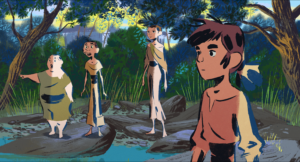
A still from VIVA CARMEN
HTN: How did you find Salvador’s voice? What were you listening for in the auditions, and when did you know that Milo Machado-Graner was the one?
SL: I worked with a casting director, she passed away. The film is dedicated to her. She was very strong and talented at finding voices. I didn’t want to know the names, I didn’t want to see any pictures, I only wanted to hear voices. We heard a lot of voices for Salvador, and one voice was amazing. It was like our Salvador, and it was Milo Machado-Graner. I didn’t know that, so it’s a coincidence. It’s not a coincidence, because when I met him, I recognized myself in him, and also his face is a little bit like Salva’s face. The only voice we wanted to work with from the start was Camélia, yes, because she’s strong, she’s talented, she’s like Carmen in real life, she’s free, she’s powerful, and I love her.
HTN: Santiago Otheguy, your co-writer, comes from Buenos Aires and has worked on Monos and Temblores, films that have pretty different registers from yours. What does he bring to this script that you couldn’t?
SL: Santiago was so important. When I met him, I didn’t want to write the story at the beginning, because it’s a strange story. It started when I talked with a friend, and this friend asked me, I am wondering what we could do if we did Carmen through the kids’ eyes. It was quite a strange idea. I told him I didn’t want to write it myself at the beginning, so we started to find a screenwriter.When I met Santiago, I thought, oh, this is the good one. Because he’s a film director, he’s also a painter, he’s also a musician, he speaks Spanish, and he brought a lot of things. He created Belén, for instance, who is my favorite character. He told me that maybe the movie’s end didn’t have to be only Carmen’s death, that we had to create something after. So yes, it was very important.
– Jack Schenker (@YUNGOCUPOTIS)