




(Check out Savina Petkova’s Parallel Tales movie review. The film just had its premiere at the Cannes Film Festival. Seen it? Join the conversation with HtN on our Letterboxd Page.)
Before he started working on his last film, A Hero (Grand Jury Prix in Cannes in 2021), Iranian director Asghar Farhadi had been offered to take up Polish master Krzysztof Kieślowski’s Dekalog and make it into a series. A daunting task indeed, but down the line, this proposal resulted in Parallel Tales (premiering at Cannes’ Official Competition), a film based on Dekalog 6: A Short Film About Love (1998) where a man falls in love with the neighboring woman he spies on. Parallel Tales sports a French cast of greats, with Virginie Efira and Isabelle Huppert at the center, joined by Vincent Cassel (The Shrouds) and Pierre Niney (Frantz). Last, but not least, the link between all those characters is a young unhoused man called Adam (Adam Bessa), an interloper into various relationships (real and imagined) between the quartet of protagonists.
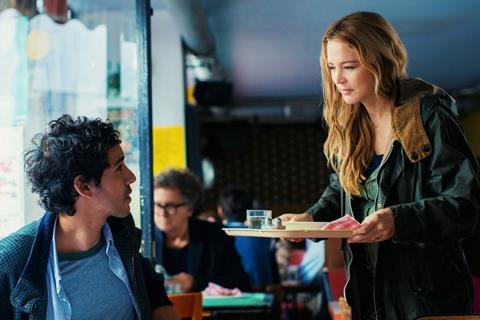
Sylvie (Huppert) is a bohemian writer living in a fortress of books and a mouse-infested flat, devoting all her time to a short story inspired by a woman in a sound recording studio across the street. She calls her (Efira) Anna, inventing an elaborate and luscious personality for her as someone who cheats on her young boyfriend (Niney) with their married boss (Cassel), a good dramatic arc observed through a toy telescope. The fictional set-up of the story is dramaturgically sound, but rather banal, according to Sylvie’s editor (played by Catherine Deneuve) since people “don’t talk like that in real life.” Throughout the film, the characters are left to question what is real and what is fiction, occasionally seduced by the possibility of inhabiting a make-believe version of themselves. Adam, on the other hand, goes from meek helper who assists Sylvie with packing up and cleaning her apartment, to a narrator in his own right.
Farhadi described the script, which he co-wrote with his brother Saeed, as a “triptych of image, sound, and writing” since the voyeuristic scenes of intimacy observed in Rear Window style, as potent as they are, are not enough to build a film (or a remake of a film) on. This is why he pays attention to the techniques of sound recording, bringing to mind Peter Strickland’s Berberian Sound Studio, but the role of ‘writing’ remains at once nebulous and exaggerated, passed on as a baton between Sylvie and Adam.
Parallel Tales is all about unreliable narrators and while Sylvie admits—with the help of her typewriter and expositional voiceover—that she’s inventing stories, Adam appoints himself as someone who can take her inventions and make them fit reality. Of course, his motivation is desire, like in Dekalog, to insert himself in the life of a beautiful woman across the street. Bessa is a very good fit for the role thanks to a well-crafted physical presence – aloof and delicate, somewhat fragile with a glint of mischief in his eyes.
Formally, Parallel Tales doesn’t take many risks, especially since its main narrative device involves reflections and peeping shots, which are done tastefully, but in an obvious, clean manner by French cinematographer Guillaume Deffontaines who’s previously worked with Bruno Dumont. Since sound is an important part of the narrative, it’s no surprise that textures and music are so crucial here, and having Kieślowski’s collaborator Zbigniew Preisner as composer legitimizes the film in a way that its images can’t. It’s not enough to transform the most prosaic shots and predictable narrative turns into the sophisticated film it claims to be. Instead, the tensions—arguably Farhadi’s biggest asset—boil up to the surface very early on and the actors run out of steam by the third act of this 140 minute runtime.Parallel Tales is a perfectly watchable film, that is perhaps more rewarding to those who aren’t familiar with Dekalog and its legacy, but if you’re looking for the ‘auteur’ stamp of Farhadi’s Oscar-nominated A Separation (2012), you’d just have to keep searching.
– Savina Petkova (@SavinaPetkova)