

2026 Oscar-Nominated Short Films
The 2026 Academy Awards will take place on Sunday, March 15. As I do every year, I have watched all 15 of the nominated short films, which are divided into the 3 separate categories of animation, documentary, and live action. Roadside Attractions is releasing them on February 20 for a theatrical run ahead of the Oscars. I offer my thoughts, below, on what should win (though I am a terrible predictor of actual results).
I was impressed with the quality of this year’s selections, though I always wonder why the documentaries need to be so much longer than the other films (especially since most feature-length docs clock in at or around 90 minutes, shorter than the average fiction effort). Otherwise, they were quite good, and my favorite film of all—Perfectly a Strangeness (the shortest of the bunch, of course)—was in that category, though I thought the live-action movies were, as a group, the best. What follows are my capsule reviews of everything, in order of category preference and then within those by film preference.
LIVE ACTION
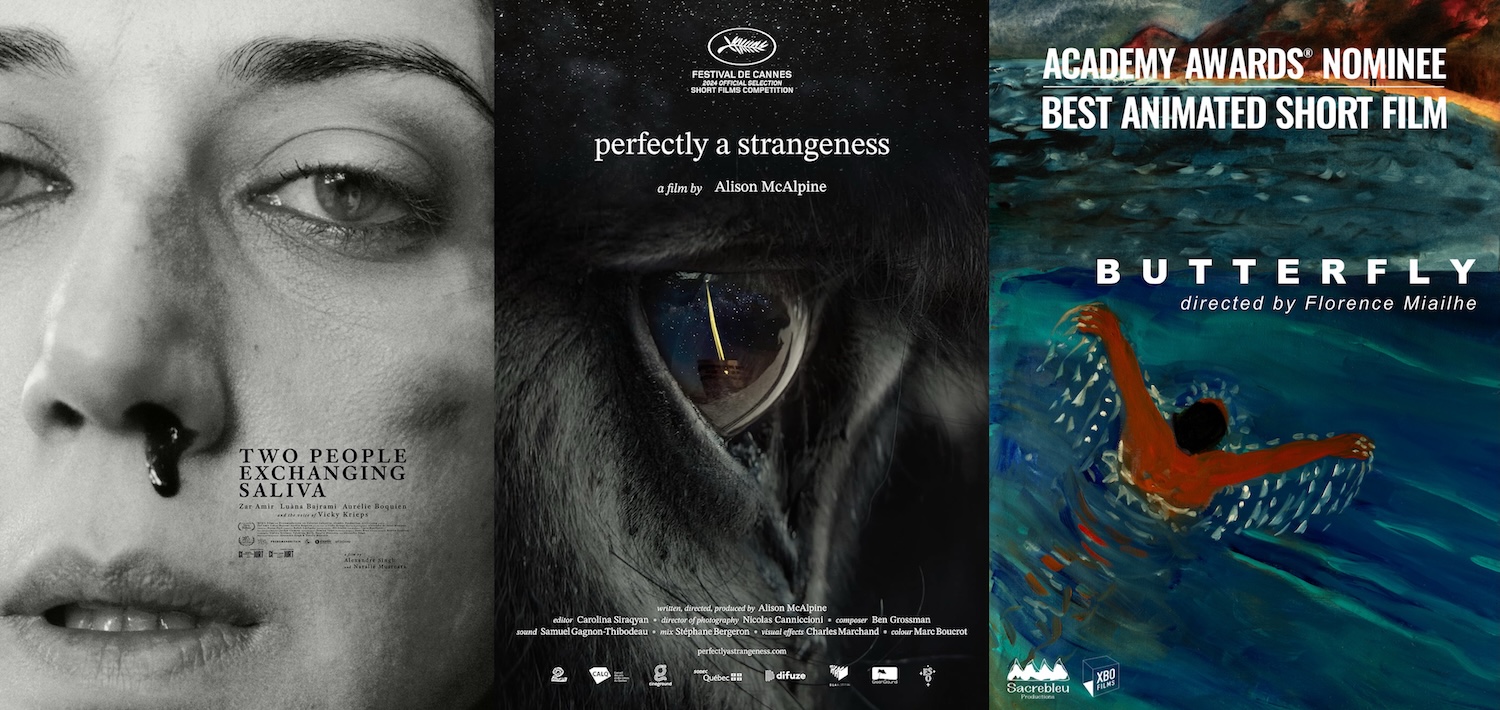
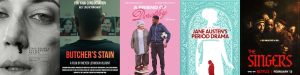
Two People Exchanging Saliva (Natalie Musteata/Alexandre Singh, France/USA, 36 min.)
Despite some overly clever narrative obfuscation, Two People Exchanging Saliva deserves high praise for the originality of its storytelling and precision of its production design and cinematography. Luana Bajrami (Other People’s Children) and Zar Amir Ebrahimi (Holy Spider) star as mismatched would-be friends (perhaps even lovers) in a dystopian world where smelling good is a crime. That’s the basic setup for a meditation on intimacy and the cost of surrendering agency to government control. Filmed in sharp black and white, with exquisite compositions, the movie never explains the how and the why of its strange universe, allowing the details to unfold in intriguing ways. It’s definitely the most unique movie here.
Butcher’s Stain (Meyer Levinson-Blount, Israel, 26 min.)
Butcher’s Stain is the most poignant, and another Israeli film that shines a piercing light on the country’s othering of the Palestinians in its midst. Director Meyer Levinson-Blount shows what can happen when prejudice, fear, and complacency replace compassion and reason. Samir (Omar Sameer) is happy in his job as a supermarket butcher; he’s also well-liked by his Jewish employers. Until, that is, someone complains that the fliers featuring hostages held by Hamas keep being torn down in the breakroom. Naturally, as the only Palestinian working there, Samir is the one suspected. The truth and its consequences are both more innocuous and more sinister than they first appear, Levinson-Blount himself appearing in the role of a less-than-supportive co-worker. There’s an unnecessary subplot about Samir’s divorce and child-custody issues, but other than that Butcher’s Stain is a moving and deserved entry in this category.
A Friend of Dorothy (Lee Knight, United Kingdom, 21 min.)
With a title like A Friend of Dorothy, this solid short gives some of its plot development away, though there are still plenty of clever twists within. The titular character (Miriam Margolyes, H is for Happiness) is dead as the story begins, the other folks in a room listening to the will be read. Her grandson is not pleased to find a young Black man, JJ (Alistair Nwachukwu) in the same space, but soon we learn the how and the why of his presence in a series of flashbacks. Above all else, the movie is a paean to fellowship and a reminder that everyone needs company, no matter how old they are. Loneliness is a disease worth eradicating. Fortunately, Dorothy and JJ found each other in time. If sometimes the points are made with an especially heavy hand, the overall experience of watching is still a pleasant one.
Jane Austen’s Period Drama (Julia Aks/Steve Pinder, USA, 13 min.)
The same holds true for Jane Austen’s Period Drama, both in terms of how the title sets up the narrative and how things become rather obvious even as they prove engaging. This is very much a satire of all things Austen, while also a mostly funny riff on how little men know about women’s bodies. Co-director Julia Aks plays Estrogenia, who is this close to receiving a proposal of marriage from Mr. Dickley (Ta’imua) when, wouldn’t you know it, she starts menstruating. What ensues is a madcap comedy of manners in which blood flows freely, prompting all sorts of questions that were never broached in works like Pride and Prejudice or Sense and Sensibility. It’s silly, but also touches upon more serious issues of women’s health.
The Singers (Sam A. Davis, USA, 18 min.)
An adaptation of an eponymous short story by 19th-century Russian author Ivan Turgenev, The Singers is full of bonhomie and sweet lessons about the power of community to heal all wounds. Set in a dingy, smoke-filled bar in the middle of nowhere, in which the exclusively male clientele downs beer after beer, the film starts out as a tale of one man trying to bum drinks and then turns into something significantly more moving. If its beats fill forced, at times, director Sam A. Davis’ heart is always in the right place, mixing gentle humor in with the pathos. Plus, once the music starts, everything swings.
DOCUMENTARY
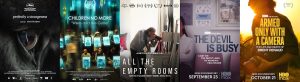
Perfectly a Strangeness (Alison McAlpine, Canada, 15 min.)
A beautiful (and short!) portrait of three donkeys walking around the magnificently situated La Silla Observatory in Chile, Perfectly a Strangeness demonstrates how much can be done with a simple premise. It’s also my top pick out of all the 2026 Oscar-nominated shorts. As the title indicates, the power of the narrative comes from the evocative juxtaposition of subjects. These donkeys are naturally curious creatures whose investigation of a site seemingly devoid of human presence (while also a testament to humanity’s innovation) highlights the gap between the natural and technical worlds. Once we engineer our own obsolescence, will animals roam the Earth without us, wondering what odd folks built these structures? Perhaps. In the meantime, enjoy the cinematic poetry. This film may not have the political relevance of the others in the category, but is formally the best, and a gorgeous work of art.
Children No More: “Were and Are Gone” (Hilla Medalia, USA/Israel/United Kingdom, 36 min.)
Israeli citizens who protest Benjamin Netanyahu’s policies in Gaza are very brave souls, confronting serious pushback from those who view their actions with suspicion and hatred. Though the politics and ethics of the Palestinian question have always been fraught, the violent retribution meted out towards innocent families and children in the wake of the Hamas attacks of October 7, 2023, have seriously upped the ante. In Children No More: “Were and Are Gone”, director Hilla Medalia (Mourning in Lod) follows the organizers of, and participants in, silent vigils within Israel, the purpose of which is to memorialize the children killed from airstrikes. Many walk by without engaging, while others take the time to read the information on the photographs held wordlessly in the air, and still others become angry and, occasionally, threatening. “What about our children and our hostages,” they say. Yes, but … If ordinary citizens do not hold their leaders to account, who will? The power of the movie lies in its plain truths.
All the Empty Rooms (Joshua Seftel, USA, 34 min.)
This is another poignant story, again with a focus on dead children. Journalist Steve Hartman and photographer Lou Bopp have been putting together a report on lives cut short from school shootings for 7 years, and as All the Empty Rooms begin, they have 3 families left. Director Joshua Seiftel brings us along on this simultaneously melancholy and sad journey, adding biographical information about Hartman along the way (which is not without interest but also less resonant). Breaking with his reputation as a “feel-good happy news” type of guy for CBS, Hartman labors to find a way to properly honor the victims of America’s refusal to solve its gun-violence problem. The movie manages to avoid maudlin sentimentality while allowing its subjects the space they need to express their pain.
The Devil Is Busy (Geeta Gandbhir/Christalyn Hampton, USA, 31 min.)
There have been many documentaries about the United States’ increasingly restrictive access to safe abortion procedures; add The Devil Is Busy, from directors Geeta Gandbhir (The Perfect Neighbor) and Christalyn Hampton, to the list. It’s effective in its portrait of the workers at a clinic in Atlanta, Georgia, if not particularly novel. Perhaps it doesn’t need to be, given the erosion of once taken-for-granted rights and the urgency that engenders. “This is healthcare, period,” says one of the protagonists, lamenting how she and her colleagues struggle to provide assistance on a range of issues beyond family planning. The film highlights the difficulties of helping women when the state bans abortions after 6 weeks of pregnancy—often too soon for most expectant mothers to realize their condition—and also explains how anti-abortion crusaders have recently coopted the language of Black Lives Matters protest as a way to claim that they are saving Black families. “Huh?,” you may ask. It’s called throwing stuff at the wall and hoping something sticks. The devil is busy, indeed, but he works through the ones who proclaim God with the loudest voices.
Armed Only with a Camera: The Life and Death of Brent Renaud (Brent Renaud/Craig Renaud, USA, 37 min.)
There are plenty of grim topics covered, above, yet Armed Only with a Camera: The Life and Death of Brent Renaud embraces its trauma in the most explicit way, often to the detriment of its potential dramatic impact. Born in 1971, journalist and documentarian Brent Renaud was shot and killed in 2022 by Russian forces while covering the invasion of Ukraine. His younger brother, Craig, a frequent collaborator of his, has now assembled a tribute to Brent that features excerpts from his work chronicling conflict zones around the planet. Unfortunately, showing explicit shots of death—which include returning, many times over, to Brent’s corpse—does not in and of itself engage. We should not shy away from difficult footage, but relying on shocking images too often results in something akin to misery porn. This by no means detracts from the tragedy of Brent Renaud’s death nor the importance of his work; he was a brave man (braver than I will ever be) and deserves our respect. But less would most definitely have been more, here .
ANIMATION
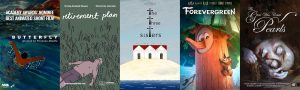
Butterfly (Florence Miailhe, France, 15 min.)
Butterfly tells the story of Alfred Nakache (1915-1983), a French Jewish swimmer originally from Algeria who went from being the pride of the nation to a concentration-camp prisoner during World War II. Sadly, he lost his wife and child in Auschwitz, though he himself survived to live and swim again. Through colorful visuals and effective sound design, director Florence Miailhe (The Crossing) follows Nakache’s tragic trajectory and ultimate survival, cutting back and forth through time and showcasing his many championships and records in both the butterfly and freestyle strokes. It’s at the same time sad and triumphant, and always engaging.
Retirement Plan (John Kelly, Ireland, 7 min.)
Wryly narrated by actor Domhnall Gleeson (The Incomer), Retirement Plan is the shortest film among the Oscar nominees, as well as a powerful meditation on aging and the acceleration of time in our final years. Indeed, life passes by more quickly than we think it will. Have thoughts on what you’d like to accomplish once you stop working? Don’t wait. Act now, before it’s too late. Fortunately, director John Kelly tells his story with a fine dose of humor as well as melancholy, so you’ll laugh even as you feel like crying.
The Three Sisters (Konstantin Bronzit, Israel/Cyprus/Russia, 14 min.)
Russian animator Konstantin Bronzit has been here twice before: in 2009, with Lavatory – Lovestory, and in 2016, with We Can’t Live Without Cosmos (a film I adore). His visual style appeals in its simple lines and expressive character faces, and his comedy is delightfully understated. The story follows three sisters who live on an isolated island, visited upon occasion by food vendors and the like. When they drop their money into the ocean, courtesy of some overly aggressive gulls, they are forced to rent one of their rowhouses, and the subsequent arrival of a male tenant completely changes the long-static dynamic of their lives. If not quite at the metaphysical level of the two animated shorts at the top of the list, it still thoroughly entertains.
Forevergreen (Nathan Engelhardt/Jeremy Spears, USA, 13 min.)
Were it not for my aversion to overt, heart-pulling sentiment, Forevergreen would rank higher. The tale of a baby bear who is saved, and then raised, by a sentient tree, the movie at times feels like a generic Disney cartoon yet nevertheless proves affecting in its ending moments.
The Girl Who Cried Pearls (Chris Lavis/Maciek Szczerbowski, Canada, 17 min.)
This is the only movie among the 15 that I actively disliked. If you want your animated characters to look like drugged-out marionettes and your narrative to lean into maudlin themes, then this is the movie for you. Only 17 minutes, it felt much longer. The story takes place in flashback as a grandfather explains to his granddaughter the origin of a pearl in his office. It turns out we were better off not knowing.
– Christopher Llewellyn Reed (@ChrisReedFilm)