



HAMMER TO NAIL’S BEST FILMS OF 2025
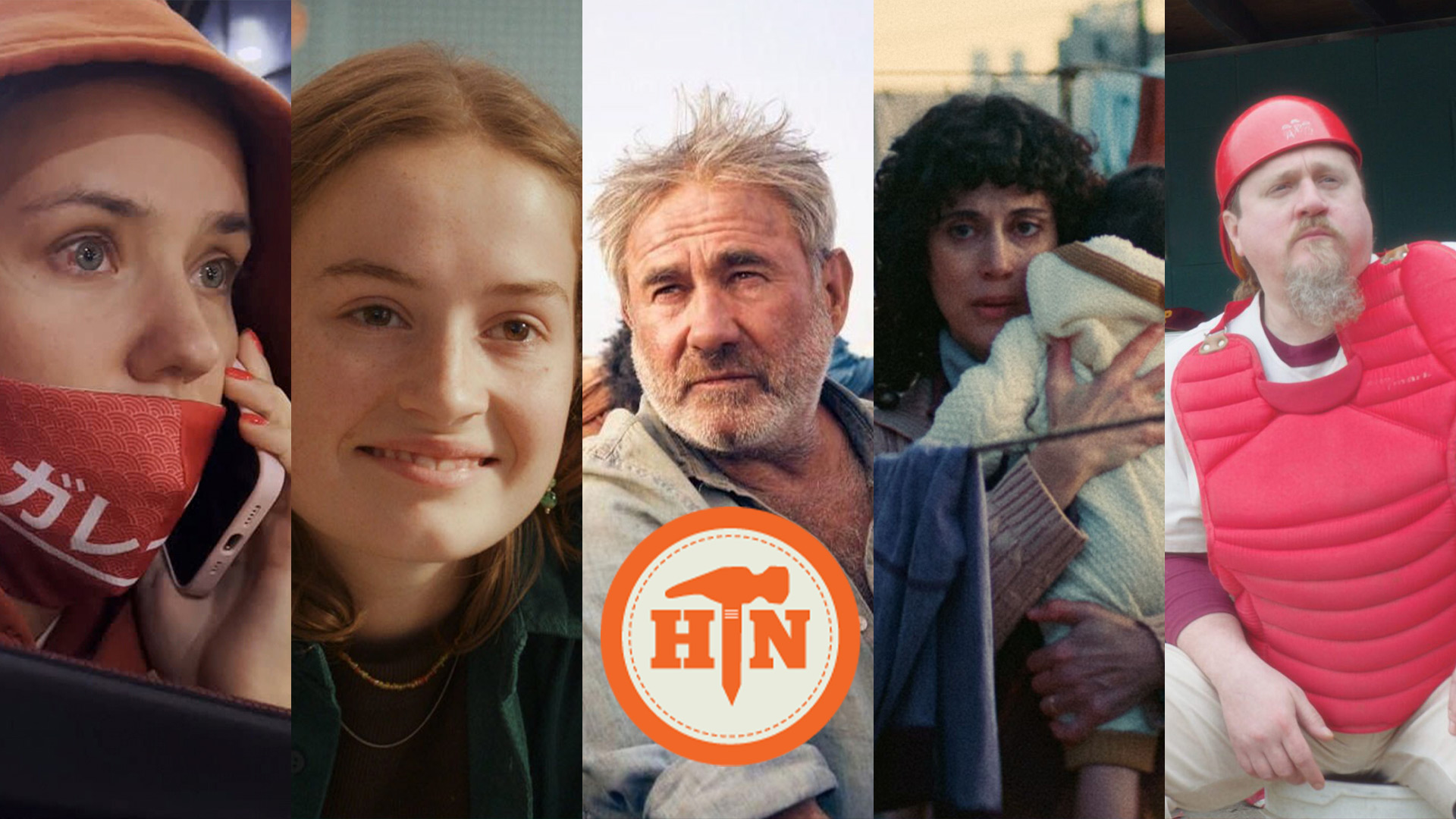
There has been no shortage of artistically strong films in 2025, which is why the critics at Hammer to Nail offer up such a great variety of titles in their respective Top 10 lists of the year. Our choices run the gamut from big studio fare like Ryan Coogler’s Sinners (a major blockbuster, marrying social commentary and wild entertainment in a thrilling mix) to more indie work released by streamers, such as Train Dreams, to documentaries that speak to the moment, among them Apocalypse in the Tropics, Cutting Through Rocks, and Holding Liat. Not all movies mentioned below have yet to come out for the general public, but everything saw some kind of screening, even if just at festivals, and should, before long, be available to all. If we have previously written a review, we link to it. In addition, each critic has written blurbs about films yet to be reviewed for the site. We hope you’ll find inspiration for future viewing, confirmation of your own preferences, or even, perhaps, a point of contention or two. We’re always here for the conversation.
Lead Critic Christopher Llewellyn Reed
NARRATIVE FICTION (in alphabetical order):
- All That’s Left of You
- Left-Handed Girl
- Little Amélie or the Character of Rain
- Nouvelle Vague
- Rebuilding
- Rental Family
- Sentimental Value
- Sinners
- Train Dreams
- The Voice of Hind Rajab
Left-Handed Girl (Shih-Ching Tsou)
First-time solo director Shih-Ching Tsou has been working with filmmaker Sean Baker since the early aughts, beginning with a movie they co-directed, the 2004 Take Out. After that, she produced his 2012 Starlet, 2015 Tangerine, 2016 short film Snowbird, 2017 The Florida Project, and 2021 Red Rocket. Making her debut behind the camera on her own, with Left-Handed Girl, Tsou nevertheless continues to partner with Baker, with whom she co-wrote the script. It is, as always, a winning creative collaboration. Set in Taipei, Taiwan, Left-Handed Girl centers on the small nuclear unit of mother Shu-Fen (Janel Tsai, Another Woman), teenage daughter I-Ann (Shih-Yuan Ma), and much younger baby sister I-Jing (Nina Ye). The trio move back to the capital after some alluded-to recent hardships, where Shu-Fen opens a noodle stand in a local night market. The storytelling and the performances (with Huang and Ye the standouts of the excellent ensemble), coupled with the simultaneously precise and loose cinematography, make the narrative come alive in ways both specific and universal. The result is a fresh take on the age-old exploration of family and relationships, moving to its core.
DOCUMENTARY (in alphabetical order):
- André Is an Idiot
- Backside
- Boorman and the Devil
- Coexistence, My Ass!
- Cutting Through Rocks
- Holding Liat
- Marlee Matlin: Not Alone Anymore
- Mr. Nobody Against Putin
- Natchez
- Teenage Wasteland
Boorman and the Devil (David Kittredge)
Of this I am certain: one need not be a fan of a movie to enjoy its making-of tale. Especially when that documentary is more than a compendium of trivia, becoming instead a rumination on art and its place in the world. Such is David Kittredge’s Boorman and the Devil, which chronicles the production of one of the worst films I have ever seen, John Boorman’s Exorcist II: The Heretic. Central to the narrative are the hopes and dreams of Boorman as he tackled a project in which he initially had no interest (he was not a fan of Friedkin’s original). Kittredge scores a coup with his primary interview, also adding stars Linda Blair and the late Louise Fletcher to the mix. Joining them is a vast ensemble of film critics and specialists, all weighing in with panache on the troubled history of the movie. Love or hate Exorcist II, the details of its origin prove fascinating, indeed.
Staff Writer Jessica Baxter
NARRATIVE FICTION (in order of preference):
- If I Had Legs I’d Kick You
- Sorry, Baby
- Die My Love
- The Phoenician Scheme
- Sentimental Value
- Sinners
- Bugonia
- Twinless
- Weapons
- One Battle After Another
If I Had Legs I’d Kick You (Mary Bronstein)
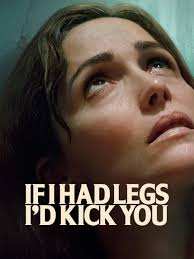 Mary Bronstein’s semi-autobiographical black comedy is Eraserhead from the mother’s perspective. Rose Byrne commands the screen as a therapist with an absent husband who must care for her sick child while her house literally collapses around her. Her frustration is palpable as she navigates a world seemingly designed to thwart her at every turn, whilst desperately clinging to some semblance of self in motherhood.
It perfectly encapsulates the feeling of being told moms are superheroes, but denying support and condemning them for having any desires outside of parenting. The viewing experience, for those in the know, is stressful, horrifying, gripping, cathartic, and uproariously funny.
DOCUMENTARY (in order of preference):
- Strange Journey: The Story of Rocky Horror
- Pee-Wee as Himself
- I Know Catherine, the Log Lad
- Goodbye Horses: The Many Lives of Q Lazzarus
- Pavements
- Natchez
- Cutting Through Rocks
- Ladies & Gentlemen: 50 Years of SNL Music
Goodbye Horses: The Many Lives of Q Lazzarus (Eva Aridjis Fuentes)
You probably know her haunting, evocative melody from Silence of the Lambs or Grand Theft Auto. But it’s only a small part of this big life that should have been so much bigger. This vibrant, charismatic woman with a powerful voice that transcended genre, was repeatedly and inexplicably shut out of the music business because she didn’t fit a “marketable” mold. Eva Aridjis Fuentes directs this lovingly curated depiction of a tremendously talented woman who languished in obscurity and hardship for most of her life, before becoming a senseless causality of American “healthcare.” It’s past time for the world to know and celebrate Q.
Staff Writer M.J. O’Toole
NARRATIVE FICTION (in order of preference):
- Resurrection
- Sirât
- Dreams (Sex Love)
- Train Dreams
- Peter Hujar’s Day
- Familiar Touch
- Eephus
- The Long Walk
- Rebuilding
- The Love That Remains
Honorable Mentions:
- Sentimental Value
- Sorry, Baby
- Caught by the Tides
- Highest 2 Lowest
- Eddington
Dreams (Sex Love) (Dag Johan Hagurud)
While Norwegian Oscar hopeful Sentimental Value is hot on the awards trail, another gem from that country came in the form of an emotionally deep and unexpectedly funny coming-of-age tale. Writer-director Dag Johan Hagurud completed his own Oslo Trilogy this year with Dreams. Preceded by his first two entries, Love and Sex, this serene drama made headlines earlier this year when it took home Berlinale’s prestigious Golden Bear award. Much of the film puts us in the shoes of teenage girl Johanne (Ella Øverbye in a stunning breakout performance) as she develops an intense crush on her French teacher Johanna (Selome Emnetu), and puts her feelings to paper with poetic elegance and dreamy narration. Johanne’s mother (Ane Dahl Torp) and feminist grandmother (Anne Marit Jacobsen) deliver a lot of hilarious back-and-forth as they try to support her the best way they can once her written words come to light. Heavy on dialogue, but no shortage of emotional profundity, there is much laughter and light to be found in Dreams, a must-watch for modern deep thinkers.
DOCUMENTARY (in order of preference):
- Mr. Nobody Against Putin
- BLKNWS: Terms & Conditions
- Zodiac Killer Project
- Cutting Through Rocks
- Come See Me in the Good Light
- Holding Liat
- Apocalypse in the Tropics
- Below the Clouds
- Prime Minister
- Coexistence, My Ass!
Below the Clouds (Gianfranco Rosi)
Known for his steady, yet unflinching gaze, master documentarian Gianfranco Rosi turns his lens on another part of his native Italy that’s haunted by the ghosts of its past. Below the Clouds is a stunningly shot portrait of Naples that captures the lives of its everyday people, captured over three years in crisp black-and-white cinematography. One piece of its history that looms in the distance is Mount Vesuvius, the very volcano that erupted and obliterated Pompeii in 79 A.D. Rosi shines a light on the archaeologists and curators discovering/restoring the scattered bones, as well as the overworked emergency call center operators, the weary firefighters, a dedicated tutor, and immigrant ship laborers coming from war-torn countries. Even when Naples is hit with its strongest earthquake in decades, these lives carry on, surrounded by the remains of history while going forward into an unknowable future. Rosi goes against what would be considered “touristy” to give us a hauntingly enthralling portrait of a city that puts the past and present side by side, to visually exquisite results.
Staff Writer Lauren Wissot
5 Most Under the Radar Cinematically Audacious Docs, 2025
Waking Hours focuses on a group of Afghan smugglers who’ve set up camp along the border between Serbia, Croatia and Hungary. Shot from a respectful distance in near-total darkness, and with the ambient sounds of the forest serving as soundtrack, Federico Cammarata and Filippo Foscarini’s feature debut forces us to adjust our eyes in order to see the shapes emerging from the blackness onscreen; and to witness a nocturnal existence in which time is suspended, the hushed tedium punctuated only by distant gunshots. In other words, to look and listen differently.
Aaron Brookner and Rodrigo Areias’s Nova ’78 centers around the Nova Convention, a late ’70s avant-garde extravaganza that took place at NYC’s now-defunct Entermedia Theater (Second Avenue and 12th Street) in honor of William S. Burroughs’s return to the U.S. after living more than 20 years abroad. (Footage of the three-day event — shot on 16mm by Howard Brookner, Tom DiCillo, and Jim Lebovitz with Brookner and Jim Jarmusch on sound — was only recently discovered in 2022.)
Arash T. Riahi and Verena Soltiz’s Girls & Gods is a stylishly crafted philosophical investigation that addresses an intriguing question both timely and timeless: Can feminism and religion coexist? The brainchild of Inna Shevchenko of the Ukrainian collective FEMEN, also credited as writer, the doc takes us on a whirlwind tour throughout Europe (and NYC) with Shevchenko serving as our inquisitive guide.
Angelo Madsen’s A Body to Live In is a doc as unconventional in form as its leading man. Comprised of various formats (16mm, VHS, archival, 2K) overlaid with underground voices (Annie Sprinkle and Ron Athey are probably the best known), the film takes us on a winding journey through the life and philosophy of photographer-performance artist-ritualist Fakir Musafar, one of the founders of the modern primitive movement.
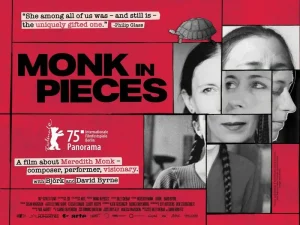
Billy Shebar’s Monk in Pieces stars Meredith Monk, an artist so singular as to be unclassifiable. Divided into discrete sections, the film makes ample use of Monk’s own vast archive and of the octogenarian herself, still working in the same Tribeca loft she’s had for over half a century. There’s a compelling dissonance between the audio and visual that renders Monk in Pieces nearly experimental. It’s a creative choice that deftly reflects Monk’s own approach to her iconoclastic art, forcing us to listen with a different ear, to look closer not away.
Editor at Large Matt Delman
NARRATIVE FICTION (in order of preference):
- Sirât
- Marty Supreme
- No Other Choice
- Resurrection
- Familiar Touch
- Sinners
- It Was Just an Accident
- Misericordia
- Twinless
- Eephus
Familiar Touch (Sarah Friedland)
In her breakout debut feature, Sarah Friedland explores dementia from the point of view of the patient. We see Ruth, an earth-shattering Kathleen Chalfant, rattle off the long list of ingredients for borscht with precision, but when it comes to her own son (H. Jon Benjamin) she has no memory. When she moves into the nursing home for the first time, she exclaims to the nurse, “I’m not the type of old person who needs help getting dressed.” The lyrical beauty of Ruth floating around a pool is juxtaposed by the harsh reality that ultimately we all will need someone to put our clothes on for us. A finalist of the Indie Film Site Network advocate award, Familiar Touch advocates for those with memory loss as well as the caretakers who often have their careers put at risk by unpredictable patients.
DOCUMENTARY (in alphabetical order):
- Coexistence, My Ass!
- Cutting Through Rocks
- Folktales
- Helen and the Bear
- Holding Liat
- The Librarians
- Listers: A Glimpse Into Extreme Birdwatching
- My Undesirable Friends
- The Perfect Neighbor
- Turbulence
Listers: A Glimpse Into Extreme Birdwatching (Owen and Quentin Reiser)
Released without fanfare on YouTube for free, Listers: A Glimpse Into Extreme Birdwatching has garnered 2.4M views in 4 months. At a full 2 hour runtime, this feature doc abounds with humor, insight, eccentric characters, and of course a ton of NatGeo-worthy bird footage. The filmmaker Owen Reiser and his brother Quentin take a gonzo approach to the birdwatching hobby, chasing what birders in the community call a ‘Big Year.’ Traveling around the country in his van, the film documents many of the rarer birds (Quentin spies over 500) and doubles as a road trip buddy comedy and a test of stamina. Reiser’s artistic ambitions shine through a blend of visual styles, elevating Listers from a basic YouTube video diary to an impressive piece of humanist and ornithological filmmaking.
Staff Writer Brandon Wilson
 Midpoint years are always my favorite in any decade, as it’s when a decade really comes into its own, having finally worked through the vestiges of the previous one—you truly don’t know what a decade is until its midpoint, and this decade has certainly been a ride. 2025 has been a remarkable year, so much so that I find myself less patient than usual with folks who engage in nostalgia for earlier decades; we can’t have another 1975, and that’s not on today’s filmmakers, but rather a different world with very different attitudes toward film.
This year, filmmakers heeded the call to arms created by the rise of authoritarianism here and abroad, and an audience showed up to hear what they had to say. This year was also an absolute watershed for film formats: what began with The Brutalist one year ago has now exploded, and not since the 1960s have so many filmmakers taken advantage of premium formats like VistaVision and 70mm. Two films by Warner Bros.—a studio that has had a frankly amazing year, and it’s fitting that the industry itself is now poised to destroy it—sent audiences flocking to IMAX screens throughout the year, and again, the audience seems hungry for this. We even had a fall film remind us that while celluloid is vital to the medium, shooting digitally can also create beautiful, breathtaking images. This is shaping up to be the greatest film decade of the new century, and I am optimistic, for once, that this trend is not going to end in 2026.
- One Battle After Another
- Sinners
- The Secret Agent
- It Was Just An Accident
- Frankenstein
- My Undesirable Friends – Part I: Last Air in Moscow
- Sentimental Value
- Merrily We Roll Along
- The Testament of Ann Lee
- The Perfect Neighbor
Honorable Mentions: The Phoenician Scheme, Afternoons of Solitude, Dracula, Pee-Wee as Himself, Sorry, Baby, Black Bag, Splitsville, The Encampments, Highest 2 Lowest, Misericordia
Staff Writer Jonathan Marlow
NARRATIVE FICTION (in alphabetical order):
- Angel’s Egg
- Careless Passage
- Caught by the Tides
- Doors
- The Ice Tower
- Invention
- Kontinental ‘25
- Miséricorde
- Reflection in a Dead Diamond
- Sanatorium Under the Sign of the Hourglass
Honorable Mentions:
- The Love That Remains
- Marty Supreme
- The Mastermind
- Merrily We Roll Along
- Mickey 17
- No Other Choice
- Nouvelle Vague
- Peter Hujar’s Day
- Predator: Badlands
- Resurrection
- The Secret Agent
- Sentimental Value
- Sinners
- Sirât
- Sorry, Baby
- Swim to Me
- Train Dreams
- Weapons
- Where to Land
Animated Honorable Mentions:
- Demon Slayer: Kimetsu no Yaiba Infinity Castle
- Killer of Killers (second sequence + conclusion)
- Little Amélie or the Character of Rain
- Doors (2022)
Albeit a mid-pandemic creation initially unleashed in London, Doors received its U.S. theatrical premiere in two venues—the Brooklyn Museum and the Institute of Contemporary Art | Boston—in June and September of this year, respectively (where it will continue its daily exhibitions until [for both venues] mid-April 2026, making it the longest-running release of 2025). While its ambitiousness is eclipsed by his similarly-themed The Clock (2010) or the even-earlier Telephones (1995), San Rafael-born / London-based Swiss-American musician/filmmaker Christian Marclay has reinvented a wheel of his own creation, in part from his relatively uncharacteristic (thus far) willingness to repeat object-oriented scenes and sequences for effect, complicating the persistent perception of beginnings or ending as the loop evolves. Which is to note that there are no introductions nor conclusions, merely the passage from one opening door and another, closing. The picture-quality varies indiscriminately (even for material where superior sources exist) with its evident over-reliance on films made in the U.S. and France—not that there is anything particularly problematic with its featuring of familiar faces, along with a handful of noteworthy occasional exceptions—over its roughly one-hour duration. Like The Clock, your perception of the passage of time erodes.
Unlike The Clock, you’re not reminded to it every passing moment. Instead. there is a rhythm to the proceedings that settles into an immersive and immensely pleasurable routine. Mia Farrow’s eye at the keyhole in Rosemary’s Baby begets a mad pursuit of Audrey Hepburn from Funny Face, imprecisely, with some embellishment added by whichever prior associations the viewer brings to these juxtapositions. Arguably, this approach is the closest of Marclay’s reconstituted visual-assemblages to his assorted turntable creations. An idyllic intersection! See also (in similar magnitudes of greatness): fellow expat / assembleur Mark Rappaport; animator Kelly Sears; found-footage maestro Craig Baldwin, et alia.
DOCUMENTARY (in alphabetical order):
- Afternoons of Solitude
- Architecton
- Being Blue
- Blknws: Terms & Conditions
- Cover-Up
- Every Contact Leaves a Trace
- It’s Never Over, Jeff Buckley
- La Jetée: The Fifth Shot
- My Mom Jayne
- My Undesirable Friends I: Last Air in Moscow
- Pee-wee as Himself
- Shifty
- Suburban Fury
- Videoheaven
- Zodiac Killer Project
Staff Writer Jack Schenker
NARRATIVE FICTION (in order of preference):
- One Battle After Another
- Marty Supreme
- Sentimental Value
- April
- Resurrection
- Sirât
- Magellan
- If I Had Legs I’d Kick You
- Friendship
- Eddington
Honorable Mentions:
- My Undesirable Friends
- Sound of Falling
- 28 Years Later
- Sorry, Baby
- No Other Choice
- Weapons
- Sinners
- The Shrouds
- Mickey 17
- The Secret Agent
- Lurker
One Battle After Another (Paul Thomas Anderson)
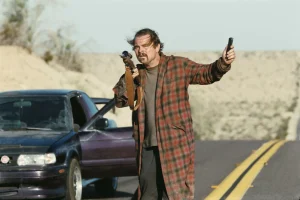
What does it feel like to be alive right now? Anxious, absurd, like you’re speeding toward something you can’t see while the people in charge get dumber and meaner by the day. PTA’s second film set in the present tense nails that sensation better than anything I’ve seen. It’s a paranoid comedy-thriller that never stops moving, structured so well that there isn’t a single moment you could cut.
Leonardo DiCaprio gives maybe the best performance of his career as a former radical turned bathrobe-wearing burnout dad, and it may not even be the best performance in the film. Teyana Taylor only gets the first act, but her presence haunts every frame after. The ferocity she brings in those opening sequences is essential, and this movie simply does not work without her. Sean Penn is doing something genuinely unhinged as Colonel Lockjaw, both cartoonishly grotesque and legitimately terrifying. The way he walks will forever be ingrained in my memory. Benicio del Toro is instantly iconic as Sensei. His calming presence cuts through the film’s high-strung nature beautifully. Chase Infiniti is a movie star.
Jonny Greenwood’s score ranges from emotionally resonant to completely bonkers. That highway car chase in IMAX 70mm is one of the most overwhelming things I’ve ever experienced in a theater. I knew exactly what would happen the second time I saw the film, and my heart was still in my throat. What elevates this into masterpiece territory isn’t just the spectacle, performances, or humor; it’s the tenderness underneath it all. Bob (DiCaprio) sees his daughter (Infinity) as something he needs to protect when she’s actually living proof that the fight was worth it and will continue. Perfect.
Eddington (Ari Aster)
Five years of everyone screaming past each other, and this is the first film that actually gets at why. Aster isn’t interested in picking sides, he’s interested in how we got to a place where sides are all that’s left. This isn’t nostalgia bait, although there are a few silly gags about spacing and masks, its an autopsy of how Covid, echo chambers, and algorithms has polarized society beyond the point of return.
Yes this is a “COVID” movie, but it’s even more relevant today. Joaquin Phoenix gives one of his best performances here. His Joe is pathetic and willfully blind to his town’s problems, but there’s something in the performance that makes you see him as a casualty rather than a cause. Pedro Pascal’s mayor isn’t a villain, he’s a true believer in systems, technology, and rules. He can’t fathom why following the playbook isn’t working. Emma Stone disappears into her online rabbit holes because the algorithm found her wound and keeps pressing on it. Austin Butler shows up as this soft-voiced cult troll telling people their rage is justified. None of these people can talk to each other because they’re not even describing the same world when they open their mouths.
Aster is at the peak of his powers here. The camera moves beautifully and with such confidence. A showdown scored to Katy Perry’s Fireworks is one of my favorite moments of the year, and those sniper sequences might be some of the best stuff Aster has shot. By the end, you’re watching a Western where nobody rides off into the sunset because there’s no shared horizon left to ride toward. The algorithm won. Pure hysteria. This is what’s left. I forgot to mention that it does this in a hilarious and entertaining fashion reminiscent of No Country for Old Men. I look forward to returning to this one as I have with all of Aster’s work. One of the best films of the year from one of our best filmmakers. A24, keep letting him do whatever he wants.
– Hammer to Nail Staff