

A Conversation with Toni Servillo (LA GRAZIA)
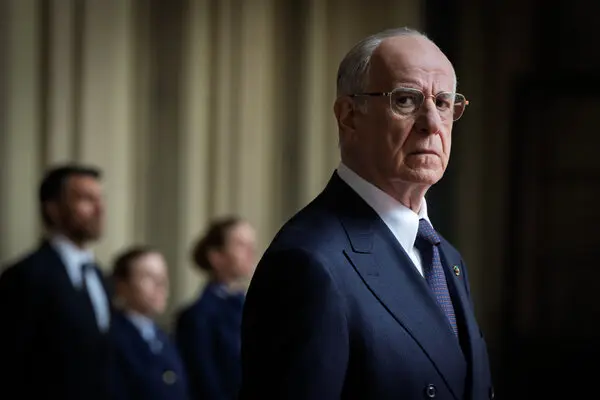
Few actor-director partnerships in contemporary cinema have proven as fruitful, or as essential as the collaboration between Toni Servillo and Paolo Sorrentino. Since their first meeting on the set of One Man Up in 2001, the Naples-born actor and filmmaker have forged a creative symbiosis that spans eight features. Servillo, who co-founded Teatro Studio di Caserta in 1977 and remains one of Italy’s most celebrated stage actors, brings to Sorrentino’s films a precision and emotional depth that grounds the director’s baroque visual excess. Their breakout collaboration came with Il Divo (2008), Sorrentino’s hallucinatory portrait of seven-time Prime Minister Giulio Andreotti, which won the Jury Prize at Cannes and earned Servillo both the European Film Award and David di Donatello for Best Actor. The role announced Servillo as one of the great character actors of his generation.. He repeated this European Film Award triumph in 2013 with The Great Beauty, Sorrentino’s Oscar-winning meditation on Roman excess, where Servillo’s world-weary journalist Jep Gambardella became an instant icon and is one of the coolest characters in cinema history.Toni was named by The New York Times as one of the 25 Greatest Actors of the 21st Century in 2020.
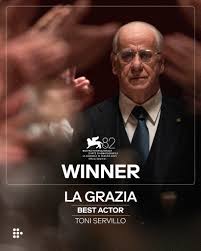
In La Grazia, Servillo delivers what may be his most restrained performance yet—a departure that earned him the best actor prize at the 2025 Venice Film Festival. As Mariano De Santis, a fictional President of the Italian Republic in the final months of his term, Servillo embodies a man nicknamed “Reinforced Concrete” for his unshakeable composure, who is haunted by his wife Aurora’s decades-old infidelity and paralyzed by two clemency petitions that force him to confront his own moral principles. The film, Sorrentino’s most sober work, finds the director and his longtime collaborator exploring the solitude of power, the burden of responsibility, and the human fragility that hides beneath institutional authority. Gone are the surreal flourishes and Fellini-esque set pieces that defined their previous collaborations; in their place, Sorrentino adopts a more classical approach, confining much of the action to the corridors and cavernous rooms of the Quirinale Palace. In these massive spaces, Servillo’s president wrestles with his own conscience and mortality. The past threatens to unravel his carefully maintained composure. It’s a performance built on withheld emotion and micro-expressions. It was an honor to speak with him in the following conversation edited for length and clarity.
Hammer to Nail: Sorrentino himself has said that this is his most sober and mature film, and he’s called it almost a form of self-denial after the excess of Parthenope. What was the atmosphere on set like compared to previous Sorrentino films? Was there a stark difference that you noticed?
Toni Servillo: I don’t think that Paolo is denying himself with this film. In fact, if you look at his first and second films, there are very many traits that are quite common to this last film as well.
I’d like you to know, and this is something that probably is not common knowledge, that this film was written three years before Parthenope. Why he did Parthenope first and then this, you have to ask him. But here he chose a sober, essential style because he realized that he had a script in his hands that dealt with very important topics and characters with a very deep psychological aspect. So he simply decided to adopt a sober style that caressed the characters and put them right in the heart of the spectator.
I’m realizing in these first interviews for the film that this is a character that actually does conquer the viewer’s heart. The story imposes a certain type of register. This happens in the biography of many great directors. If you take Martin Scorsese, for example, if you watch Goodfellas and then you watch The Age of Innocence with Daniel Day-Lewis, you realize that you’re looking at two very different films.
HTN: I think that location definitely imposes a lot on this film. Watching you inhabit these massive spaces alone in silence is part of the emotional core. Can you talk about shooting in these locations and how that impacted your performance?
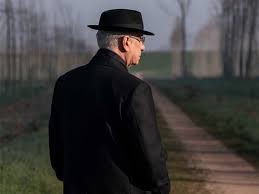
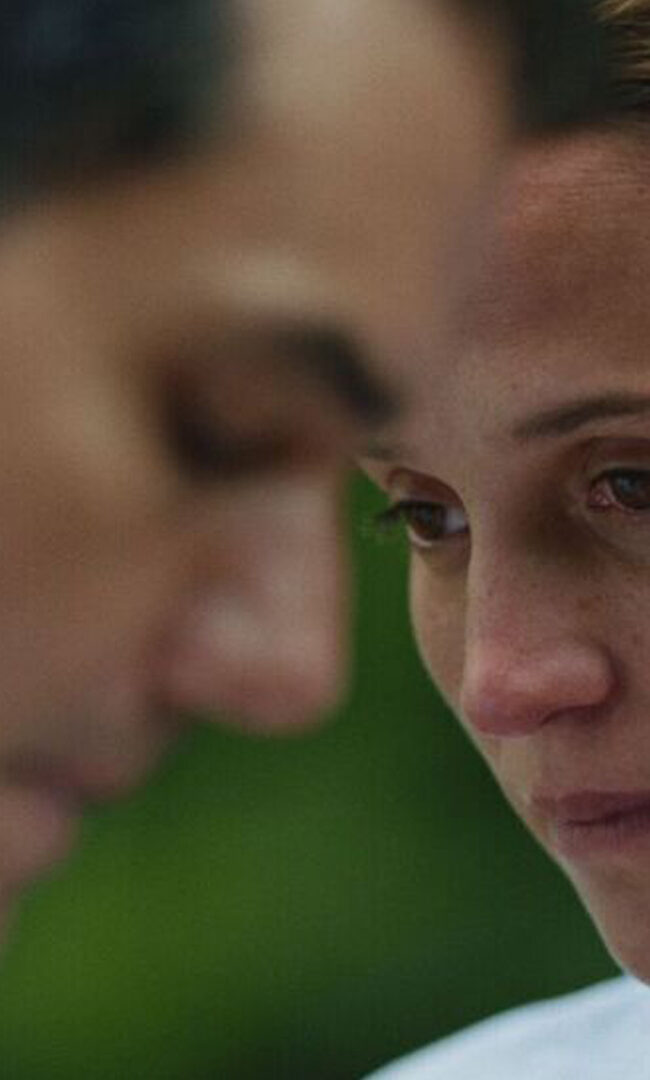
Toni Servillo in LA GRAZIA
TS: This is an important aspect because men of power many times have to live in solitude. I think that this was made evident by the fact that he was in these massive spaces. This man is so against and is so allergic to being a showman, to being on the stage. He’s sacrificing his life, his personal life, to be able to provide service.
HTN: At the 35-minute mark, there’s an amazing silent moment from your character that I really adored. It’s you at Aurora’s funeral, looking around, sensing that Aurora’s lover was there in the flesh. Without saying a word, you’re able to communicate so much with your facial expressions and body language. Talk about what was important to you in that small but crucial moment.
TS: You see here that he is a very fragile man. He has this great fragility that contradicts the nickname that everyone gives him, Reinforced Concrete or Solid Cement. He’s at his wife’s funeral, in this circumstance in which he should show his humanity, his love for her, but at the same time, he’s thinking of his best friend and he’s identifying him as the traitor.
HTN: At the 56-minute mark we have probably the most explosive moment from your character as he screams at Coco to confess who Aurora’s lover was. She stands her ground and yells back at him, which really seems to shock your character, and you say to her, “You cannot speak to the president like that,” but in a very defeated way. Again, just what was important to you in this sequence?
TS: You are right to say he seems defeated. Before tackling the scene, of course, this is something that we study. We look at the screenplay and we discuss it with the director. We study it very closely. Then what I tried to achieve was a balance between his official responsibilities as a president and, at the same time, his human fragility.
HTN: At the hour and six-minute mark, there’s this confrontation in front of the dead horse, Elvis, between you and your daughter. She says she’s going to Montreal without you and you take it personally. A lot of things come to surface here as you say, “[you] don’t know who [she] is,” and she says, “all you’ve ever needed is more time to reflect.” This leads into you admitting that your wife cheated and then you curse for what is seemingly the first time you’ve sworn in forever. Talk about that moment.
TS: I want to congratulate you because you really found and pinpointed the scenes in which this character shows his fragility. This is one of the most difficult scenes because it encompasses so many different angles and different aspects.
There he is in front of the horse that is about to pass away. The horse is suffering. He realizes that his daughter is leaving, and he has to make this decision on whether he is going to sign the bill that is going to allow Italians to have euthanasia.
At the same time, there’s this irony. He has his feelings for his daughter, who’s leaving. Both of them, in spite of their love for each other, they’re facing each other as jurists. They are rational. He’s thinking about euthanasia, and then he’s thinking about how he was betrayed by his wife, he says “Your mom betrayed me.” But his daughter replies as a jurist: “Well, Dad, even if that happened, there’s a statute of limitations, so there’s nothing you can do about it.”
HTN: At the hour and 16-minute mark, we have this great sequence at the dinner with the singalong. The Alpine troops start it off and you continue the song. When everyone joins in, you seem to fade out. Your facial expressions here give off a great ambivalence. What was your thinking?
TS: This is a man that is so anchored in tradition. As president of the Italian Republic, he is the head of the military in Italy. So he becomes very touched, he’s very moved by these songs, by these older men that are singing. Why? Because he is so steeped in tradition. But at the same time, he also realizes that he’s going back into the past. What he needs to do is to be courageous, brave, and open himself up to the future.
HTN: The last sequence I want to talk to you about is at the hour and 30-minute mark, this great conversation between you and the man who killed his wife with Alzheimer’s. Lines like “For me, love is a celebration of life” and the exchange, “Why would you let yourself die?” “Because I only want to forget, to become light again”—has really stuck with me. Your character is more cold and calculated at this moment. What was your thinking? What was important to you?
TS: What I had to do here is show that this is a man who used to be a judge, a magistrate, and he has not exercised his profession in many, many years. However, he also understands that he has to do this human gesture of going to see and to look in the face of this man that killed his wife.
By doing that, he’s putting on his magistrate hat, but at the same time, he’s also putting on his human hat. He realizes that this man is not telling him the truth. This is what he has to convey in this scene.
HTN: Smoking is obviously a very important element of your character. The way he smokes is very different. It’s as if every cigarette is his last. He really savors them, taking long, deep drags. Can you talk about smoking in this film and the discussions you had with Paolo about how your character would smoke?
TS: We had to show the viewer that he was being naughty. He knew he was not supposed to smoke because he has only one lung. He had to hide. He was doing this when no one was watching, or at least when only his guard was watching him. We had to make him even more human because of this, and that’s why he would inhale with such energy.