





LITTLE TROUBLE GIRLS
(Check out Chris Reed’s Little Trouble Girls movie review, it’s in theaters now. Seen it? Join the conversation with HtN on our Letterboxd Page.)
“If you want me to/I will be the one/That is always good/And you’ll love me, too/But you’ll never know/What I feel inside/That I’m really bad/Little trouble girl.” So begins the 1996 single “Little Trouble Girl,” by Sonic Youth, from which Slovenian director Urska Djukic takes the title of her feature debut, Little Trouble Girls, and which plays over the end credits. A coming-of-age tale wrestling with the usual sexual confusion of teenagers, Djukic’s movie captures the heightened emotions and desires of its subjects in precise compositions that sharpen the immediacy of pubescent isolation. It’s a time of life where we push against boundaries while also succumbing to conformity, everyone a rebel and a follower all at once.
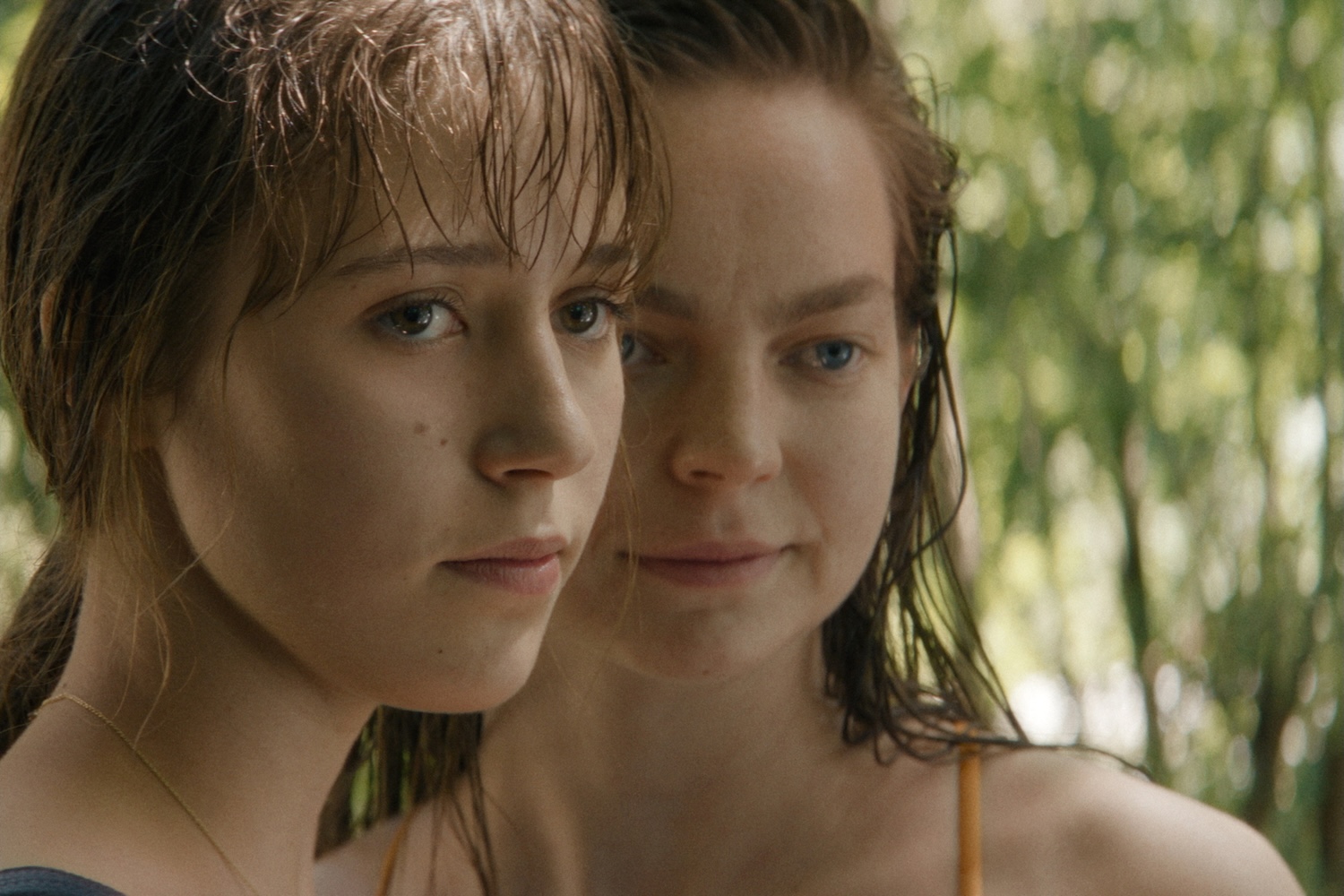
Lucija (Jara Sofija Ostan) is 16 and has yet to menstruate (as we learn) and is very sheltered. Her mother is so strict that she is not supposed to wear lipstick, even when at rehearsal for the Catholic all-girls chorus in which she sings. Still, mom is not opposed to the choir and has no apparent objections to the upcoming three-day trip to a convent in Cividale del Friuli, in Italy, for rehearsals and then a concert.
Lucija appears a bit infatuated with an older girl, Ana-Marija (Mina Svajger), who takes her under her wing. By the time they get to Italy, they are fast friends, sharing secrets and spying together on the hunky construction workers repairing parts of the convent. In alternatingly languorous and quick montages, we jump to Lucija’s fevered flights of fancy, shots of bees pollinating flowers juxtaposed with less metaphorical, decidedly more concrete imagery. Is it the muscled man restoring stonework in the garden or Ana-Marija who attracts her, or both? Perhaps it’s God or the Virgin Mary, instead. She is definitely torn between the carnal and divine, the two strains of thought coming together in her dreams.
As the narrative progresses, Djukic layers visual details in simultaneously simple and complex mixes, evoking the innocence of youth and blossoming of identity, a process that all human beings go through that nevertheless feels unique to the individual who is in the middle of it. Adding to Lucija’s anxiety are the actions of one very bad (or at least very weak) adult, even as the convent’s Mother Superior proves kind. There’s nothing worse, as a young person, than trusting a mentor who is not worthy of the trust.
The beauty of Little Trouble Girls is, in fact, its beauty. Cinematographer Lev Predan Kowarski elevates the ordinary problems of adolescence to the level of high art through his meticulous frames, and editor Vladimir Gojun then cuts them together in ways redolent with meaning. Like a butterfly from its chrysalis, Lucija is about to break free, her burgeoning sense of self a trouble to some, but otherwise a cause for celebration.
– Christopher Llewellyn Reed (@ChrisReedFilm)
Kino Lorber; Urska Djukic; Little Trouble Girls movie review