


A Conversation with Hélène Cattet and Bruno Forzani (REFLECTION IN A DEAD DIAMOND)
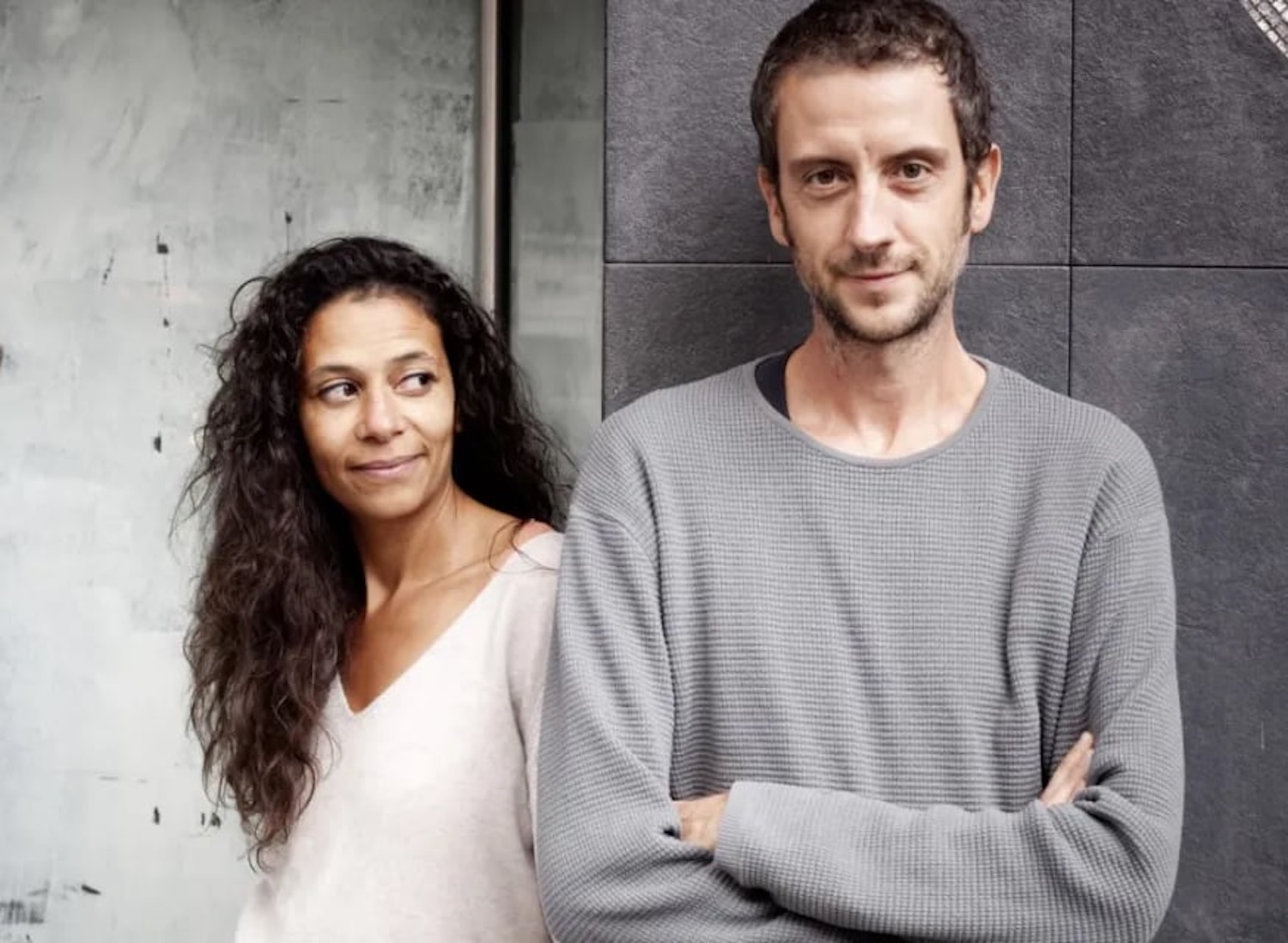
Married directors Hélène Cattet and Bruno Forzani (Let the Corpses Tan) are out with a new film, Reflection in a Dead Diamond (which I recently reviewed), which offers espionage and visual delights aplenty. Featuring actors Fabio Testi and Yannick Renier as the old and young versions of a very Sean Connery-like spy, the movie is an homage to not only the Bond universe but the campy Eurospy movement of the 1960s, as well. I recently had the chance to speak with Cattet and Forzani by Zoom. Our conversation took place in both French (their native language) and English, and what follows is my best attempt to reconcile the two linguistic threads into one coherent interview, edited for length and clarity.
Hammer to Nail: I understand from the press notes that your journey to making this film begins with your viewing of Monte Hellman’s 2010 Road to Nowhere. Please explain.
Bruno Forzani: We saw the film at a festival in Brussels. It was a friend of ours who told us to watch the film. At that time, we didn’t know the movies of Monte Hellman, and there was a retrospective, which is how we discovered his amazing work. When we watched Road to Nowhere, there in the movie was Fabio Testi. We hadn’t seen him on the screen in a long time; we knew him from the 1960s and ‘70s, and when we saw him in this film, he looked like Sean Connery—an old Sean Connery—and he was dressed in white with a Panama hat, like Dirk Bogarde in Death in Venice. And when the lights came on after the screening, we thought, “It would be great to do Death in Venice with James Bond.” And that was how it started. (laughs)
HtN: I love it! And indeed, as soon as I saw him on screen, I thought, “He looks like an older Sean Connery.” (laughs) And the young actor, too, Yannick Renier, could pass for a combination of the different Bond actors, in many ways. So, your film has so many allusions to spy thrillers—both Bond and Eurospy movies—all of which are paid homage to here with great panache. And then you also have a recurring reference to Jean-Jacques Beineix’s 1981 Diva, with that aria from Catalini’s La Wally and the blue dress. Where did that come from?
BF: (laughs) For me, Diva is the movie that made me discover opera when I was a kid.
HtN: (gestures in affirmation)
BF: You, too? OK! This music was the first opera I heard and the most beautiful.
HtN: I’ve actually never seen any of the 1960s/1970s Eurospy films, although I have seen spoofs of them starring Jean Dujardin as Agent OSS 117. Which one, or which ones, would you recommend watching?
Hélène Cattet: Operation Frere Jumeau is the title of one in French.
BF: It’s “Kid Brother” in English.
HC: So Operation Kid Brother, also called “OK Connery,” with the brother of Sean Connery, Neil Connery. (laughs)
HtN: And what is it about that film that makes you recommend it?
HC: It was one of the best. To be honest, Eurospies are a bit cheap but with a really fun, psychedelic, pop vibe—which was perfect for our subject—but they are not the most creative movies of that time.

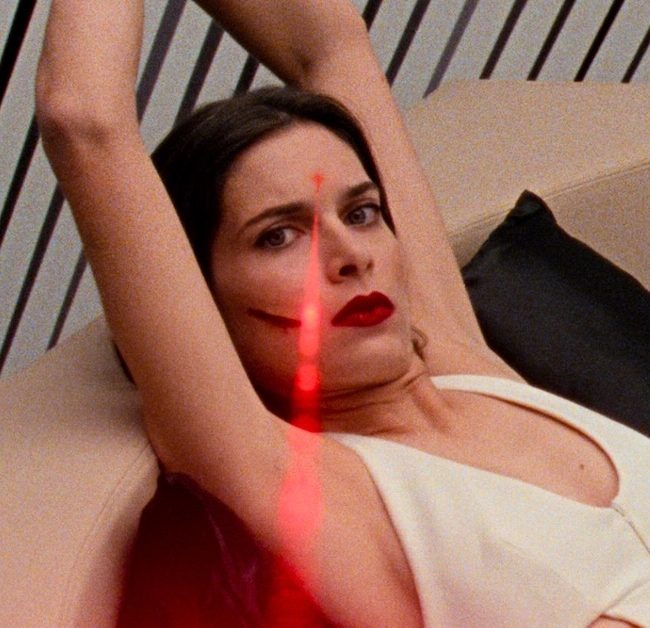
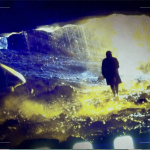
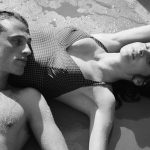
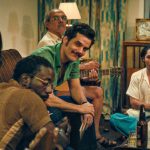
A still from REFLECTION IN A DEAD DIAMOND
BF: If you know Italian Westerns or giallo, it’s all about the mise-en-scène, with amazing sequences. In Eurospy, there’s a general feel to the overall genre, but there is no one amazing sequence or thing like that. But this one is very well-made, set on the French Riviera, with funny gadgets. The fact that there is the brother of Sean Connery … sometimes you go, “Oh, it looks like Sean Connery,” but no, it’s not. And it’s very funny. The costume design is also very pop and psychedelic. And there is another one, not from Europe but Japan, called …
HC: “Les Tueuses en collants noirs.” Black Tights Killers.
BF: This one is very well-edited with a real mise-en-scène sequence. This one is very good.
HtN: Thank you very much for those recommendations. Do you have a favorite actual Bond film?
BF: For me, it’s Never Say Never Again, because it was shot in the town where I grew up, Menton, on the French Riviera. And to see, in your everyday life, James Bond coming with all the stunts and things like that, it was a very magical moment. And it was the first James Bond I saw in a theater and it was a real event for the area.
HtN: And how about you, Hélène? Do you have a favorite?
HC: No, not really. To be really honest, I have a terrible memory and I mix up everything. One may think that’s not a good thing, but in the end it is a good thing, because my bad memory makes me very creative. I can’t remember movies and I am very inspired by that.
BF: (laughs) By your bad memories?
HC: (laughs) Yes! And sometimes I tell myself when I am writing something that I can’t do that because it’s the same as in another film, but then when I watch that other film, it is nothing like that. So it’s very good for me to have such a bad memory. In terms of James Bond, I guess I like the first ones, because they had those gadgets which were so perfectly crafted and funny and absurd.
HtN: The best line is in Goldfinger, when Sean Connery responds to Q, who has just shown him the ejector seat, with “You’re joking.” That expresses the ridiculousness of all the gadgets in those Connery films. Now, again in your press notes, you talk about the influence of OpArt on the visual design of the film. You’ve worked with your cinematographer, Manuel Dacosse, on other projects. What kinds of things did you talk about with him to create your extremely evocative visuals for this film?
HC: We have worked with Manu since our second short film.
BF: So, 24 years.
HC: Yes. And now we can communicate really easily, which is a good first step in our collaboration.
BF: It was more in the set design that we used all this OpArt aspect. Based on the elements created in the set design, we based the construction of the film around that.
HC: But this time, there was a lot of reflection and flashes of light, which made things different.
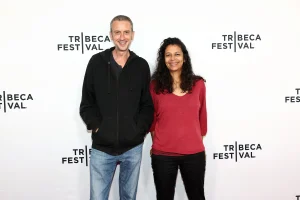
Bruno Forzani & Hélène Cattet
HtN: Because you have the diamond, which is constantly exploding in light. So, your production designer was Laurie Colson. How did you work with her to create this design?
HC: Through special props and sets to help with the lighting.
BF: And with the costumes, like the Paco Rabanne dress, which was one element. When Manu lit it, it gave off all this craziness.
HC: But in fact, all our intentions are built into the script. So Manu and Laurie know the direction we want to go in and they worked a lot together.
HtN: What was your intent with the rapid switches between languages? You also have your older Bond speaking French with an Italian accent and the younger Bond speaking French like a native. So you have all this linguistic back and forth. What were you doing there?
BF: One theme of the film is about the loss of identity of our character. Who is he? We used two aspects of the industry to tell this story. One is the Bond casting, with the changing series of actors, and the other is the language. In Italy, when they shot all these B movies in the ‘60s, there wasn’t direct sound and they were always dubbed. So we used that fact to tell that part of the story about our guy.
HtN: Let’s talk about the casting. You see Fabio Testi in Road to Nowhere and you want him in your film. How did you choose Yannick Renier?
BF: For Yannick, it was a challenge, because it’s easy to imagine an American or English actor in that kind of role, but in Belgium we are not used to that kind of cinema. So to imagine someone like that—a Belgian actor, a French actor—it was more complicated. And when we met Yannick, we did some tests, and he was really perfect in terms of how we like to work with actors; we were on the same wavelength. But he lacked the physicality of James Bond.
HC: He was really thin, because he was playing a role where he was sick and dying, so he was really, really, really thin (holds up pinky for emphasis). And we told ourselves, “Oh la la …. “
BF: Impossible. But he said …
HC: But he said that he could add some …
BF: … muscles (pumps his arm).
HC: Yeah, 10 kilos of muscles in 4 months. And we trusted him. And it worked out! (laughs)
BF: Voilà!
HtN: Yeah, he’s built in your movie. (laughs) Well, thank you so much for chatting with me.
HC/BF: Thank you so much!
– Christopher Llewellyn Reed (@ChrisReedFilm)