



A Conversation with Fergus Campbell & Elsie Fisher (SPARKS)
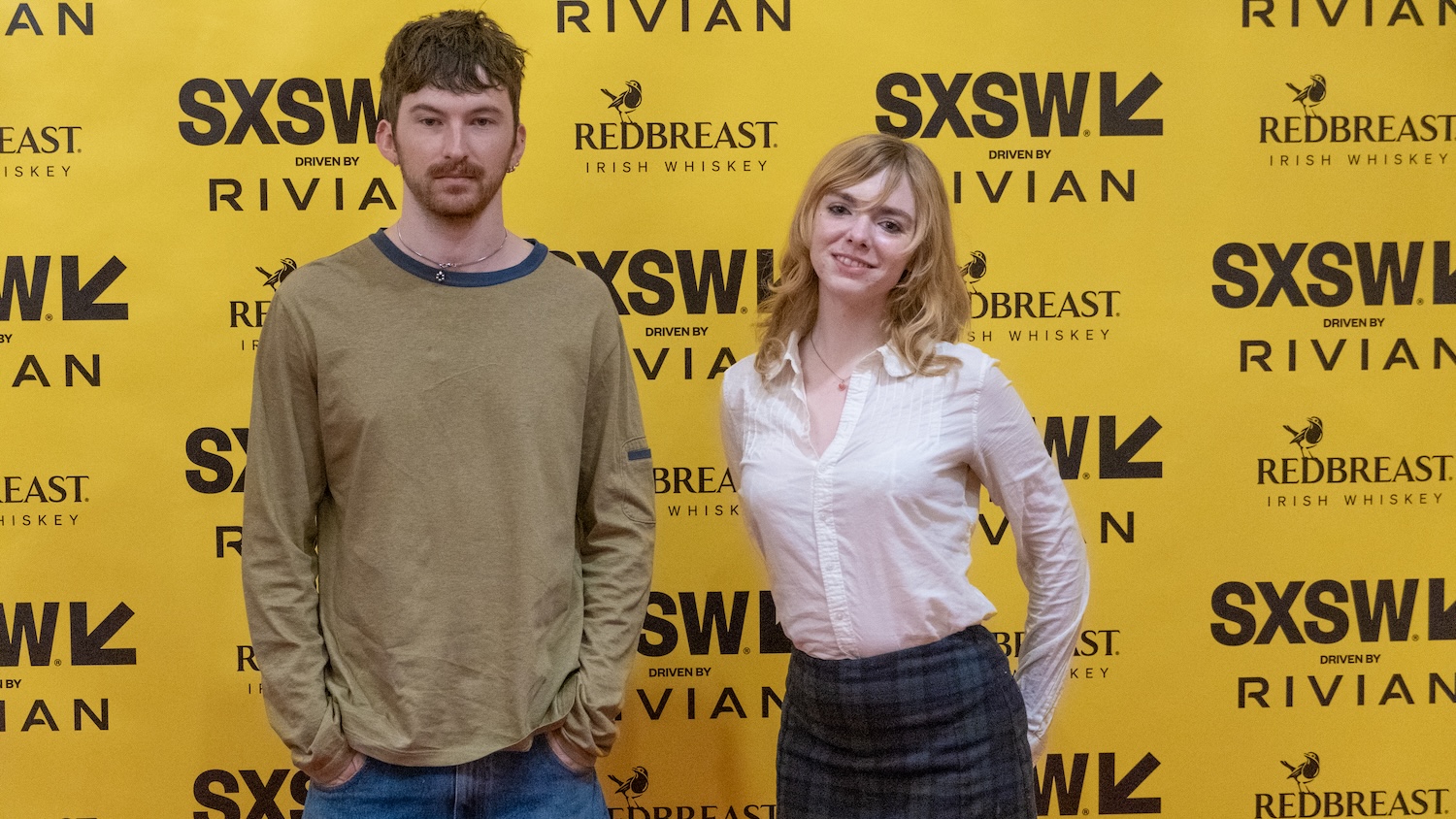
Director Fergus Campbell just premiered Sparks, his debut feature film, at the 2026 SXSW Film & TV Festival (where I reviewed it). The movie stars Elsie Fisher (Eighth Grade) as Cleo, a young woman out of time and out of place. Obsessed with the French New Wave (particularly Jean-Luc Godard), she will do anything to get out of Sparks, Nevada, even if it means leaping into a literal void that may just be a time-travel vortex. She meets a fellow group of misfits in the area and soon all of them are sharing their own dreams about where to go and what to do in their era and location of choice. For Cleo, it would definitely be 1960s Paris. Made on a limited budget but with excellent technical elements and great performances, Sparks shines brightly throughout. I spoke with both Campbell and Fisher at the festival, and here is that conversation, edited for length and clarity.
Hammer to Nail: Before we talk about the specifics of your story, I want to know if going into this film you were both fans of the French New Wave.
Fergus Campbell: Definitely. I think there’s an element of the character’s obsessions, which has to do with picking a director who you’ve heard is kind of the top guy and then choosing him because of his reputation rather than because of the fact that you’ve seen his movies. I feel like that’s a theme that I like exploring: when do we pick our idols because we feel pressured to do that or we feel like people will react well if we pick them that way? But yeah, I’m obsessed with Godard’s New Wave films. And I wanted to keep it narrow because New Wave is obviously a huge movement and there are a lot of instances in the film of either recreating or channeling very specific beats and details in Godard films and I feel like if the mandate had been to go even broader, we would have lost focus, which we were already constantly on the verge of doing.
HtN: And yet you named the main character that Elsie plays “Cleo,” which references Agnès Varda.
FC: Yes. I don’t want to spoil the film, but there’s a line that Cleo has where she says that Varda doesn’t know her, which is kind of a joke. And I think that gets to the fact that Cleo is a very fated character. She discovers things and then acts on a sense of destiny. Cleo being her name had more to do with destiny than with paying tribute to the Varda film.
HtN: Understood. How about you, Elsie? How much of a fan of the French New Wave were you before making this movie?
Elsie Fisher: Well, Godard reinvented cinema. I think we’re all independent filmmakers and I think that sort of guerrilla-style of shooting really opened doors for people to have these really complex and nuanced conversations about topics that are all actually quite dear to us. But we’re still having fun and doing it for like no money and just cranking them out in this kind of Corman-esque way, to just get the movies out and get people to see these movies. They’re huge. I mean, a little pretentious, but I like them.
HtN: Have either of you seen Richard Linklater’s film Nouvelle Vague from last year, which is about the making of Breathless?
FC: I have.
EF: No, I have not seen it yet.
HtN: I recommend it, especially in light of this film.
FC: I like Nouvelle Vague because of how instructive it is; it’s packed with advice. Every character’s line is like a piece of wisdom. And I wanted to write all of those lines down because I was like, even if I don’t agree with them, it’s good to have them in the back of your mind when approaching the next project.
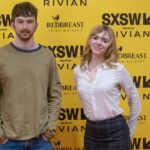
Our Chris Reed, Fergus Campbell & Elsie Fisher
HtN: So what originally inspired this tale of dreaming misfits in Sparks, Nevada?
FC: I’ve had an idea, an image in my head since I was very young, since I was maybe 9, of a body of water that will take a swimmer from one location to another. You dunk your head and then you pop out and you’re somewhere entirely different than when you started or where you started. And I didn’t know what to do with it for a very long time, but I knew I wanted it to be an image and something that I made before I even knew that I wanted to be a filmmaker.
And then a lot later, I was with my producer, Lola—the producer of Sparks—in Northwestern Nevada on a research trip for the nonprofit that runs Burning Man. And we were dropped into the reservoir and onto the alkaline flats that we would later shoot on. And we just fell in love with the region and before knowing what to do there were like, “We need to make something here.” And pretty quickly I was like, “Well, I had this idea for this magical reservoir that has these powers.” And so we put it there.
And then separately, I had written a script that also had to do with time travel and it was about high-schoolers and my philosophy right now—it could change—is that I want to contain periods of recent life in my work. And so every film is ideally a container for a bunch of observations and experiences and memories and pieces of memory. So that made sense as a canonic high-school film. And so yeah, it was like high school plus the reservoir plus this image all kind of converging in one space.
HtN: That’s a really evocative combination. How did you cast Elsie and how did you, Elsie, first hear about the film?
EF: We have a friend in common who put us in touch—our dear friend Miles—and I auditioned and I remember that was really exciting. I came to Lola’s house, I think, and auditioned for you guys. And the whole process happened really quickly. It was maybe two weeks before we were in Reno, right? Between me auditioning and …
FC: Yeah. Maybe three …
EF: I was just so fascinated. I mean, the story is quite bizarre and I loved that because I was just like, “Wow, there’s nothing else like this story.” And I really love movies and the idea of getting to play a character who is so passionate about her love of cinema; again, even if she is maybe a little pretentious or doesn’t know where it’s coming from. I think anyone who works in the film industry is like, “Of course Godard is the movie guy,” but then you go out in the world and you’re like, “Oh, people actually really don’t know.” So to even give them the basic YouTube summary of who Godard actually was is kind of huge. So getting to do that was cool.
HtN: You do so much in your film with locations, which really helps with the lush visuals, and you have great production design. Can you talk about working with your creative team? Your DP [director of photography] is Keldon Duane-McGlashan; your production designer is Natasha Parbhu, your costume designer is Claire Easton, and your composer is Jane Paknia. They do amazing work.
FC: I think locations were also an early stage of development in planning the movie, and we let the locations really inform a lot of the action and a lot of the cinematography and production-design choices. So it’s coming from an indie approach. We were like, “OK, how can we build in amazing atmosphere and amazing mise-en-scène and then not necessarily have to do as much work in shaping those spaces?” So that was the jumping-off point. And then Keldon and I are best friends from high school. As far as Elsie goes, she’s a performer who gave one of the great adolescent performances of the last 15 years in Eighth Grade.
HtN: (turning to Elsie) I loved that film and I loved you in the film. So I’ve been watching you ever since.
EF: Thank you.
FC: So Elsie, honestly, was on our mind early on, but we just didn’t know her and we didn’t have a casting director, but then I remembered that my friend Miles, who was also a cinephile, knew her. So I was like, “Miles, can you just text Elsie and send her the script?” And then he did.
EF: it’s amazing, though. Miles is someone I know just from going to movies.
FC: As do I. Yeah. They’re known in New York for seeing … they were a Guinness World Record candidate for most movies ever seen. (laughs)
EF: And part of our movie, in a lot of ways, was brought together by this love of the craft, which I think is really beautiful and it comes through.
A still from SPARKS
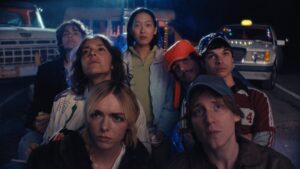
FC: Exactly. So. Keldon and I, our priority was really large compositions, or large in the sense that they were packed with characters and layers and depth. Everything Keldon cared about was adding depth and pushing things away from camera or towards camera, but in a staggered fashion. And another kind of logistical, but also creative, element was that we didn’t want to cut. We didn’t want to have too much coverage because we wanted to move fast and move locations and get a lot in there. So in that way we were responding to the environment and channeling these wide-open spaces, and even Westerns, and just leaning in there. And then for production design, Natasha bought a bunch of stuff in LA, where she’s based, before driving up to Reno and added tchotchkes and kitsch. The character Trip’s taxi was probably, I think, the most fun she had, kind of decking out an interior. Our big reference for that was the taxi in Women on the Verge of a Nervous Breakdown, which has nothing to do with Godard, but it’s still …
HtN: It’s a great film!
FC: Yeah, it’s a great film. And at the end of the day, I want to make my influences clear, regardless of where they come from. And then, for score, Jane is another college friend and is like a synth wunderkind. And I just was like, “I need you to make a score for a movie.” But then we didn’t stay in the synth space. There are two songs in the film that sound like diegetic, or jukebox, songs and they’re actually written by her. There’s a jazz song that she recorded with a 10-part band and also a song that plays in the carwash scene and in the vintage-store scene and back at The Crop when Antoine gets mad at Cleo for convincing all the other Crop kids that they’re going to time travel the next day. And for that we used Fellini and Nino Rota’s work as launchpads.
HtN: One other thing about production design: who came up with the cigarette machine in the middle of the road that spews out the Godard book? That was such a great moment.
FC: It was me. (laughs). But actually, it was my producer who was like, “I think that Cleo should find the book.” And in an earlier cut of the film, Cleo just showed up at The Crop without announcement and it was hard to get into her head. And I think we needed a moment to really understand that her fatedness, as I mentioned earlier, was going to be a narrative thread from the get-go, and then just establishing the magical-realist tone of the film, even if the magic is never really three-dimensional, but …
EF: That moment also read sort of metaphorical in this.
FC: Completely.
EF: You know what I mean?
FC: Everything Cleo does is kind of like that: from “did she time travel?” to these layers of either magic or imaginative capacity.
EF: Storytelling, really.
HtN: We never fully know actually, which is part of the …
FC: I know. (laughs)
HtN: Yeah, you know. (laughs) I think I have an opinion, but I think everyone can have a different one.
FC: I hope they do.
HtN: Elsie, you do such a wonderful job playing a young woman out of place and out of time. How did you prepare and what sort of things were you doing to play this character, who doesn’t want to be where she is at that moment?
EF: I think that’s just adolescence, in many ways. I often find myself feeling that way, or really did feel that way when I was that age … Cleo is 16 or 17, probably. But she’s this very sort of rigid person really struggling to find her identity. And it was just fun to explore. I always came up around people who were obsessed with fandom and a lot of that was internet fandom or anime or video games. And it was really kind of interesting to explore like, “OK, what could that be through the lens of Godard and the French New Wave?” Because she almost cosplays, in a way. We had so much fun exploring it. And I just wanted to try to create someone who felt very different than myself.
HtN: Well, I really enjoyed the film. Thank you both for making it, and I wish you all good things here at SXSW.
FC: It was a pleasure.
EF: Thank you.
– Christopher Llewellyn Reed (@ChrisReedFilm)