






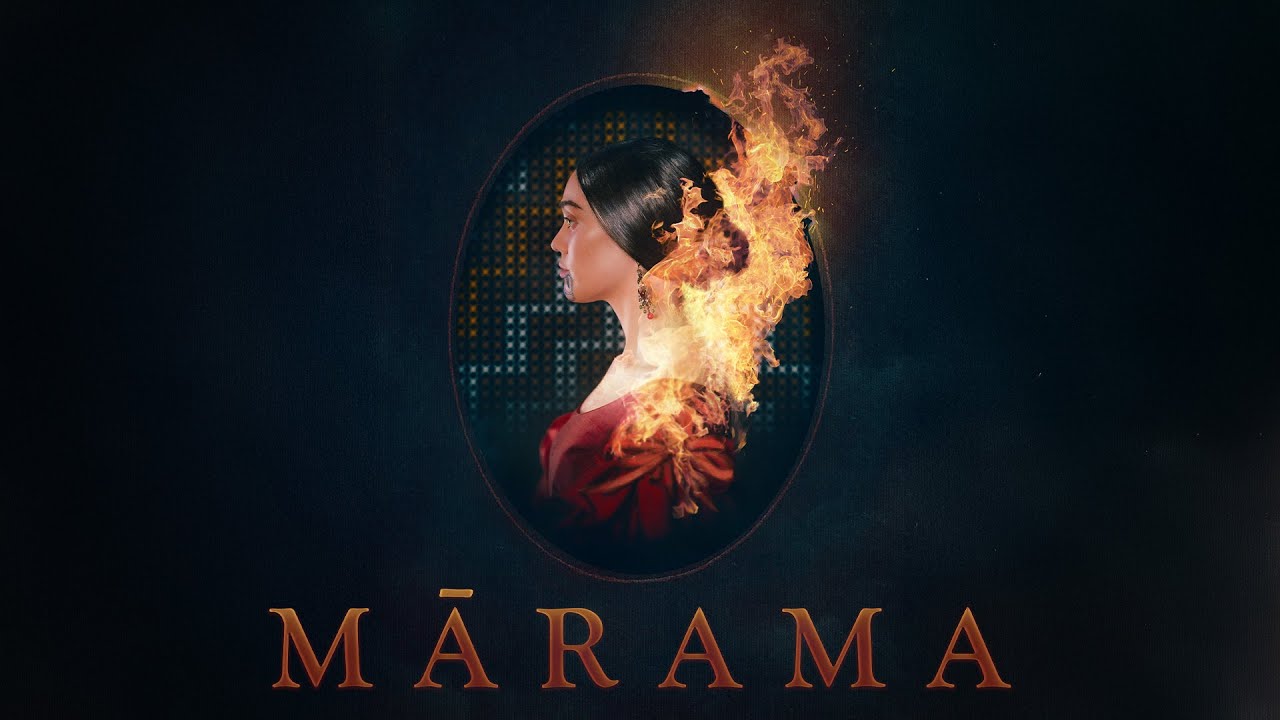
(The 52nd Seattle International Film Festival runs May 7-17th in and around Seattle. Check out Jessica Baxter’s Mārama movie review, fresh from the fest. Seen it? Join the conversation with HtN on our Letterboxd Page.)
Writer/director Taratoa Stappard didn’t set out to make a horror film for his feature debut. But as he researched Māori history and his personal connection to it, the horrors emerged on their own. He discovered so much colonizer-perpetrated violence, that one thing became painfully clear. Any film that truthfully reflects Māori history is inherently a horror story. And, as with most historical horror, women get the worst of it. Mārama is a powerful film in every respect. Even though the villains in Mārama are exploitative, Stappard worked very carefully to ensure that the viewers don’t feel complicit. The narrative presents and honors the culture, while simultaneously conveying how it feels for wāhine Māori to see it ravaged by predators.
Set in 1859, Mārama follows the eponymous young Māori woman (Ariāna Osborn) as she leaves behind her adopted parents in New Zealand and travels to the coast of Yorkshire, England seeking answers about her birth family. As Mārama walks down the dark corridors of her past, what she discovers sheds a blinding light on the grotesque ways the English decimated her culture and her people. The film lives in an accessible intersection of gothic horror, revenge drama, and historical fiction. It’s not an “easy” watch, but the rewards of sticking with it are immense.
With the opening, Stappard imparts a powerful thesis written in Māori and English on a black screen: “This story is grounded in the colonized history of Aotearoa New Zealand. It contains disturbing scenes of the violation and desecration of the Māori culture. To move into our future, we must understand our past.”
After this, there is no narrative handholding. Stappard trusts his film and his audience. Next, we’re dropped into a dark, sparse room, looking down on a woman in a plain nightdress on her knees. Behind her is a broken chair. She drops a chisel to the ground and blood drips from her chin. But when she looks up, her eyes are filled with defiance. Through her garment suggests imprisonment, she has given herself moko kauae, a traditional tattoo for Māori women to honor their ancestors and heritage. She lets out a growl that is filled with the pain and vitriol of the thousands of wāhine Māori before her. It’s clear by her surroundings that this woman is not with her people. This is the only way she can reclaim her identity after everything else has been stripped from her. Upon rewatch, I am so grateful for this bold opening image, because it sets the tone for what’s to come. We will see colonizer violence galore, but the victims of it will not go quietly to that good night.
When we next meet our protagonist, she is stepping out of a stagecoach, dressed head to toe in the garb of her oppressors: just her face and dark hair peeking out from behind a giant bonnet, bound inside a long-sleeved multi-layered, buttoned-up dress that must weigh 50 pounds. The carriage driver can take her no further. Through a letter in voiceover, we learn why she is making such an arduous journey as she lugs her dress and suitcase over hills, rocks, and mountains to the estate of the white man who sent for her and promises to “tell you everything.” It’s such a long way from where she was dropped off that when night falls, she takes refuge in what appears to be an abandoned farmhouse. The man who funded her journey can’t be bothered to move an inch to meet her, instead tasking his housemaid, Peggy (Umi Myers) to fetch Mārama for the final leg. She ultimately arrives at a vast gothic estate, both glorious and ominous, and punctuated by a low-hanging full moon. This is the first of many shots that quite literally took my breath away. In an era when gothic aesthetic is synonymous with poor lighting, Gin Loane’s cinematography is so refreshing, deftly conveying the darkness of the manor, without sacrificing the ability to see everything in the frame.
When Mārama finally meets the master of the house, he calls her Mary Stevens. This is the name her adoptive parents gave her, and a constant reminder of the ways in which her past has been suppressed. This man is not the one who sent the letter. That man died sometime during Mārama’s seventy-two day journey. Her surprise host is a British whale magnate named Nathaniel Cole (Toby Stephens), who lives with his half-Māori granddaughter, Ana (Mihi Te Rauhi Daniels) and his still-grieving widower son, Arthur (Jordan Mooney). Cole’s oppressively English manor is peppered with stollen Māori artifacts, including an entire wharenui house that he transported from Aotearoa and stashed inside a secret hedge to use as his colonizer man cave. He smiles and coos at Mārama about how much he loves her culture and her people. Indeed, he does seem to know a lot about it, including the language. His right-hand man, Jack (Erroll Shand) is an even more grotesque appropriator, baring traditional garb and tā moko tattoos that are meant to honor Māori ancestry and heritage, of which he has none.
Mārama knows right away that these men are trouble. But Cole baits his trap with the promising honey of information. He claims to know everything about her birth family and might even be privy to the whereabouts of a close relative. As Mārama cautiously traverses the halls, she becomes increasingly aware of the sinister secrets buried within the walls of this labyrinthian estate. Every time she touches a Māori object, she is struck with violent images, some of which involve a woman who looks exactly like her. Are they visions, dreams, or portents? Mārama’s need for the truth overrides her self-preservation instinct, and she agrees to become Ana’s nanny and continue her Māori education.
Stappard deftly balances multiple themes and tones as we accompany Mārama on her dark odyssey. The stark contrast between looming English oppression and Mārama’s heritage screams out from every frame, sometimes literally. Meanwhile, Mārama connects with Ana, and the warry housemaid Peggy, who is also a woman of color. Everything Ana has learned so far has the insidious tinge of whitewashing. Being raised in this way protects Ana from the painful truth of her origins, but only for so long. Everything in this story points to exploitation and deeply racist misogyny. It’s only a matter of time before Ana is no longer safe in her childhood. The house is full of ghosts, but in this story (as in real life), it’s the living white men who pose the biggest threat.
As she learns more about the extent of Cole and Jack’s hideous appropriations and her connection to them, Mārama’s rage slowly bubbles up. These man present subjugation and fetishization as honor and compassion. It’s the most insidious type of bigotry because the perpetrators have gained in-depth knowledge of the culture and use it to appropriate and desecrate in equal measure.
A particularly gruesome depiction of this theme occurs when Jack performs a mocking version of Haka (a ceremonial dance used to prepare for battle, honor the dead, or welcome guests) for a room full of white aristocrats gathered to “celebrate” the day Captain Cook “claimed” Aotearoa for England. For an encore, he sings a disgusting song about sexual assault. Despite remaining mostly silent throughout, Osborne is positively electric in this scene. Her face twists with ancestral pain as she is forced to witness this mockery disguised as tribute. Scenes such as this make this historical drama feels as timely as ever. We know these men. They walk among us to this day, “lead” our countries, and continue to commit genocide in the name of enterprise and liberation.
The score remains sparse, making space for the musicality of the sound design. Mārama’s creaky footsteps on the wood are more storied than any instrument could convey. They use music sparingly, with just a handful of score cues, choosing instead to highlight the power of traditional Māori songs sung by the characters past and present.
I don’t generally give spoilers in reviews, but considering this subject matter, I think it’s helpful to offer the following assurance: All this violence leads to Mārama taking control of her story in a way that might seem ostensibly anachronistic in a period drama. But in this case, it feels nothing short of cathartic. Though the themes of Mārama are rooted in real history, our heroine looks toward a brighter future.
– Jessica Baxter (@TheBaxter)