

A Conversation with Radu Jude (KONTINENTAL ’25)
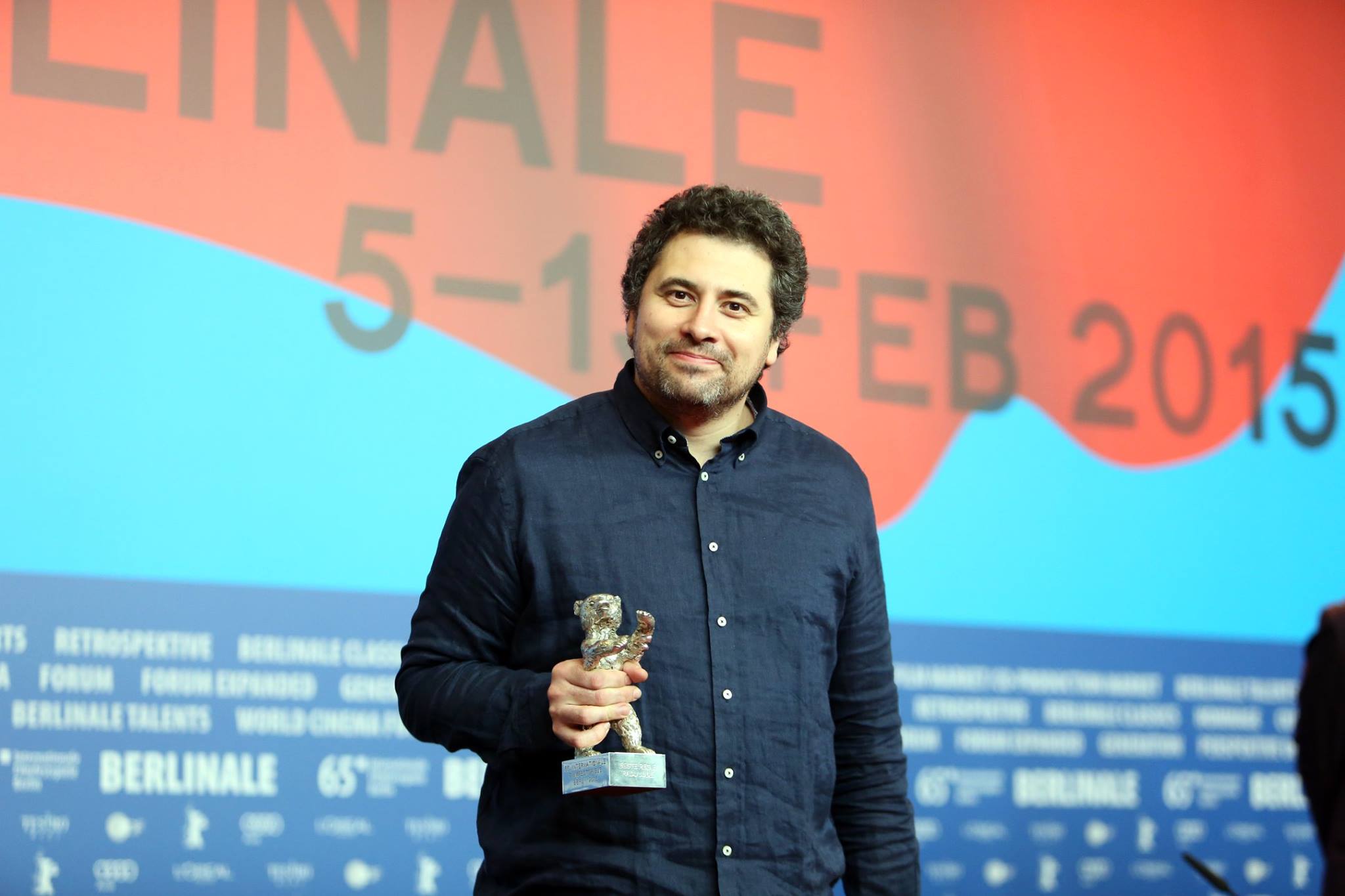
Radu Jude was born in Bucharest in 1977. He studied film directing at the Media University in Bucharest and began his career making shorts, television programs, and music videos. His feature debut, The Happiest Girl in the World (2009), won several international awards. Aferim! (2015), a black-and-white Western set in 19th-century Wallachia about a constable hunting an escaped Roma slave, won the Silver Bear for Best Director at the Berlinale. I Do Not Care If We Go Down in History as Barbarians (2018), about a theater director staging a reenactment of a Romanian-perpetrated Holocaust massacre, won the top prize at Karlovy Vary. Bad Luck Banging or Loony Porn (2021), about a schoolteacher whose career is threatened after a sex tape leaks online, won the Golden Bear at Berlin. Do Not Expect Too Much from the End of the World (2023), a nearly three-hour satire shot partially on an iPhone, won the Special Jury Prize at Locarno and was Romania’s Oscar submission.
He is one of the most prolific and formally adventurous filmmakers working today. He has made over twenty features and shorts in the last fifteen years, ranging from archival documentaries to gonzo satires, each one reconfiguring the relationship between past and present, fiction and document. His films are dense with literary and cinematic allusion, Brecht, Rossellini, Hitchcock, Godard, etc.
Kontinental ’25 began as a news item Jude read in 2011: a bailiff burst into tears on camera after an eviction she carried out led to a suicide. The story stayed with him for years, through several false starts, until it finally came together in a matter of months. He shot the film on an iPhone immediately after wrapping his excellent Dracula film, using the same crew and several of the same actors. The whole production took ten or eleven days, with no lights or grip equipment.
The title references Roberto Rossellini’s Europe ’51 (1952), about a wealthy woman consumed by guilt after personal tragedy. In Jude’s version, Orsolya (Eszter Tompa), a municipal bailiff in Cluj, Transylvania, oversees the eviction of an elderly homeless man from the basement of a building slated for demolition. The man hangs himself, Orsolya spirals. She wanders the city, talking to her husband, an old friend, a former student, a priest, searching for absolution or at least understanding. The film is structured around these conversations, each one revealing a different facet of her guilt and the inadequacy of her responses to it. She donates to charities. She reads left-wing intellectuals. She knows none of it is enough.
Jude shot the film in Cluj, a city in the heart of Transylvania that has transformed in recent years into a booming tech hub, rents similar to London, gentrification rampant, construction everywhere. The film sets this booming tech hub against those who have been crushed by it. The iPhone allowed Jude and cinematographer Marius Panduru to shoot like tourists, invisible in public squares and at a poetry reading the characters crash. It also ties into Rossellini’s “poverty of means,” the idea that films about poverty should not be made with enormous budgets.
I spoke with Jude about the film in the following conversation, edited for length and clarity.
Hammer to Nail: The press notes mention that this story came from a news item you read years ago and that you even pitched it to Romanian HBO at one point before it fell through. What kept pulling you back to the story over the years, and how closely does the finished film follow what actually happened versus what the fiction demanded?
Radu Jude: The real fact lasted five or ten seconds. It was just a small news item on the internet, from 2011 or something like that. I was shocked to see this bailiff bursting into tears because of a similar situation. Someone committed suicide after she evicted her. It was an old lady, actually, in the real story. Even the reporter and her husband tried to comfort her. I thought, how interesting, she feels guilty, but all the others around her don’t accuse her, on the contrary. So that stayed with me.
I tried to develop it in different ways over the years, but I always had a lot of false starts. At some point, several things came together. One was the development of real estate issues in Romania, corruption mixed with corporate greediness, especially in Cluj. I teach there once a month, so I could see how this city bloomed into the richest Romanian city, which comes with the cost of everything being so expensive. The rent is more expensive than London, or close to it. There’s a lot of gentrification, a lot of bad construction around the city, urbanistic chaos, demographic chaos.
That prompted the desire to make the film again. Then I rewatched Rossellini’s Europe ’51, and I saw some rhymes, not identical, but somehow connected, with themes and perspectives the story could have. At that moment, the project became very easy to build. Everything was prepared and written and shot in two and a half months. After so many years of back and forth.
HTN: You’ve told me before that you consider the structure of the film to be one of its most important elements and that you’d never repeat a structure. Kontinental ’25 begins with one character and then shifts to another entirely. Can you talk about finding that structural pivot and when you knew the film would belong to Orsolya rather than the homeless man?
RJ: An interesting question, because I don’t remember the moment I found this structure. But now the first part feels more like an intro. In my mind it was also modeled on Psycho by Hitchcock, which starts with one character, and then the character is killed, and then you follow the murderer. That kind of dialogue with Psycho helped me structure the film, you start with the victim, then there’s the murder, and actually, in the script, the murder was supposed to happen in a dilapidated bathroom, in a bathtub, so it would be exactly like in Hitchcock. But because the film was made with very little money, I adapted to what location I could find, which was actually the basement of my producer’s office. There was no bathtub there. So in the end the reference to Hitchcock is not that overt.
But I think it’s there, because you start with him, then there’s the murder, but the weapon of the murder is not the knife, it’s paper. You see the paper, and then you follow the murderer, so to speak. I had so many false starts with this project that somehow my memory is fading in organizing things chronologically, but finding the structure was close to the end, close to the last versions. Before, my problem was exactly that I didn’t find a structure. I didn’t find a way to organize a narrative around these issues.
HTN: When we spoke for Dracula, you talked about the iPhone letting you shoot like a tourist in a crowd, how that invisibility was a real advantage. Kontinental ’25 is a different kind of film, with long, static, dialogue-heavy scenes. How did you and Marius approach the iPhone differently here? Did it offer different advantages than it did on the Dracula set?
RJ: That’s interesting, because this film was made immediately back-to-back with Dracula, but after Dracula. In Dracula, we pushed the iPhone to all extremes possible, low lights, digital zooms that make the quality of the image very low. Here, we wanted to treat the iPhone image properly, to have good conditions for a regular image. I think it’s pretty good. I saw it at the Berlin Film Festival on the really big screen of the festival palace, and it looked pretty good for what it had to offer.
The first idea you mentioned about being a tourist is also helpful here, because we have a lot of exteriors. There are some dialogues in the square. We didn’t have money to hire a cafe, so I put the characters on a bench in the main square in Cluj.We looked like tourists, so nobody paid attention to us. That’s the advantage of iPhone shooting. For the first part of the film, we really shot like cinéma vérité. There’s a poetry reading that our homeless character breaks into, and that was a real poetry reading in the city. It was a late summer, hot evening. We just bombed their poetry reading, but nobody knew we were making a film. There were so many people filming it with their iPhones. We were just one of them.
HTN: You discovered Eszter Tompa during rehearsals for Dracula and realized she was perfect for Orsolya. What was it about her specifically that made you see this character in her?
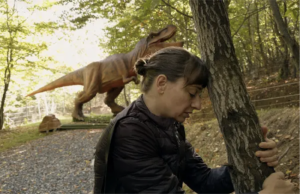
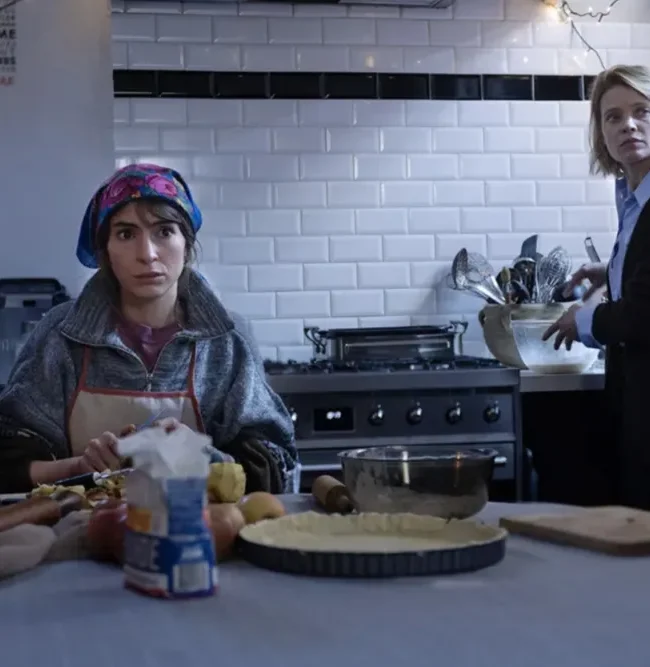
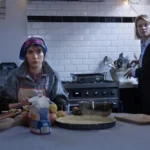
A still from KONTINENTAL ’25
RJ: The process was more complex. I knew her for some time, but I never imagined this character being an ethnic Hungarian. Transylvania used to belong to the Habsburg Empire and to Hungary. Since 1918, it has belonged to Romania, although even before there was a big Romanian population there. But now there’s still a very big Hungarian minority, and the ownership of Transylvania, the European Union forbids any discussions regarding borders, so if you’re part of the EU, you sign a status quo of the borders, still, there’s a lot of nationalist people who are afraid of the Hungarian minority, or there’s a lot of chauvinism in the Hungarian minority or in the Hungarian state, which is now run by Viktor Orbán. It’s a hot potato between Romanians and Hungarians.
So the moment I decided to invite Eszter as the main character, I knew this would bring a totally different layer into the story, the layer of this troubled history, but it’s a history that is somehow connected with the story of the film, which is ownership and private property. Our story of private property is put in the big history of property in Transylvania. Then there’s another layer in how people relate to her and how she might relate to people, because any Hungarian in that position knows she could be accused not only of being insensitive or creating a tragedy, but that it’s against a Romanian. Everything is getting doubled.
I had some hesitations. Then I discovered in Eszter not only a very brave actress, but actually a very good one. I discovered in her a capacity to embody very subtle nuances of psychological states. Sometimes you can see on her face or her body opposite states at the same time. I really admire her for that and think it’s rare.
HTN: At the 30 minute mark we have this sequence where Orsolya’s husband tries to console her. She talks about how her work does not feel important, he counters by talking about the girl she returned to her mother. Orsolya talks about how she should have become a lawyer and mentions their mortgage they have not been able to pay off for quite some time. My favorite exchange from the film comes in this scene where Orsolya’s husband remarks that maybe she should not have left him in the room alone, she responds that he would have killed himself later. Her husband says, sure but you would not have seen it happen. Can you talk about what was important to you in this sequence which then leads into the article with the vicious comment section.
RJ: The structure of this second part, the biggest part of the film, is built around these conversations. This is very intentional for two reasons. One is that words are very cheap. They’re free. You can use as many as you want and you don’t pay anything. It’s a good asset. Secondly, most of our communication and trying to solve problems involves language, verbal language, articulate words.
So the conversation with her husband is part of this string of conversations. Each conversation shows a different aspect of her relation to that story, or sometimes the same side but differently interpreted. In this case, I felt it’s also an indication of category or class, but maybe in a broad sense. After the revolution, Romania had only a very small rich minority and a lot of people who were rather poor. It’s only the last twenty years that brought a bigger middle class. This middle class exists, but it’s always on the edge, on the verge of losing status. They have the elements that make them middle class, A house, a car, kids in a good school, some money for a holiday, which in Western Europe the great majority of people have.
Many people make a lot of sacrifices for this. They work extra hours, extra jobs, they make compromises in their job, in their private life. I wanted to portray Orsolya as someone who had already done her share of compromises in order to get there. I think of myself, I worked for more than twenty years doing television programs, TV shows, advertising, music videos. It’s not like I was a purist artist who says, “I’m going to do my art only.” No, I made a lot of compromises. I wanted to portray her as a woman who is strong and successful but already had a history of compromises that now, in a moment where these compromises show their darker side, feels a kind of remorse.
– Jack Schenker (@YUNGOCUPOTIS)