

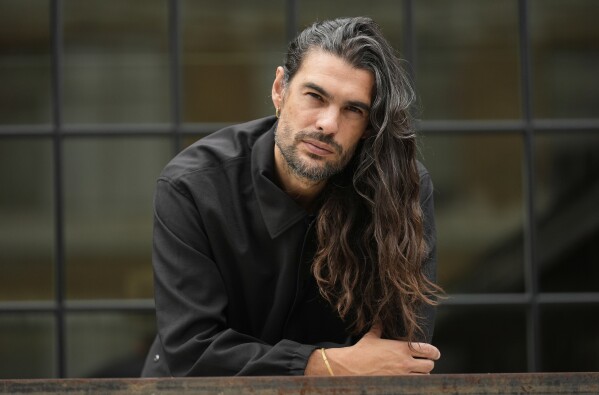
Oliver Laxe was born in Paris in 1982, the son of Galician emigrants. When he was six, his family returned to Northwest Spain. After completing his studies in audiovisual communication, he moved to Tangier, Morocco, where he self-produced his 2010 feature debut, You Are All Captains, which won the FIPRESCI Prize at Directors’ Fortnight in Cannes. His second feature, Mimosas, filmed in the Atlas Mountains, won the Critics’ Week Grand Prize at Cannes in 2016. Fire Will Come, made in the Os Ancares Mountains of Galicia, won the Jury Prize in Un Certain Regard at Cannes in 2019. Fifteen years after his debut premiered there, Laxe entered Competition with Sirāt (reviewed here by Matt Delman), where it won the Jury Prize—making him one of the few filmmakers to have premiered and won awards in every section of the festival.
Sirāt follows a Spanish father, Luis (Sergi López), and his young son Esteban (Bruno Núñez Arjona) as they arrive at a rave deep in the mountains of southern Morocco, searching for Marina—daughter and sister—who vanished months ago. They hand out her photo again and again. When Moroccan soldiers shut the rave down, they follow a caravan of ravers deeper into the desert in search of the next party Marina may be at.
Laxe started thinking about Sirāt in 2011 while living in the Moroccan desert, beginning with a singular image: dust kicked up by trucks driving fast through the sand. Three years into his residency, some ravers came to organize a party near where he lived. He and his then-partner Nadia Acimi started hanging out with them. Most of the script came to him while dancing at raves across Europe with Acimi. Laxe, a practicing Muslim, opens the film with an epigram from Arabic scripture referring to a mythical bridge conjoining heaven and hell. “Sirāt” also means “the path” or “the way.”
The five ravers who join Luis and Esteban are played by non-professionals cast from Europe’s Free Party Movement. López, the veteran Spanish actor who plays Luis, is the only professional in the ensemble. The film features a hypnotic techno score by Berlin-based producer Kangding Ray and was shot on Super 16mm by longtime collaborator Mauro Herce. After premiering to acclaim at Cannes, NEON acquired the film and released it in the United States. The film earned two Oscar nominations for Best International Feature Film and Best Sound. It can be seen in theaters now and must be seen there.
I spoke with Laxe about this extraordinary film in the following conversation edited for length and clarity.
Hammer to Nail: I really love the opening credits. We see men setting up speakers and subwoofers, then a long shot of the speaker setup amidst this breathtaking mountainous desert as “Amber Decay” by Kangding Ray (interviewed here by Tristan Kneschke) comes in. The camera drifts across the speakers before cutting to stunning long shots of the canyons. The drums come in, we get an overhead view of the rave slowly zooming into our main characters, then we cut into the pit and run through all the characters in their element until we find Luis and Esteban entering the rave searching for Marina.. What was important to you in these opening moments, and how did you create such authenticity in this rave?
Oliver Laxe: We wanted to underline the sacrality of these raves, the ceremonial dimension that they have. Obviously there is also a toxic dimension, like everything in life. But I think these ravers have a memory of what we were doing for thousands and thousands of years—dancing in nature, praying with our bodies. We underlined this. I like to dance. At the end, a filmmaker has to follow his taste and flavor. I like to see bodies dancing. I like this music. I wanted the spectators to dance while watching the film.
HTN: At the ten-minute mark, as “En La Noche” plays and the credits wrap up, we get one of the most incredible shots I’ve seen in a film—this light structure slowly forming across the canyons with some kind of staircase. As the drums come in, we cut to the sparkling light projector itself, and this crossfades into the party heated up in the nighttime. How did this moment come to life? Was it specific in the script or found in the edit?
OL: All that we shot was in the script. We also had a kind of totem that was going to be burned, but we had no money to do it. But yes, these lasers were designed before, and they were really important. There is only one shot in the film like this—you see these two pillars, and you see a star going through the middle. In a way, that image evokes the film—stars, transcendence. At this moment you feel this raving energy. The party starts at day, goes to night, and after that is the sunrise. This party that never stops, this intensity, this diurnal intensity.
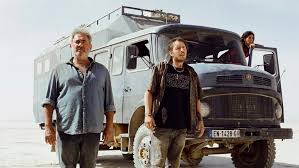
A still from SIRĀT
HTN: At the 29-minute mark, after acquiring gas for the trip, Stef wanders into a little structure to see a TV showing a ritual or call to prayer happening somewhere in the world. “Surah Maryam” plays as she watches hundreds of people moving in unison in a circle. We cut to Tonin walking on the sand, then to a moving close-up of the road as “Blank Empire” by Kangding Ray comes in. The camera pans up the first vehicle, then across and out to a long shot of the vehicles as they veer off the road into the desert. Those incredible drums come in, and once all three vehicles are in the shot, the title appears. I don’t know if I’ve ever had a bigger grin on my face watching a movie than when the title dropped.
OL: There are several filmmakers who do this, in particular the Thai filmmaker Apichatpong Weerasethakul. That was written in the script—the mix of Quran and techno music. I think this sequence has the essence of the film, and it has the essence of myself too. The only thing not written in the script that we found through editing are these moments when we present the future in the present. We have five or six moments in the film where you see images from the future, like you are in a dream state of mind, when you break space and time. This is something we found editing, but it was not intellectual. You test things during the edit, and you find magic and light between two images.
HTN: At the 45-minute mark, Jade invites Luis in and plays with a busted speaker. She explains it blew up at the party—they throw them away when they’re fucked, but she loves how it sounds. Luis says they all sound too loud to him. Jade turns it up a little bit and guides his hand onto the speaker. “It never sounds exactly the same. You never know if it’ll be the last time it works.” Luis says he can’t hear anything. Jade says, “It’s not for listening. It’s for dancing.” What were you thinking with this moment?
OL: In a way, the father is having a mirror of his daughter. Jade is a little bit older than his daughter, but she understands her better. Luis is wounded, graver. We were looking for tenderness. The way Jade says, “I’m sure she’s OK”—she is worried about him. She asks him how long he’s been looking for her. I like the empathy in that scene.
HTN: At the hour-and-five-minute mark, we have this harrowing moment where Esteban and Pipa go over the mountain. While that is an incredibly crafted sequence, what I’m more fascinated by is the aftermath. Tonin admits to Jade in the car that he saw Esteban’s body. Then we cut to Luis, half crying, half completely shocked, entirely lost. The camera sits on him as the pulsating music intensifies. When he puts his hand into his face, this crossfades into an incredible long shot of the two cars with their lights on, traversing down this mountain landscape as the sun slightly peeks out. The camera drifts over the landscape for a little bit before cutting to the cars driving in pitch black. How was that shot achieved, and what was important to you in these moments immediately following the overwhelming shock?
OL: That was a really important shot in the script—this mountain shot by a drone, these two trucks really small, really thin, going down. The landscape and the music in that moment are expressing and evoking that they are nothing, that they are really small, that this mountain is bigger than them, that life is bigger than them, that nature is inhabited. After, you have these shots of the truck crossing the night with all the dust, their lights—these images have a lot of inner symbolism. It’s not something intended. They are keeping the way, they are keeping going through, they are crossing a state of mind. Yes they are crossing the desert, but we have the feeling they are crossing another thing. At the same time, we are evoking with the music that as spectators, we are also emotionally collapsed. This is shock therapy. You die like the father. You die. You fall in the abyss as a spectator. That was important at this point.
HTN: You shot on Super 16mm with Mauro Herce, who you’ve worked with for years. At what point did you know the story had to be on film rather than digital? How did the tactile grain of 16mm help you capture the disintegration of narrative that happens as the film progresses?
OL: I didn’t go to film school. What I did is I bought a Bolex camera from the ’70s. So I’ve been shooting on film since always. We have to make alchemy. My body is chemistry. I don’t have pixels in my body. So if we want images to penetrate human metabolism, silver is the way. At the same time, the grain is something alive. The images are alive. The work I was doing with the sound engineer, Laia Casanovas, who is also nominated, and with the musician—we really wanted to make a sculpture. The grain was the same as the distortion we were having. The grain of the image is like the sound of the sand when they are in the desert. We were working on a really structural dimension of sound and image.
HTN: Ben Rivers made an entire film, The Sky Trembles and the Earth Is Afraid and the Two Eyes Are Not Brothers, about you being abducted off your own set and turned into a kind of feral clown. You surrendered to that experience completely. What did it teach you about being on the other side of the camera, and did any of that inform how you worked with the non-professional actors on Sirāt?
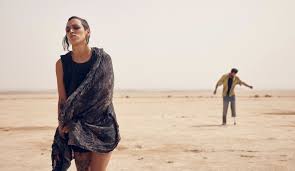
A still from SIRĀT
OL: I act sometimes for friends. They ask me. I did theater also. I like it—it’s another way to die, acting, playing. Even if I’m not an actor. This is my fourth film, and it’s the first time I worked with a professional actor. I have my methodology to work with people. I don’t make the difference between professional and unprofessional—they are people. My methodology is to just give them confidence and build something. I invent them like they are. I make them like they are. I don’t touch much.
HTN: Before shooting began, you brought the five ravers to Casa Quindos for a month and a half reading the script, watching films, working in the forest. What were you hoping they’d absorb?
OL: This is my house, where I shot my previous film. We went to the forest. We were working, building this confidence, doing rehearsals. We knew this film was really technical with a lot of visual effects, so it was important to arrive with a lot of rehearsals. Sometimes when you make too many rehearsals it’s bad—you lose freshness. We probably did too many rehearsals. At the same time, the French actors had to speak in Spanish, so it was more difficult. We had only seven weeks of shooting, and when you’re working with visual effects everything is really slow. The script is like 50 pages. Not much dialogue. We always try to evoke things with specific cinematic tools. We don’t watch TV or series much. Dialogue is something we work on in the script, but we always try to go to the bone of the thing.
HTN: Santiago Fillol has co-written your last three films. He’s an Argentine theorist. What does he bring to the writing process that you couldn’t access alone, and at what point does he enter?
OL: I like to talk about Santiago. I start writing the first treatment. I have the imagery, the idea, the intention. So, OK, I want to deal with death, for example, with Sirāt. Santiago comes later, and he helps me to be more courageous. Alone, it’s difficult to deal with your insecurity—because it’s important to have insecurity. It’s important to have fears. The question is, how do you deal with that? Do you keep going with the fears or do you stop? Do you change or do you betray yourself because of the fears? That’s the danger. Having someone like Santiago, who has the talent and the generosity to work within my universe, allows you to go further. At the same time, he’s someone who is not supporting all the pressure of the production and creative process. So you have more fears than your colleagues. That’s why it’s important to have them—they can push you to be more courageous. He’s extremely talented, he has really great ideas. He also comes to the set as the script supervisor. He is always helping me to rewrite the dialogue. We are going to work together again on the next film.
HTN: The relationship between Luis and Esteban really anchors the film emotionally, and Bruno Arjona had almost no acting experience. How did you create the bond between Sergi and Bruno off-screen that would read as genuine paternal love on screen?
OL: We were doing a casting in an organic way. Sergi López, who is an artist, an actor who has made probably 50 films in his career—he had the generosity to come to the casting process. We had six kids, the six finalists. With Sergi, we did six rehearsals with these six kids. At some point we listened to him. We were looking for chemistry, and for him it was really clear with Bruno. Even physically, the way they are similar—they are from the same bridge. It was beautiful to see the chemistry between them. I think you feel it’s true, the love they have, making jokes in the film. They were like that all the time.
– Jack Schenker (@YUNGOCUPOTIS)