

A Conversation with Nathan Silver (CAROL & JOY)
Nathan Silver’s Carol & Joy is a 38-minute documentary portrait of Academy Award-nominated actress Carol Kane and her 98-year-old mother Joy, a music teacher who still gives lessons and plays piano in their Upper West Side apartment. Shot on 16mm by cinematographers Sean Price Williams and Hunter Zimny, the film captures an afternoon of music, stories, and visitors in a space that feels untouched by time. Silver, whose previous fiction film Between the Temples earned Carol Kane the New York Film Critics Circle Award for Best Supporting Actress, reunites here with that film’s crew and co-writer C. Mason Wells to document a remarkable mother-daughter bond. Working with just 17 rolls of film and no monitors, they created something tender and deeply moving—a glimpse into a hidden corner of New York and nearly a century of one woman’s life. The documentary premiered at the Telluride Film Festival and has since screened at the New York Film Festival, Hamptons International Film Festival, and Woodstock Film Festival. It can currently be streamed on the Criterion Channel.
Hammer to Nail: You went to Carol and Joy’s apartment during the press period for Between the Temples. At what point during that day did you realize you were witnessing something that needed to be filmed?
Nathan Silver: It was within minutes of entering the apartment because you’re immediately served tea, coffee, there’s conversation happening, piano playing, neighbors coming in, dual pianos and people coming in to sing. It just felt like this corner of New York that had been hidden from me throughout my 20 plus years of living there. I was like,“Wow, what—this feels like from another era.” I was astonished. So it was pretty quickly into my first time entering that apartment.
It’s funny because I immediately wrote to Chris Wells, who was the co-writer of Between the Temples. I told him all about it and he’s like, ‘We have to make a movie of this.” Emily Schubert, who had done hair and makeup on Between the Temples had grown very close to Carol and started taking voice lessons with Joy, had told me all about this. So she was instrumental in helping make this happen because Carol, and Joy in particular, trusted Emily. So it was really neat after that press session to discover that there was the possibility of another movie with Carol and now with her mother.
HtN: Hunter Zimny and Sean Price Williams shot this film. It’s a very tight space you guys operated in and you shot on 16 millimeter with only 17 rolls of film. What kinds of discussions did you guys have prior to shooting? What was important that they captured? There’s a lot of focus on hands, for example.
NS: We’ve shot a bunch of stuff together now. I think they inherently know what I’m after. They know I love close-ups of faces. Joy, because she’s a pianist, I feel like she expresses with her hands and her hands are so important for her. So I think that was just something that Sean picked up on very early on the first day of the shoot because I couldn’t see anything—there were no monitors and also I was in it so no playback or anything like that. We had very little money so it was just more a matter of trusting that they were capturing what was needed. That they were moving with whatever felt emotionally right for either Carol or Joy at that time.
Sometimes I would have one camera spin around to capture a reaction shot of Carol or something along those lines, but a lot of it was just trying to be there in the space with them and have it feel like a conversation, so the audience could feel like they’ve just entered into this apartment. They’re hearing these stories and hearing music. Just like the experience I had when I first went over there.
HtN: What surprised you most about seeing Carol in her home environment rather than on set?
NS: She becomes a caretaker for her mother. She’s really there to make sure that her mother is comfortable at all times and fed. You’re seeing her in her home, vulnerable to a degree because this is her life, this is her space. But she’s so open as a person in general that I feel like I’d already gotten a sense of who she was. It just adds another layer of what a generous, kind person she is because of the way she is around her mother. She regards her mother so highly. She just has such admiration for her. It’s pretty beautiful to see that she wants you to know what a special person this is.
HtN: At the 14-minute mark, we have this moment where Joy is talking to a child about how she became a Francophile. She discusses how she heard La Mer at a great big concert hall, and we hear it faintly in the background. She talks about the rigidity of American life and how it’s not fluid or flexible. At one point, she asks the kid if he knows what nuance is and tells him, “it’s feeling.” First of all, forgive me if I missed it, but who is this kid? And secondly, what was important to you in including this moment?
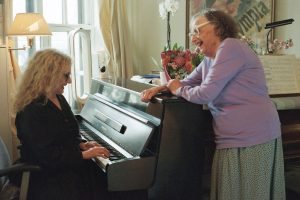
A still from CAROL & JOY
NS: That’s Harrison Liebman. That’s actually the son of Carol’s manager. They came together. So Brian Liebman is a producer on it. His son came by to visit the set and basically we were just like, “oh, we should have Harrison in the scene.” He was excited to see the cameras and everything, so we planted him on the couch. The whole idea was just to have a revolving door of guests.
It’s so beautiful when she’s talking about the rigidity, I found it immediately moving. It is just so grand. It works so well because she’s trying to explain something that he’ll come to understand later. At that moment, I don’t think he can grasp what she’s saying. It immediately struck me as something that needed to be in the film. Shortly after we shot Harrison there, I went outside and started getting close-ups of the knocker. We knew that we would have different guests and we could announce them through either the sound of a knock on the door or the image.
HtN: At the 22 minute mark, we have this moment where Joy and Emily Schubert are singing together. The moment starts on Carol and the look she gives here is very fascinating. She seems like she almost has to force a smile. She appears to be a little annoyed or melancholic. Joy is always very present and does this funny movement where she keeps saying, “poke.” This is a quick moment, but one that really speaks to Joy’s unique spirit and also their unique relationship. Again, what was your thinking in including this part?
NS: They have this wonderful relationship where she goes over there, takes lessons and then has tea. I think they’re good friends now, too. I love watching Joy teach because she is very strict. I think regarding the reaction shots of Carol, For me, it wasn’t her being annoyed. It was almost her just watching her mother teach. This has been her life.
There’s something fascinating about being surrounded by music. Carol’s been in musicals and stuff, but there’s a sing-songy quality to her personality in how I view her, just emotionally speaking. I view her as someone who seems like a piece of music. It’s funny that she comes from a house of music, because she has this energy that’s musical. I think we included that moment because I wanted to show the lessons and I wanted to show the people who mean a lot to Joy.
Jeremy, who is the guy from the first lesson that she gives, they constantly work together and they’re very close. Marianna, who’s the pianist at the end, they play together all the time. That’s why she has two pianos in the apartment. It’s her piano partner. There’s something neat about these people, this constellation of students and friends for her that come through the apartment. It’s her life. She just turned 99. She spends her life making music, thinking, philosophizing about what it means to be her age and what she’s lived through. That is pretty special to see someone so articulate about knowing that she has regrets, but yet seeing someone continue to work through what their life is, even at that age. It really struck me as pretty potent. It moved me.
HtN: I could have watched a feature length film of her talking about life and art.
NS: It was only supposed to be a 10 minute movie when we were shooting it. We realized in the edit that it was definitely longer than that. It sits in that perfect place where it’s a portrait, who knows, maybe it will be a feature one day.
HtN: At the 28 minute mark, after finishing up her story about getting an abortion, you exclaim that she wanted to be an artist, as in not having the third child would give her time to focus on that. She laughs because she finds the questioning silly. She flips it and says, “Do you want to be an artist or are you one?” She says “I was, I always was, but I never knew it.” Can you talk about what was important to you in including this?
NS: In this documentary I made about my mom, called Cutting My Mother, she at one point talks about if she hadn’t had my brother, she would have continued her pursuit of a dance career. I am fascinated by when you view yourself as an artist and when life takes over and takes away from your work, the regrets of a life spent outside of making your work. Immediately, I knew when she said that, I was like, this is the movie. I knew it was going to go in there.
I think about that line often, because obviously making work is not the easiest thing, financially speaking, emotionally speaking. Every aspect of it is trying in some way. Sometimes it’s just, that’s who you are and so that’s what you do. It’s incredible that she turned her life around in her fifties. She really upped, moved to Paris and made her life about her work, about art, in a very humble hotel room. It’s very inspiring in that way.
We shot this in New York mere days before I came over to France for what I thought was just a month, and now I’m living here. I feel like she has some influence in that as well, that decision.
HtN: Speaking of the Paris discussion, at the 33 minute mark, there is this discussion about her decision to go to Paris and her accommodation. I really love how emotional Carol gets about her courage to follow her dreams and live in Paris at 55. Joy talks about how she paid like a few nickels a day for a tiny room, but it was absolute heaven for her. It was her room and she could be whoever she wanted in it. Just expand on this moment.
NS: I think when I first met Carol, I felt like she told me about what her mother had done and how she always looked up to her mother. She loved the fact that her mother had changed her life midstream, that everything that seemed like this quixotic kind of escapade actually turned out into a career for teaching over here. Her life just blossomed in this way that made sense, because she willed it into making sense. I saw the hotel, and it was a cheap room without a toilet and all that stuff. It was a way for her to escape the rigidity of the States. So maybe she had a comfier life in the States, but this was her access to actually be the artist who she was all along.
Her love of France and my love of France, there’s the immediate overlap there. I knew that I wanted the whole French element to come into play. It’s impossible to tell her story without bringing it into play. When I shot her and Carol over in France a month or so ago, the whole conversation was in French. I didn’t realize Carol was also completely fluent in French. So they’re both fluent in French. We shot in their hotel room. We had a bunch of their French friends come and lie in the bed with them and talk, and we would just swap people out. It’s just another version of that living room in New York. It’s a similar size in Paris, and there’s just a bed there where conversations happen.
HtN: Going back to the beginning of the film, at the three minute mark, Joy talks about how she was born with all the gifts. She had parents who could afford her. She was musically gifted and she was beautiful from birth, yet something was always off. She was isolated, punished, and ultimately never felt free. Why did you want to start the film with this soliloquy, or is what we watch mostly just chronology of the day?
NS: We wanted to basically outline some aspects of who this person is now and how she feels about her life, and then look at her in a semi chronological order after that. It’s introducing us to some version of how the person views things now with a sense of regret and removal. We watch her talk through it in a way to come to understand it. We returned there later to that sentiment, to that line of thinking about her father and the fact that a lot of the men in her life resembled her father. It shows that this person kept her down and kept her from being the person that she would become in France in middle age.
HtN: The film was originally supposed to be ten minutes long. I feel like a lot of this movie, you have to find the language in the edit. Can you talk about your collaboration with John Magary and how that process worked?
NS: We worked remotely because I was in Paris at the time, he was in New York. He sent me all the footage, then we brought it down to selects. We whittled it down from there. He then found that we can actually work the rollouts into the film, because rather than hide them, it’s like the limitations of the film wouldn’t contain her. She would continue talking. Sometimes she would repeat certain things that had been cut off by the rollout, but we decided to not use any of that and embrace these rollouts. John was the one who found that rhythm.
That along with the knocker, those were the things that gave us a structure for the movie. We would have different segments with different people coming in and out. Also we’d use the rollouts as a way to jump from one topic to another.
– Jack Schenker (@YUNGOCUPOTIS)