



A Conversation with Urška Djukić (LITTLE TROUBLE GIRLS)

Urška Djukić’s Little Trouble Girls (which Chris Reed reviewed here) follows introverted 16-year-old Lucia as she joins her Catholic school’s all-girls choir and befriends Ana-Maria, a popular student. When the choir travels to a countryside convent for a weekend retreat, Lucija navigates unfamiliar surroundings, complex teenage social dynamics, and her own awakening sexuality. Winner of the FIPRESCI Prize at Berlinale 2025 and Best Cinematography at Tribeca, the film is a stunning portrait of adolescent self-discovery.
Djukić, whose previous short Granny’s Sexual Life won the 2022 European Film Academy Award and 2023 César Award, brings remarkable sensitivity to this feature debut. Shot with striking intimacy by cinematographer Lev Predan Kowarski and featuring a specially created project choir of 30 young singers, Little Trouble Girls is one of the year’s most visually arresting and emotionally resonant films. I spoke with Djukić about the Cannes residency that birthed the project, her collaboration with Kowarski, and finding the film’s distinctive visual language in the following conversation edited for length and clarity
Hammer to Nail: It said in the press notes that you developed this film partly during the Cannes Cinéfondation residency in 2019. What was that experience like?
Urška Djukić: It was an experience that really changed my life completely and I think this residency is so amazing. I’m so happy that it exists and I hope it will exist in the future because it really helps young auteurs to focus on their work. To go and spend some time in Paris with a lot of inspiration, art and culture everywhere, it was important. I was in a time in my life that I needed to escape. That really helped me. That time to develop in this residency. But there were no mentors or anything. We just had the time and space to develop our own thoughts. I think that’s the most important thing when you’re a writer.
HtN: And you co-wrote this with Maria Bohr…
UD: In the beginning, yes. But then, you know, it’s so hard to co-write because people want to go in different directions. So at one point we did not agree where to go. So I continued the process myself.
HtN: Well, the film has a very distinctive visual language. Can you talk about your collaboration with Lev Predan Kowarski and how you guys developed that together?
UD: Lev is an amazing cinematographer. We already worked on two short films before and we’re very good friends. We have known each other for a very long time. He studied in Poland. He’s just very passionate about his work, which is most important.
We started collaborating very early. He was also present in the process of rehearsals when we were exploring the story. So he could also explore the angles. I knew very early that I wanted to be very close with the camera to make a very sensual and tactile experience. To go close and to feel what Lucia is feeling. To try to convey those feelings to the audience
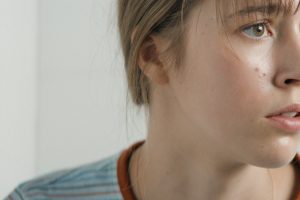
A still from LITTLE TROUBLE GIRLS
The interesting thing that happened is when you go so close, everything starts going out of the frame. It was also a metaphor that you cannot really frame the young girl. So this approach really served the story very well.
HtN: You mentioned in the press notes adapting the script to suit your actors. Could you give a specific example of a scene that changed significantly because of what Jara or Mina brought to it?
UD: Jara was 16 when we started and 17 when we were shooting, it was her first experience on camera. Mina was already studying acting but it was also her first time in a film. I used their real characters, not to try to push them to act and be something they are not, but to use their real lives, their real characteristics for the story, to enhance these characters.
We started working with actors very early, doing a lot of improvisational rehearsals and researching the characters and their chemistry together. That’s how we built some scenes and dialogues that happen in the film, because I think sometimes when I write dialogues they are very dry and not realistic. When you start working with real people and create a space, things can just come out. That’s the most magical part for me in making films.
HtN: At the 15 minute mark, Lucia and her mother are sitting eating ice cream. They make a few jokes about the father being in very deep sleep as they enjoy the ice cream, and what seems like it’s going to end as a sweet moment lingers as a sex scene begins in the movie they’re watching. Lucia stares pretty dead on as the mother becomes very uncomfortable and switches the channel. What was your thinking with this sequence, which is the last that we see of her mother?
UD: That’s definitely a scene from my own life, when I was growing up and how uncomfortable my mother was whenever a sex scene or love scene came on and she didn’t know how to react. These are the subconscious things that when you’re a kid, you take it, and you start understanding sexuality and the body as something very awkward. So this was a completely silent scene, but it tells so much about the history of female sexuality, the cycle of trauma being passed from generation to generation.
A woman’s relationship with her mother is one of the most important things in life. That’s where you learn life but also, you pick up on trauma. In the beginning, the story about the mother was even more important in the script and the film ended with a scene with the mother. We realized that we did not need it, that actually when Lucia transcends her frames of oppression, we don’t need to go back anymore to the past. So that’s how the film also changed along the way.
HtN: At the 36 minute mark we have this truth or dare spin the bottle sequence. After one of the friends tells a story of a guy they slept with from school, Ana-Maria moves the bottle to Lucia and forces her to answer. Certainly more than just one truth is asked of her as the girls laugh and make fun of her. They spin the bottle again and it lands on Lucia. She chooses dare. This leads into this incredible mini montage as she kisses the Mary statue. What was important to you here in this sequence?
UD: It’s a very intuitive sequence and also something very beautiful. In the beginning, I didn’t really understand why it’s so beautiful. Sometimes it’s enough, just this beauty of kissing the marble statue, which is dead. But with this kiss, Lucia gives the statue this life.
Also the symbol of Virgin Mary is very stolen. A woman robbed of her wild nature and sexuality, because the symbol of Virgin Mary is just a woman who is a servant, a mother, someone who takes care of others and she doesn’t have sexuality. I think it’s a very important symbol of patriarchal society. So with the kiss I feel that she gives life to this woman. But at the same time, it’s a play. It’s a clever situation, what Lucia does, to not have to kiss anyone. She goes and kisses the statue. It continues in this montage that gives more raw emotion rather than something intellectual.
HtN: At the hour mark, we have this small but great sequence between Lucia and the professor where she tells him she thinks that Ana-Maria is in love with her. He finds the claims to be slightly ridiculous and kind of lectures her on how they are here to work. What was important to you in crafting this moment?
UD: Definitely what is not said, all the silent things that we pick up on the body language. We understand the distress of people. We don’t need to explain it too much. That was what we were aiming for, to just feel that the character of the conductor, who was created as a character who follows rules, has very clear ideas about life and what he wants, that something like this little thing about girl sexuality would disrupt him and his ideas. Of course he wishes to have a perfect choir. He also isn’t very clear about his sexuality. So that throws him off balance. This moment is so beautiful, and so human at the same time.
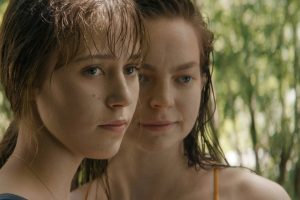
A still from LITTLE TROUBLE GIRLS
HtN: Shortly after, we have this moment where Lucia returns the shirt to the naked man. She first snaps a picture of him and then slowly approaches. As he notices, he covers himself slightly and walks over to her. We hear the water flowing and they stare into each other’s eyes from a distance until they’re right next to each other in the same frame. She hands him the shirt and after one last gaze into each other’s eyes, she runs off. What was important to you and if you could talk about the sound design process, because obviously that was such a crucial part of this film?
UD: I put a lot of emphasis already on sound in the script. I wrote a lot about what the audience hears. I believe that sound is sometimes even more important than the image, because it’s a vibration. It can really go even deeper and it can lead the viewer. So we were thinking a lot about the sound and in this moment it was mostly about tension. Tension from this confrontation, this meeting. It was just growing, how to create the tension growing, the sound here helped a lot.
HtN: I love this long scene as the professor scolds Lucia, however, I want to talk about directly after that happens. She walks off extremely overwhelmed and heads straight for the bridge. These whispers start to come in as we cut to a stunning long shot of this location. She peers over the bridge and we find Lucia walking into this church cave. She witnesses a prayer happen in this stunning location as we then are taken through a barrage of imagery with the flowers, the hand of the statue breaking off, Lucia in the murky flowery water, etc. It’s a jaw dropping moment. Can you talk about how that moment came to be from the page to the screen?
UD: It was a very intuitive process. When I saw the location of this waterfall, I had this image of these women singing. This idea about going inside of the body. It’s very surrealistic. It’s a kind of magical realism that happens there. There’s this whisper sound, even from the beginning of the film, that leads Lucia inside her body.
When she goes there, through some pain and rejection from the society, she finds there the truth, actually, this strength and this intuition that is sometimes more important than the mind. That was the idea of this film also, that the body has an intelligence of its own and sometimes it’s stronger. It tells you immediately what to listen to and what not, but the mind follows the constructions of society. These ideas of shame and guilt that were passed through generations, are just mechanisms to oppress people. So this moment was a meeting with the deeper self and the personal spirituality, which gives her the strength to move on.
HtN: The film’s title obviously comes from the Sonic Youth song. So when did you discover that track and also what specifically about it captured what you were trying to express?
UD: I discovered Sonic Youth like 10 years ago, and when I heard this song I had this rare feeling of being understood with the lyrics. It says that if you want to be a girl, to be a woman, you learn to pretend in order to be accepted and to fit into the ideas of others. But at the same time you will still have inside you this wild, destructive nature that every woman has. Even though it’s not accepted, it will be there. But I can learn to conceal it for you to accept me.
So that’s the important topic that I wanted to explore through the film. This song says it so well. So I said, “okay, let’s just go for it. We’ll ask Sonic Youth if we can use it for the ending.”
HtN: I think I probably have time for one more question, so I’d love to ask about the choir and those rehearsal scenes. It must have really required enormous coordination. How did you bring all those people together? Can you just talk about crafting and casting the choir moments?
UD: It was a big project because actually we didn’t take an existing choir, we made our own project choir. We made auditions for 30 girls, singers, and then we put our own actresses inside. We had a real conductor leading the choir, rehearsing these few chosen songs. Also our conductor, the actor Saša Tabaković, was learning from this conductor while conducting this choir.
So it was actually a huge project all the time. We had 30 girls on set. It was a lot of energy. But also this kind of energy and the voices of the girls gives this film this specific strong color. It was beautiful, but also quite intense shooting the rehearsals and at the same time the relationships between them. That was very challenging technically to shoot. I wanted it real time with everything. So there’s no playback, nothing. That’s why it’s so realistic.
– Jack Schenker (@YUNGOCUPOTIS)